Taiwan passes Artificial Intelligence Basic Act, names NSTC as AI authority
Taiwan’s legislature has approved the Artificial Intelligence Basic Act, establishing guiding principles for AI governance and naming the National Science and Technology Council as the responsible authority, marking a significant step in the island’s AI policy framework.
- The Legislative Yuan has passed Taiwan’s Artificial Intelligence Basic Act, outlining seven core principles for AI governance.
- The law designates the National Science and Technology Council as the governing authority for AI, despite opposition from DPP lawmakers.
- The act mandates a national AI strategy committee and commits the government to funding, safeguards, and labour protections linked to AI development.
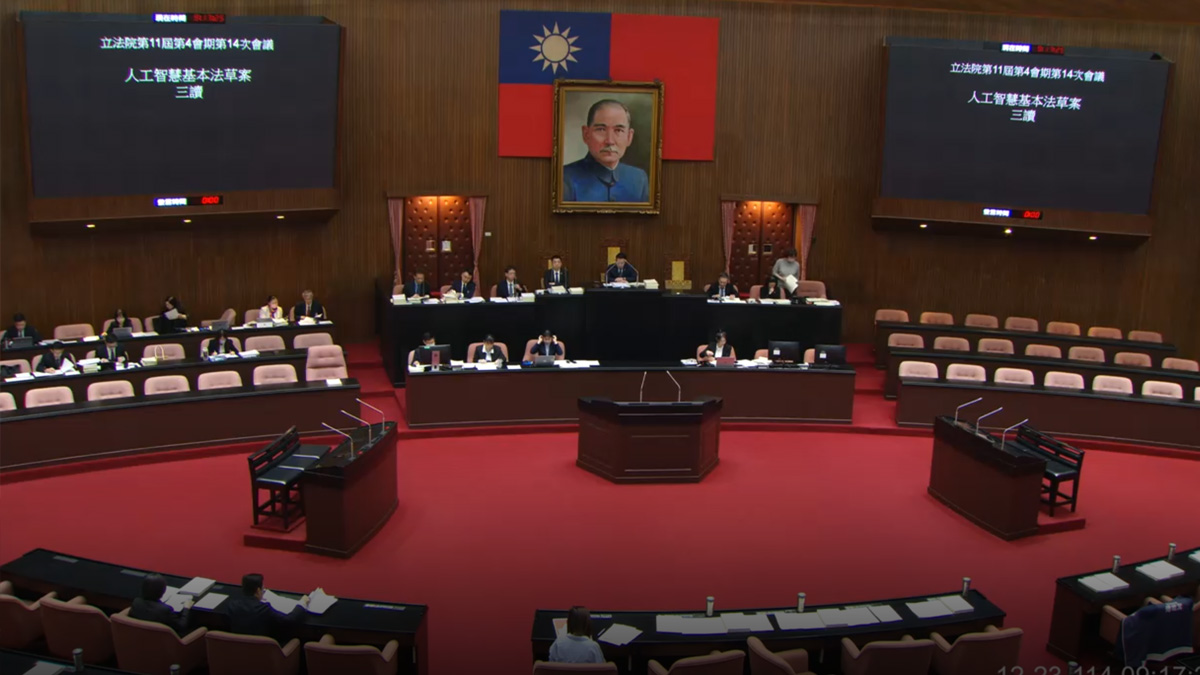
Taiwan’s legislature yesterday, 23 December 2025, passed a new law setting out the core principles for governing artificial intelligence, formally designating the National Science and Technology Council as the central authority responsible for AI policy and coordination.
The Legislative Yuan approved the Artificial Intelligence Basic Act after deliberations that highlighted both broad agreement on the need for AI governance and sharp divisions over institutional arrangements.
Under the new law, the government is required to promote artificial intelligence research and applications while prioritising social welfare, digital equity, innovation, and national competitiveness, according to legislative documents and debate records.
The act establishes seven guiding principles for AI development: sustainability and well-being, respect for human autonomy, privacy and data governance, cybersecurity and safety, transparency and explainability, fairness and non-discrimination, and accountability.
Lawmakers also wrote explicit risk-mitigation requirements into the act, stating that AI applications must not harm people’s lives, freedom, or property, nor undermine social order, national security, or the environment.
The law further prohibits AI systems from involving bias, discrimination, false advertising, misinformation, or fabrication, reflecting growing global concern over the societal impacts of advanced algorithms and generative technologies.
While the act lays out broad principles and prohibitions, it does not include detailed enforcement mechanisms or penalties, leaving future regulations and guidelines to be developed by the executive branch.
A central point of contention during the legislative process was the decision to name the National Science and Technology Council as the governing authority for artificial intelligence.
That provision was adopted with the backing of lawmakers from the Chinese Nationalist Party and the Taiwan People’s Party, overcoming objections raised by the Democratic Progressive Party.
DPP legislators argued that basic laws in Taiwan traditionally set out principles and objectives without designating a specific authority, warning that doing so could limit future administrative flexibility.
Supporters of the provision countered that AI governance requires a clear lead agency to coordinate policy, research, and international engagement, particularly as AI technologies evolve rapidly.
Beyond the designation of an authority, the act requires the Executive Yuan to establish a national AI strategy committee to guide long-term development.
The committee is to be chaired by the premier and include academics, industry representatives, heads of government agencies, and local government leaders, ensuring cross-sector input into AI policymaking.
Under the law, the committee must meet at least once a year, with administrative support and coordination handled by the National Science and Technology Council.
The act also commits the government to allocating funding for AI research, applications, and infrastructure within its fiscal capacity, signalling continued public investment in the sector.
In addition, it calls for assistance and subsidies to support AI development, professional training, testing, and validation, aimed at strengthening Taiwan’s innovation ecosystem.
Data openness and personal data protection are also highlighted, with the act endorsing risk-based AI management approaches that align with international standards and best practices.
Labour protections form another pillar of the legislation, as the government is tasked with safeguarding workers’ rights, including retraining programmes and employment assistance for those displaced by AI-driven changes.
Together, the provisions of the Artificial Intelligence Basic Act mark Taiwan’s first comprehensive attempt to define a national framework for AI governance, balancing innovation goals with social safeguards.