Top Chinese generals under investigation in widening military corruption crackdown
China’s top general Zhang Youxia and CMC chief of staff Liu Zhenli are under investigation for serious discipline and law violations, in a widening anti-graft purge targeting the upper ranks of the People’s Liberation Army.
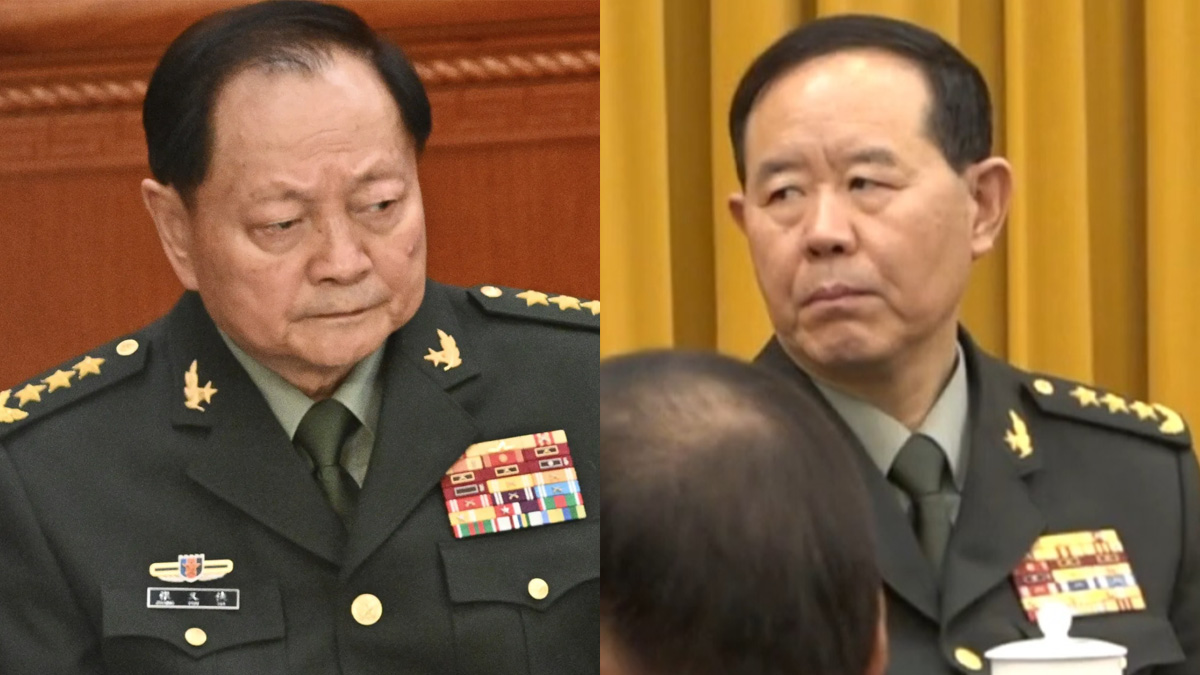
- Zhang Youxia and Liu Zhenli are under investigation for suspected serious discipline and law violations.
- Both serve at the top of China’s military command structure under President Xi Jinping.
- The move is part of an ongoing campaign officially framed as anti-corruption, though some analysts view it as political consolidation.
China’s Ministry of Defence announced on Saturday, 24 January 2026, that senior military officials Zhang Youxia and Liu Zhenli are under investigation for suspected serious violations of discipline and the law.
Zhang serves as vice chairman of the Central Military Commission (CMC) and is also a member of the Communist Party of China’s (CPC) Politburo. Liu holds the position of chief of staff of the CMC’s Joint Staff Department and is a fellow CMC member.
The investigations were approved by the CPC Central Committee, according to the Ministry’s statement, though no further details on the nature of the violations were disclosed.
The announcement marks the latest escalation in a long-running anti-corruption campaign within China’s armed forces, which has accelerated significantly under President Xi Jinping’s leadership.
Zhang Youxia, 75, is China’s highest-ranked serving general and a close political and military ally of Xi. A veteran of the 1979 Sino-Vietnamese War, Zhang is known for overseeing key aspects of military operations, training and weapons procurement.
His ties with Xi Jinping are widely reported to be rooted in family history, as both men are the sons of revolutionary-era comrades.
Liu Zhenli, 61, oversees combat planning and training operations as head of the CMC’s Joint Staff Department. He rose rapidly through the military ranks during Xi’s tenure.
Both officials were notably absent from a recent high-level meeting chaired by Xi Jinping and attended by other senior defence leaders, fuelling speculation of pending disciplinary action.
The Central Military Commission, which both men serve on, operates directly under Xi’s command and holds authority over China’s military forces, including the People’s Liberation Army (PLA), Rocket Force, and the People’s Armed Police.
Xi Jinping has called corruption “the biggest threat” to the Communist Party, and his anti-graft campaign has brought down several senior military figures since its inception in 2012.
In October 2025, eight generals were expelled from the Communist Party on corruption charges. Among them was He Weidong, formerly the second-highest ranked CMC vice chairman, who served alongside Zhang Youxia.
Others expelled included Miao Hua, former head of the Political Work Department, and generals He Hongjun, Wang Xiubin, Lin Xiangyang, Qin Shutong, Yuan Huazhi and Wang Chunning.
These officials represented the uppermost tier of China's military leadership, with portfolios spanning the PLA’s Eastern Theater Command, the elite Rocket Force, and paramilitary units.
Zhang Shengmin, who replaced He Weidong as CMC vice chairman, has played a central role in enforcing Xi’s military clean-up. He has been secretary of the CMC’s Discipline Inspection Commission since 2017 and is not related to Zhang Youxia.
The two previous defence ministers, Li Shangfu and Wei Fenghe, were also expelled from the Party in June 2024 for corruption, according to Reuters. Li's case was reportedly linked to bribery and illicit procurement of military equipment.
The latest investigations into Zhang and Liu suggest that the anti-corruption purge has reached its highest level yet, potentially reshaping the future of China’s military leadership.
Critics have argued that the campaign may also serve to consolidate Xi’s political control over the military, while proponents view it as a necessary move to ensure clean governance and institutional discipline.
While the official stance frames these investigations as part of efforts to root out corruption and improve governance, observers caution that they may also reflect internal power struggles.
The lack of transparency in disciplinary actions within the PLA has fuelled speculation that the campaign also functions as a mechanism for political purging.