Israeli woman falsely reported dead in Iran protest coverage by Israeli media
An Israeli woman, Noya Zion, said she was shocked after seeing a news report falsely claiming she was killed in Iran protests. In a video posted on Instagram on 26 January 2026, she criticised what she called journalistic negligence and urged media outlets to verify reports involving life and death.

An Israeli woman was left shocked after watching a television news report that incorrectly stated she had been killed during anti-government protests in Iran.
The report claimed she was among four Jewish individuals who died during recent demonstrations.
The woman, identified as Noya Zion, later confirmed that the information was false.
Public Response on Social Media
Zion addressed the error in a video shared on her Instagram account on 26 January 2026, saying the experience had been deeply distressing.
In the video, she stated that she was alive, at home, and preparing to attend a training session.
She criticised the report as an example of journalistic negligence, stressing that media outlets have a responsibility to verify information before publishing, particularly when reporting on matters of life and death.
Pattern of Misinformation
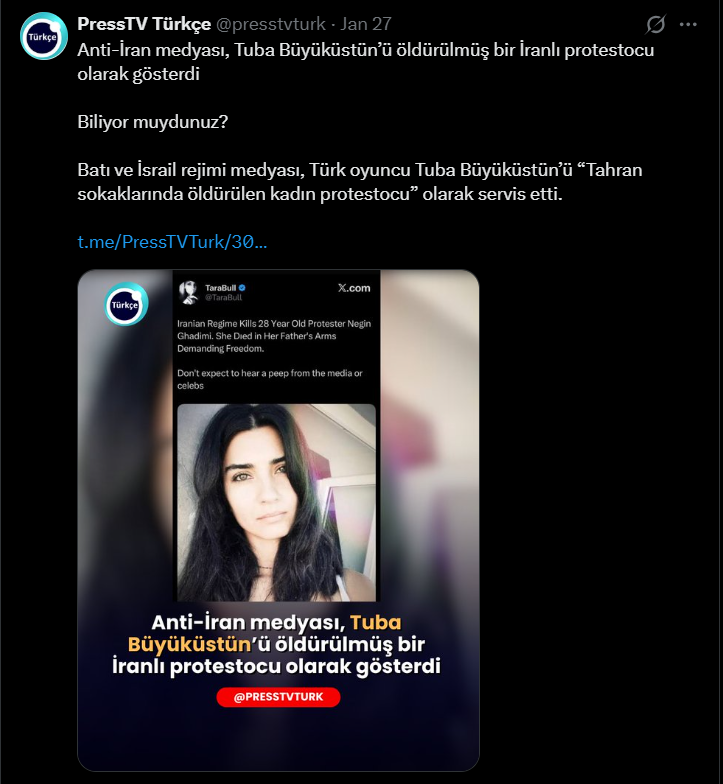
The incident is not an isolated case. Less than two weeks earlier, media reports had falsely claimed that a woman was killed during protests in Iran.
Turkish media later clarified that the individual was a Turkish actress with no connection to Iran.
Zion said inaccurate reporting — whether published domestically or internationally — can have serious consequences, urging journalists to exercise greater diligence when covering sensitive events.
The real cost of Iran’s crackdown
Despite these incidents of misinformation, the reality on the ground in Iran is far grimmer.
According to the US-based Human Rights Activists News Agency (HRANA), at least 6,126 people have died in Iran since nationwide protests erupted in late December 2025.
The report, published on 27 January 2026, notes that among the dead are 5,777 protesters, 214 government-affiliated forces, 86 children and 49 uninvolved civilians.
Over 41,800 arrests have also been recorded. The data was compiled and verified through a network of activists operating inside Iran.
Authorities downplay the death toll
Iran’s government disputes the figures. Official statements place the death toll at 3,117, of whom they say 2,427 were civilians or security forces. The remaining fatalities have been labelled “terrorists”.
However, Iran has a history of underreporting deaths from civil unrest. The current death toll exceeds any protest-related fatalities in Iran for decades and is comparable only to the 1979 Islamic Revolution in terms of scale.
The scale of the crackdown is still emerging, with authorities cutting internet access and phone services for over two weeks—the most extensive digital blackout in the country’s history.
A wider geopolitical crisis
The unrest in Iran has also triggered regional instability.
The USS Abraham Lincoln and its accompanying destroyers have been deployed to the Middle East, signalling the possibility of US military action. Gulf states, however, appear reluctant to be drawn into any conflict.
Iran-backed militias across the region, including Hezbollah in Lebanon and Kataib Hezbollah in Iraq, have issued vague but ominous warnings of potential retaliation should Iran be attacked.
Iran has repeatedly blamed external forces, including the United States and Israel, for fomenting the protests. However, analysts point to the ongoing economic crisis and a plummeting rial as the primary domestic catalysts.