Alex Honnold completes record-breaking free solo climb of Taipei 101
Alex Honnold made history on 25 January 2026 by becoming the first person to complete a free solo climb of Taipei 101. The daring 92-minute ascent was broadcast live and drew global attention as the climber scaled the 508-metre skyscraper without safety equipment.
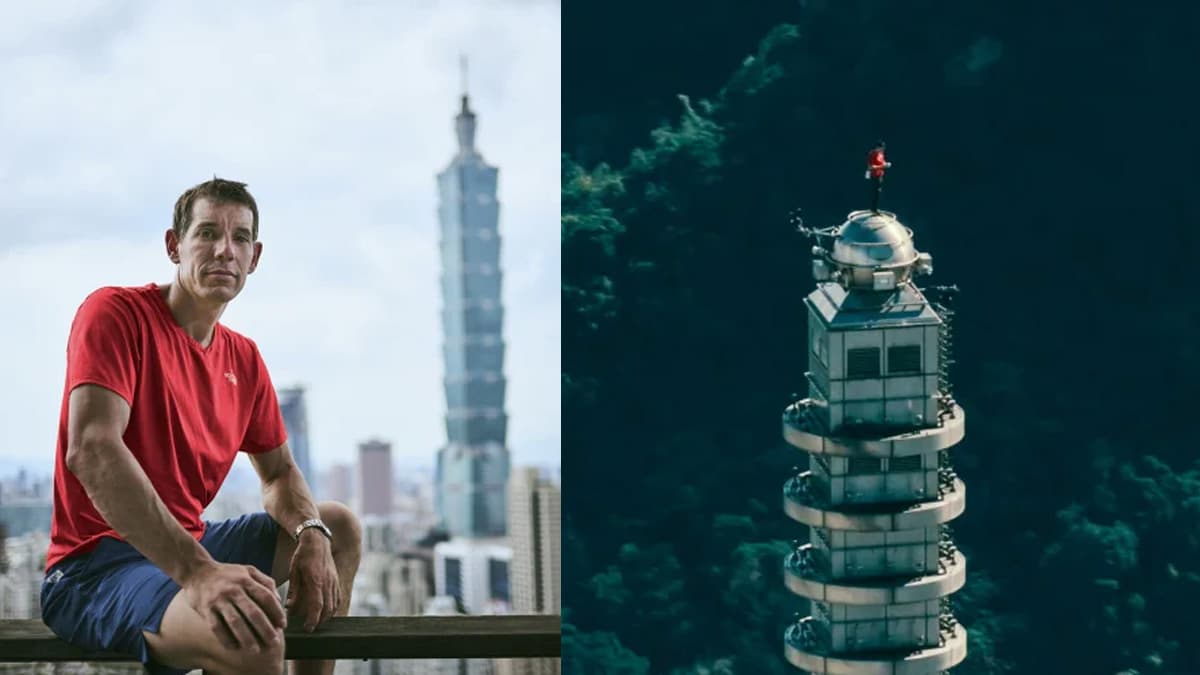
- American climber Alex Honnold completed a free solo ascent of Taipei 101 on 25 January 2026, without ropes or safety equipment.
- The 92-minute climb was live-streamed globally on Netflix and drew large crowds in Taipei.
- Honnold described the experience as a “grand adventure” and said it fulfilled a decade-long dream.
On a clear Sunday morning in Taipei, climber Alex Honnold achieved what few had dared to attempt: a free solo ascent of the iconic Taipei 101. Without ropes or a harness, he scaled the 508-metre skyscraper using only his hands, feet, and a chalk bag.
The climb began at around 9:11 am local time on 25 January 2026 and was completed at 10:43 am. Spectators in Taipei watched anxiously from below while viewers around the world followed the live broadcast on Netflix.
Honnold, 40, described the experience as “incredible” and “a grand adventure.” Speaking to reporters after the climb, he said, “You spend so long thinking about it and imagining that it’s possible, but then to actually do it always feels different.”
Standing atop the metal spire of Taiwan’s tallest building, he waved to the crowd, grinning broadly. “It’s amazing,” he added. “I’m sure I’ll be glowing for days.”
The feat marked the highest-ever urban free solo climb. It was also the realisation of a dream Honnold had held since first seeing Taipei 101 over a decade ago. He had previously considered climbing the building without permission, but ultimately waited for an official opportunity, citing “respect for the building and respect for all the people on the team who had allowed me access.”
The climb was initially scheduled for 24 January but was delayed due to poor weather. Conditions on Sunday proved ideal, with blue skies, sunshine, and minimal wind.
Throughout the 92-minute ascent, Honnold moved quickly and confidently, stopping at balconies to rest and wave at onlookers. Although he admitted the presence of a crowd made the experience “a little more intense,” he said the atmosphere helped him stay focused.
“For me, personally, the biggest challenge was staying calm,” Honnold said. “But as I climbed, I relaxed more and more. Like, ‘Oh, this is so fun, this is why I do it.’”
Honnold’s wife, Sanni McCandless, watched nervously from inside the skyscraper. At one point, she waved to him from a window as he climbed past her floor. After the ascent, she greeted him on a balcony with an embrace, joking: “I was basically having a panic attack the entire time.”
French climber Alain Robert previously climbed Taipei 101 in 2004 as part of the building’s official opening. However, Robert used safety ropes during his four-hour ascent, which took place in heavy wind and rain. Honnold’s climb was significantly faster and completed entirely unaided.
While the climb was not considered technically difficult by elite climbing standards, Honnold had to navigate several more challenging sections near the top. The building’s design includes ledges, metal structures, and architectural features that provided handholds—unlike sheer rock faces or glass exteriors.
The event has been described as a landmark moment in urban climbing and a demonstration of what is possible with extreme preparation and control. Honnold has become internationally recognised for pushing the limits of human capability in climbing, especially after his 2017 free solo of El Capitan in Yosemite National Park, a feat captured in the Oscar-winning documentary Free Solo.
Reflecting on what he hoped people might take away from the climb, Honnold offered a typically understated response: “I really don’t know. People kind of take the messages that they need from it.”
He added that viewers often find their own inspiration through such feats. “It’s often the kick they need to pursue their own challenges, their own goals.”
The spectacle caught the attention of Taiwan’s President Lai Ching-te, who congratulated Honnold and praised the event as a way for the world to witness “the warmth of the Taiwanese people and the island’s beautiful hills and landscapes.”
Although Taipei 101 is no longer the tallest building in the world—having been surpassed by Dubai’s Burj Khalifa and others—it remains a powerful symbol of Taiwan’s skyline and global recognition.
Honnold’s climb not only made history but also reinvigorated public interest in high-altitude urban climbing. For many, it was a reminder of the human spirit’s capacity to overcome fear and push boundaries.
“It’s so great,” Honnold said simply at the end of the media event. “What a nice day.”