Migrant workers protest 12-year work limit in Taiwan, calling for equal labour rights
Hundreds of migrant workers marched in Taipei demanding the abolition of Taiwan’s 12-year work limit for blue-collar workers, calling it discriminatory and detrimental to long-term livelihoods despite government retention schemes.
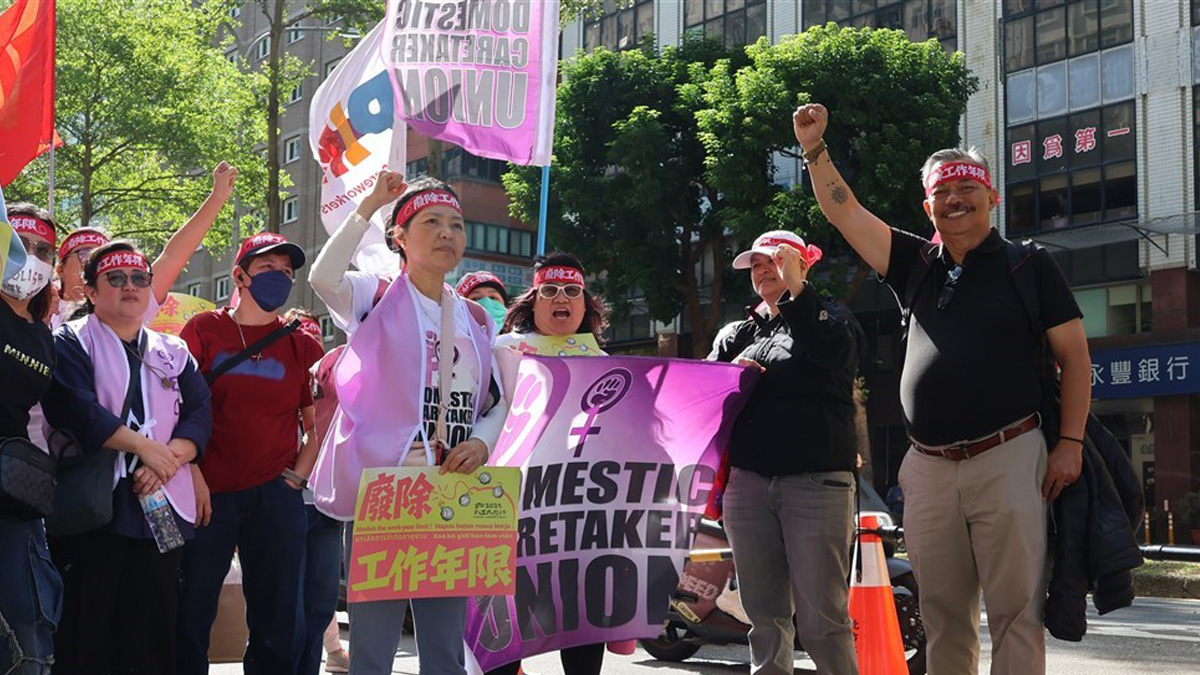
- Migrant workers in Taipei protested the 12-year employment limit, calling it unfair and restrictive.
- Current government programmes to extend employment require employer consent, limiting workers’ autonomy.
- Advocacy groups argue that retention schemes are inaccessible and reinforce unequal treatment.
Hundreds of blue-collar migrant workers marched through central Taipei on Sunday (7 Dec), demanding the abolition of the 12-year employment limit imposed on foreign caregivers and industrial workers.
Organised by the Taiwan International Workers Alliance, the march began at the Ministry of Labor and ended outside the Legislative Yuan. Protesters carried props resembling bombs and packages of meat, symbolising how the countdown toward forced departure disrupts their lives and careers.
Under Taiwan’s Employment Services Act, most migrant workers in caregiving and factory roles face a mandatory departure after 12 years. While amendments introduced in 2015 allow certain exceptions up to 14 years, campaigners argue this system still undermines migrant workers’ basic labour rights.
According to the Migrant Empowerment Network in Taiwan (MENT), such restrictions treat long-term workers as disposable and fail to recognise their contributions to Taiwan’s ageing society and labour force.
To address talent shortages, the government launched the Long-term Retention of Skilled Foreign Workers Programme in 2022. This initiative allows some blue-collar workers to reclassify as “intermediate skilled workers” and remain beyond the 12-year threshold.
However, eligibility is tightly controlled. To qualify, workers must have held a relevant technical role in Taiwan for at least five years, earn up to twice the minimum wage, or hold a Class B technician certificate. Crucially, applications must be submitted by employers on behalf of the workers.
This employer-led process has drawn criticism from advocacy groups and workers, who say it places undue power in the hands of employers and leads to exploitation.
MENT spokeswoman Wu Jing-ru described the programme as “deceptive,” arguing that many workers tolerate poor treatment to improve their chances of promotion to intermediate status, while few employers offer salaries high enough to qualify them for permanent residency.
Wu said, “Unlimited employment duration in Taiwan should not be a ‘favour’ granted by employers.” She added that blue-collar workers contribute to society equally to their white-collar counterparts and deserve the right to remain without arbitrary limits.
Data from the Ministry of Labor cited by MENT shows that as of September 2025, only 42,752 migrant workers had achieved intermediate-level status — just 4.7 percent of the total 858,939 blue-collar migrant workforce.
According to MENT, many skilled workers have been excluded because their employers prefer more submissive and lower-paid new hires. Others are reportedly blocked by international employment agencies, which profit from continuously importing new labour.
Protesters’ costumes included packaged meat — representing how workers are treated like perishable goods with expiration dates — and mock bombs marked with the Chinese character for “year,” signifying the countdown imposed by the work-year limit.
In response to ongoing criticisms, the Ministry of Labor has announced the Migrant Workforce Enhancement Plan, which will be implemented in 2026. The plan allows employers to hire an additional migrant worker for every NT$2,000 they raise the salary of a local worker.
Wu criticised the plan, saying it misrepresents the issue as a conflict between migrant and local workers. She noted that employers already pay into a national employment security fund to protect local employment, and encouraging individual salary increases does not address structural issues.
“Raising salaries for individuals does not improve overall labour conditions,” Wu said. “It could also lead to resentment among local workers.”
Premier Cho Jung-tai confirmed in October that a labour force review is underway to assess how Taiwan recruits and retains foreign workers, with findings expected to be released soon.
Taiwan is facing an urgent demographic shift as it moves towards becoming a super-aged society. The foreign workforce — currently around 850,000 — is expected to grow as industries face shortages in both care and manufacturing sectors.
While the government continues to expand direct-hiring options and mid-level employment pathways, labour groups maintain that the only equitable solution is to remove the 12-year cap and recognise migrant workers’ rights to live and work without arbitrary limits.