Opposition blocks Taiwan’s NT$1.25 trillion defence budget, demands President Lai’s briefing
Taiwan's opposition parties blocked a proposed NT$1.25 trillion defence budget, urging President William Lai to appear before the legislature and explain the spending plan aimed at countering China’s military threat.
- Taiwan's opposition blocked the NT$1.25 trillion special defence budget from being scheduled for debate.
- President Lai Ching-Te is urged to brief the legislature before any vote, as critics cite a lack of transparency.
- DPP says Lai is open to discussions within constitutional procedures, but rejects opposition's full-questioning demand.
Taiwan’s opposition lawmakers on Tuesday, 2 December, blocked a proposed NT$1.25 trillion (US$39.8 billion) special defence budget from being added to the Legislative Yuan’s plenary session agenda for 6 December.
The Chinese Nationalist Party (KMT) and Taiwan People’s Party (TPP) jointly called for President William Lai Ching-Te (賴清德) to personally appear before the legislature to answer questions on the budget before any consideration takes place.
The Executive Yuan had passed the draft bill last Thursday, approving the supplementary budget to span eight years from 2025 to 2033.
President Lai first announced the proposed allocation last Wednesday, stating the urgency stemmed from China’s stated ambition to be militarily ready for unification with Taiwan by 2027.
During the legislature’s Procedure Committee meeting on Tuesday, the KMT initiated the motion to delay consideration of the bill, with support from the TPP.
The opposition said it does not reject military investment outright, but demands greater transparency and public accountability before proceeding.
KMT caucus whip Fu Kun-chi (傅崐萁) stated that while the party supports the strengthening of Taiwan’s defence capabilities, the Ministry of National Defense has not provided any formal assessments suggesting the Chinese Communist Party will have the capacity to seize Taiwan by 2027.
Fu criticised the president for announcing the budget through an international op-ed rather than through formal legislative channels.
He argued that presenting such a substantial proposal without prior disclosure of the weapons systems or platforms involved amounted to asking for a blank cheque from the public.
Fu further demanded that President Lai face legislators directly to explain the rationale, timeline, and specific objectives of the budget, emphasising the need for open democratic oversight.
TPP Chairman Huang Kuo-chang (黃國昌) echoed these sentiments, stating that while there is widespread public support for enhancing Taiwan’s defence, the administration must provide guarantees that the budget would yield concrete improvements in combat readiness.
Huang criticised the government for providing only minimal documentation — reportedly two A4 pages — to support the NT$1.25 trillion proposal.
He called for meaningful debate, and accused the Democratic Progressive Party (DPP) of undermining the role of the opposition by framing their request for oversight as obstructionism.
According to Huang, allowing the president to justify the budget by referencing a looming invasion without sufficient evidence or legislative scrutiny risked alarming the public without due cause.
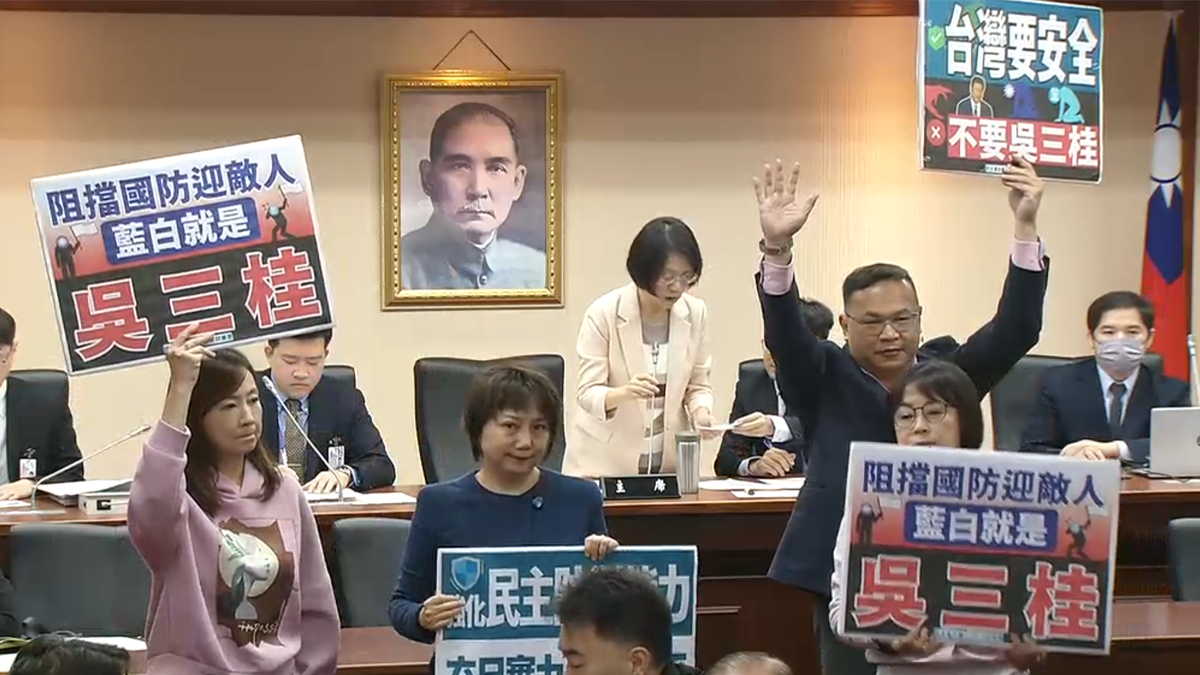
In response, DPP lawmakers defended the proposal and accused the opposition of politicising national defence. During the committee session, DPP legislators displayed protest placards to voice their objection to the delay.
DPP caucus secretary-general Chen Pei-yu (陳培瑜) said the opposition must clearly explain to the public why they are blocking the budget, which is aimed at safeguarding national security. She added that the president is open to briefing the legislature, provided such an appearance aligns with procedural rules.
DPP Legislator Fan Yun (范雲) suggested the opposition’s demand for the president’s appearance was a political tactic to mask their underlying opposition to increased defence spending.
DPP spokesperson Justin Wu (吳崢) stated that while Lai is willing to engage the legislature, the opposition’s request for every lawmaker to question the president directly is unconstitutional and outside the bounds of current parliamentary norms.
The proposed budget forms part of Taiwan’s broader strategy to bolster its defences in light of escalating military pressure from China.
Recent years have seen increased incursions by Chinese military aircraft and vessels near Taiwan’s airspace and waters, prompting Taipei to reinforce its procurement of advanced weapons and surveillance systems.