US warns Beijing may see Taiwan invasion as only ‘prudent’ option
A new Pentagon report warns that China is preparing for a potential full-scale invasion of Taiwan, viewing it as the only “prudent” option amid diminishing alternatives for unification.
- The US Department of Defense warns that Beijing could view a full-scale invasion of Taiwan as the only viable unification strategy.
- China is actively refining multiple military options, from coercive tactics to amphibious assault.
- Taiwan’s defence capability and US deterrence strategy remain critical to regional stability.
The US Department of Defense has issued a stark warning that China may ultimately consider a full-scale invasion of Taiwan as the only "prudent" means to achieve unification, as outlined in its Annual Report to Congress: Military and Security Developments Involving the People's Republic of China 2025 released on 24 December 2025.
While the Pentagon noted that Beijing still prefers less extreme measures, it cautioned that time and space for alternative strategies are narrowing, making a joint island landing campaign (JILC) — a high-risk amphibious assault — increasingly appealing.
The report presented the PLA’s evolving unification strategies in a newly structured analysis, citing four distinct options: coercion short of war, joint firepower strikes, joint blockade campaigns, and full amphibious invasion.
Beijing’s campaign options: spectrum of escalation
According to the report, the PLA has significantly advanced its capability for coercion-based strategies aimed at pressuring Taiwan into submission without initiating full-scale conflict. These tactics combine military threats with cyberattacks, electronic warfare, diplomatic pressure, and economic measures.
Such operations would aim to instil fear and reduce public confidence in Taiwan’s leadership, potentially leading to surrender without bloodshed. The success of this strategy, the Pentagon notes, would hinge on Taiwan’s societal resilience and continued international support, particularly from the US and its allies.
The next tier of escalation involves a joint firepower strike campaign, in which the PLA would launch precision missile and air strikes on critical Taiwanese military and political targets. This would seek to decapitate leadership and degrade defensive capabilities, though it would require complex coordination across multiple PLA branches — a challenge given current readiness levels.
The joint blockade campaign represents a longer-term approach. It would employ maritime and air blockades to sever Taiwan’s access to essential imports while simultaneously striking critical infrastructure. This could also involve the seizure of outlying islands, such as Kinmen and Matsu. However, the report stops short of evaluating the potential effectiveness or pitfalls of a blockade.
Landing campaign: most decisive, most dangerous
Despite the risks, the report indicates that China is actively preparing for a joint island landing campaign (JILC), which involves a massive amphibious assault to breach coastal defences and establish a beachhead. From there, PLA forces would aim to capture key targets, potentially forcing Taipei into unconditional negotiations or capitulation.
Beijing’s military planners increasingly see this as a "prudent" — albeit last-resort — course of action, particularly if all other strategies fail to compel unification on Beijing’s terms.
The Pentagon acknowledges gaps in understanding Beijing’s internal deliberations but cautions that as diplomatic and coercive avenues narrow, the appeal of a decisive, if costly, JILC may grow.
PLA preparations and lessons from Ukraine
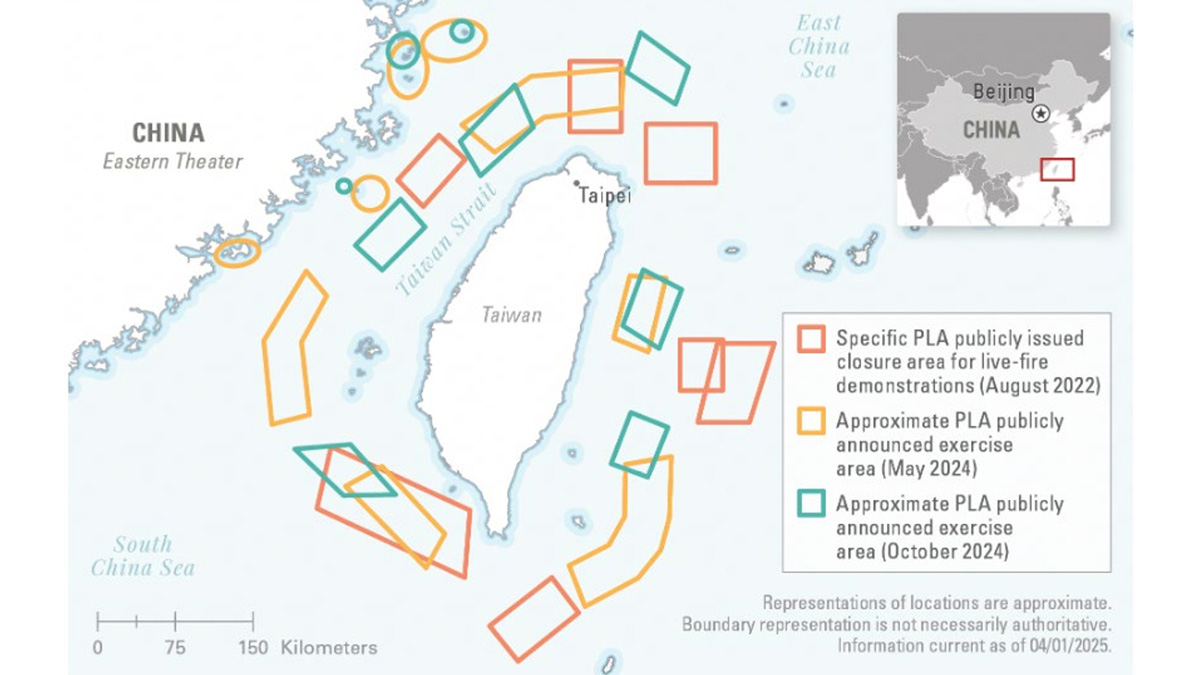
Over the past year, the PLA has conducted operations that simulate key components of all four unification strategies, including drills focused on maritime blockades, precision strikes, and amphibious landings. The report also notes that China is incorporating lessons from Russia’s war in Ukraine, such as the importance of information warfare, logistics coordination, and preemptive cyber operations.
These drills often simulate efforts to neutralise US military intervention — a key concern for Beijing. The PLA is expanding capabilities to strike up to 2,000 nautical miles from China’s coast, potentially threatening US forces stationed across the Indo-Pacific.
China's military expansion remains aligned with its 2027 goal of achieving “strategic decisive victory” in a Taiwan contingency, coupled with “strategic counterbalance” against the US and “strategic deterrence and control” over regional actors.
Taipei voices growing concern
In Taipei, National Security Institute deputy secretary-general Ho Cheng-hui described China’s expanding military capabilities as having reached "crisis proportions." He warned that 2027 would mark a window of vulnerability when US and allied deterrence might be weakest.
Ho stressed the importance of maintaining Taiwan’s defence spending. A freeze in the defence budget, he said, would leave Taiwan vulnerable and effectively "disarmed," lowering the threshold for a successful Chinese invasion.
Shen Ming-shih, an analyst at the Institute for National Defense and Security Research, echoed these concerns. He stated that US deterrence efforts — based on strengthening the first island chain — rely on Taiwan doing its part to resist military coercion.
If Taiwan alone fails to bolster its defences, Shen warned, it would create a critical weak point in the region’s defensive line, undermining Washington’s broader strategy.
Growing urgency in Washington’s tone
The US Department of Defense has taken the unusual step of publicly outlining Beijing’s most dangerous military scenarios, not only to inform Congress but to signal the urgency of the situation to Taipei and allies.
The Pentagon's report forms part of a larger effort to enhance deterrence across the Asia-Pacific and dissuade Beijing from choosing the military path by raising its costs.
As diplomatic, economic, and informational options narrow, Washington appears increasingly concerned that China will act not just from opportunism, but from a sense of strategic inevitability.