The Angkor “bombing” mislead: A failure born of uncritical wire dependence
Major outlets, including CNA, repeated AFP’s claim that Thai jets bombed “the province home to Angkor Wat” without noting the strike was over 90km from the temples. By failing to verify basic geography and ignoring Thailand’s statement that targets were selected under international law and rules of engagement, the reports amplified a misleading narrative at a sensitive moment in the conflict.
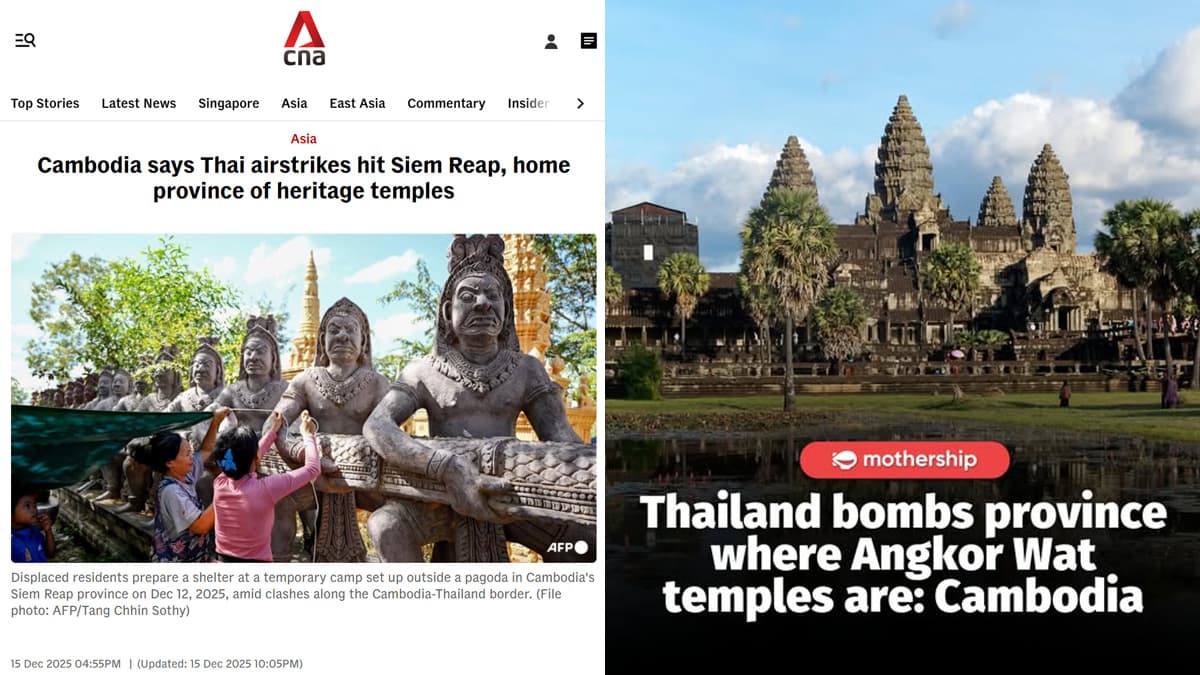
The recent AFP report alleging that Thai fighter jets bombed “the province that is home to the Angkor temples” is a case study in how nuance collapses when major newsrooms rely uncritically on wire services.
It is also a reminder that regional outlets, even those positioning themselves as experts on Southeast Asia, must exercise far greater editorial responsibility when reporting on sensitive cross-border conflicts.
AFP’s headline framing suggests proximity between the airstrike and Cambodia’s iconic UNESCO heritage site.
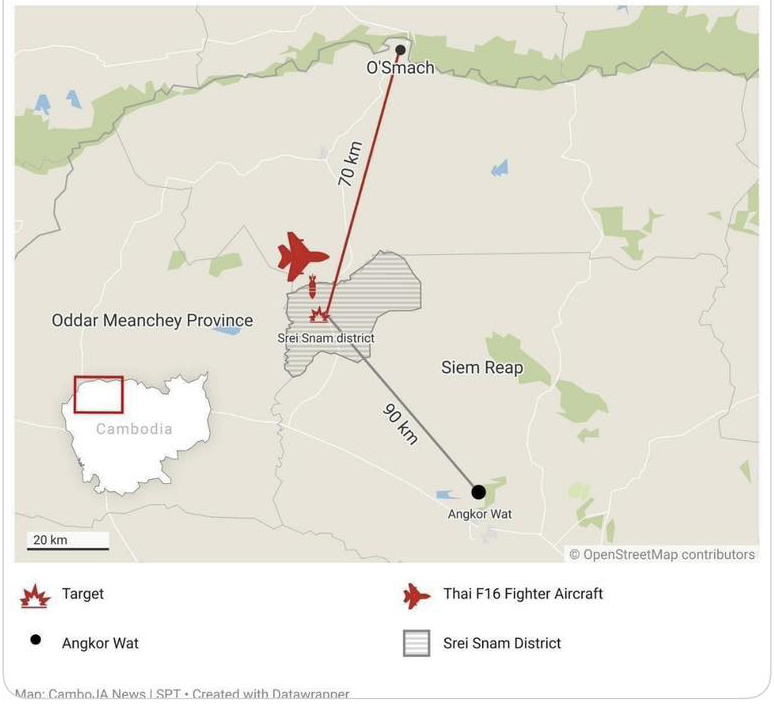
Yet the alleged strike occurred in Srei Snam district, located in the south-western corner of Siem Reap province. Using the nearest stretch of the Thai-Cambodian border as a reference point, the temple complex lies roughly 60 to 70 kilometres from the frontier. However, mapping of the specific strike location shows it to be even farther still — close to 90 kilometres from the Angkor Archaeological Park.
At such a distance, even a nuclear explosion would struggle to affect Angkor Wat. The idea that conventional Thai munitions could endanger the temple complex is therefore impossible on any physical or military assessment.
The geographical separation is so great that invoking Angkor’s name functions more as emotional leverage than factual description.
This distinction matters. Cambodia understandably emphasised Siem Reap’s identity as the home of Angkor Wat in its official statements — governments engaged in conflict naturally frame events to maximise international sympathy.
But what is “understandable” for an involved government becomes unacceptable when global news agencies reproduce the same framing without providing clarifying context.
The troubling part is not Cambodia’s press release. It is AFP’s failure to interrogate it, and the subsequent wholesale replication by outlets including CNA, which published the wire story almost verbatim despite marketing itself as a regional authority on ASEAN affairs.
If a newsroom based in Singapore — a short flight from Siem Reap — is unable or unwilling to verify district-level geography or to examine the implications of official statements, what does this say about the state of regional journalism?
More concerning is the omission of what the Royal Thai Air Force (RTAF) in the Thai military's daily briefing publicly stated that same afternoon. At 4pm (Thai time) on 15 December, Thai military spokesmen reiterated that:
-
Military targets are defined by their characteristics, purpose, and actual use, not by their distance from the border.
-
Target selection is made in accordance with international law and established rules of engagement.
-
The RTAF “will not attack any civilian target” and all operations are guided by considerations of sovereignty and humanitarian restraint.
These statements should have been included in any balanced report, especially given the gravity of the accusations. Instead, many newsrooms ran with only one side’s framing, reinforcing an inaccurate impression that Thai forces had struck near one of Southeast Asia’s most treasured heritage sites.
What made matters worse was how AFP’s already-slanted phrasing — “home province of heritage temples” — was uncritically replicated by outlets such as CNA, and then further sensationalised by Singapore’s Mothership, which published headlines implying Thailand had bombed “where Angkor Wat temples are,” accompanied by a full-screen image of the temple complex. This is how a geographically irrelevant detail, more than 60 kilometres from the strike zone, mutated into a perceived attack on Angkor Wat itself.
This is how a geographically irrelevant detail, more than 60 kilometres from the strike zone, mutated into a perceived attack on Angkor Wat itself.
The result is a public misled not by malice, but by editorial inertia — a reliance on wire copy over basic verification, and a willingness to prioritise recognisable keywords (“Angkor Wat”) over geographical reality.
At no point should Angkor Wat have appeared in the headline or framing of this story. The temple complex had no connection to the military activity, and invoking it served only to reinforce Cambodia’s intended emotional narrative. A newsroom’s responsibility is to report the event, not the propaganda ambitions of one party.
This is not a high bar. It is the baseline for responsible reporting. When conflicts escalate, accuracy becomes more — not less — important.
The Angkor “bombing” narrative is a reminder that journalism suffers when convenience replaces scrutiny, and when even well-resourced broadcasters abandon independent fact-checking in favour of fast publication.
If Southeast Asia’s media landscape wants to be taken seriously, it cannot outsource its judgment to wire agencies.