The Taiwan paradox: Why China cannot afford the war it signals
As China's war rhetoric grows louder, recent regional responses — including a pointed statement from Japan — highlight an uncomfortable truth: even if Beijing could seize Taiwan by force, it cannot win it.
- Japan’s Prime Minister Sanae Takaichi warned that any blockade or invasion of Taiwan would threaten Japan’s national survival, prompting sharp concern in Beijing.
- Analysts note that a Taiwan conflict would likely trigger regional and global involvement rather than remain a bilateral fight.
- Historical experience, political resistance, and economic risks pose major long-term obstacles to any attempt by China to take Taiwan by force.
When the Japanese Prime Minister Sanae Takaichi recently stated that any blockade or invasion of Taiwan would constitute a threat to Japan's national survival, it struck a raw nerve in Beijing.
This was no abstract policy comment. It was a direct signal that a Taiwan conflict would not remain a one-on-one fight, and China’s ambitions for swift, decisive unification would collide with an entirely different kind of war — multilateral, unpredictable, and impossible to contain.
The statement, made in the context of Tokyo’s new national defence strategy, reminded the world — and especially China — that military aggression against Taiwan would not be another Ukraine-style engagement where Western aid flows, but Western troops do not. It would be an Asian-Pacific escalation of the highest order.
And that’s exactly the scenario Beijing cannot afford.
Rhetoric is rising — but options are shrinking
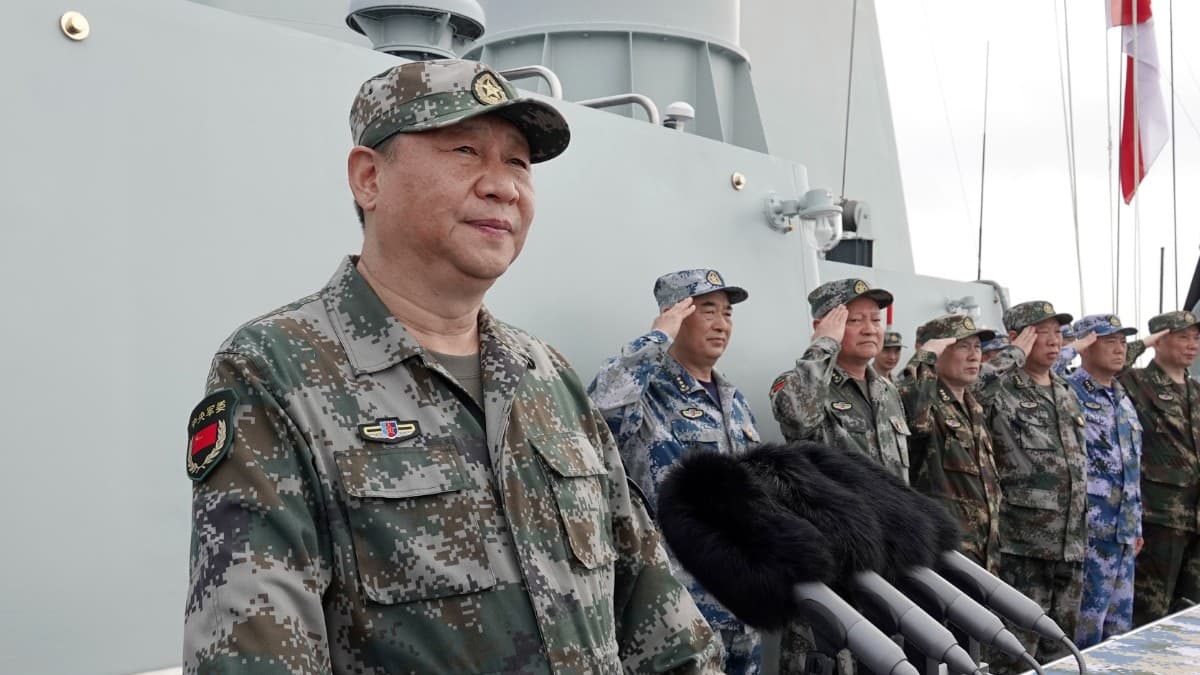
Over the past two years, China’s military posturing has intensified. Fighter jets routinely cross into Taiwan’s air defence zone. Naval drills simulate blockades. Statements from top leaders frame unification as both historic destiny and political obligation.
Xi Jinping has made it clear that the Taiwan issue is not to be indefinitely postponed. In 2022, he told the Communist Party Congress that “the wheels of history are rolling on toward China’s reunification.”
Yet for all the bluster and rehearsals, Beijing remains caught in a strategic paradox.
It talks like it’s ready for war — but it knows war is not only unjustifiable, but potentially catastrophic.
No cause, no support, no justification
Under international law, Taiwan has done nothing to justify invasion. It has not declared independence. It has not attacked China. It is a functioning democracy with a defensive military posture.
Beijing claims Taiwan as a breakaway province. But that alone does not constitute a legal basis for war. Any unprovoked military action would be categorised globally as aggression — and China would immediately forfeit whatever soft power and international legitimacy it has spent decades cultivating.
The world’s response to Russia’s invasion of Ukraine is instructive. Western nations imposed sweeping sanctions, pulled investments, isolated Moscow diplomatically, and rallied behind Kyiv with military support.
And Taiwan, unlike Ukraine, is not surrounded by passive neighbours.
A fight with consequences far beyond the Strait
China would not be able to count on a one-on-one conflict. Japan has made that clear. So has the United States, even while maintaining “strategic ambiguity.”
A blockade of Taiwan would directly affect Japan’s maritime routes. It would almost certainly involve the United States, which has deep informal ties to Taiwan’s defence. It could bring in Australia, the UK, and possibly others under new Indo-Pacific defence frameworks.
More importantly, the symbolism of the fight would mobilise resistance far beyond governments.
In a democracy like Taiwan, where the population is politically engaged, educated, and deeply conscious of its freedoms, an invasion would ignite widespread civil resistance — not just from the military, but from an armed and motivated civilian population.
This would not be a swift campaign. It would be a long, bloody occupation, with no obvious endgame.
And even if China wins the battle — what comes next?
Let us assume, for argument’s sake, that China launches an invasion, disregards international condemnation, endures economic sanctions, and takes Taiwan at immense cost.
What then?
- How many troops would China garrison in Taiwan to maintain control?
- How long would they stay?
- What level of resistance are they prepared to crush?
- And what happens when the world watches a democratic population being subdued by foreign soldiers?
There is no clean answer. And history offers little reassurance.
Every attempt to govern Taiwan by force — from the Qing dynasty to Japanese colonial rule — has been costly, unstable, and ultimately impermanent.
When the Qing navy defeated the Zheng loyalists and annexed Taiwan in 1683, they did not do so to reclaim lost territory. They did it to eliminate the last stronghold of Ming resistance. Even after their victory, senior Qing officials urged the emperor to abandon the island, calling it remote, rebellious, and not worth the trouble.
One court official famously described Taiwan as "a ball of mud beyond the seas" — not a treasured province, but a strategic liability. The Qing only held onto Taiwan to prevent it from being occupied by pirates or foreign powers.
And indeed, their fears were not unfounded. Throughout the Qing period, Taiwan experienced repeated uprisings, ethnic tensions, and armed resistance from both Han settlers and Indigenous populations. The empire never fully pacified the island, and governance remained fragile and reactive.
Fast forward two centuries: Japan’s colonisation of Taiwan (1895–1945) followed a similar pattern. The island was taken by treaty after the First Sino-Japanese War, but control was not easily established. It required decades of military suppression, assimilation efforts, and direct rule from Tokyo. Taiwan remained restive, and Japan’s grip ended abruptly with its defeat in World War II.
The pattern is unmistakable: Taiwan can be seized, but it cannot be peacefully held — not without immense cost, long-term repression, and permanent instability.
So what would the People’s Republic of China do differently?
Would it station hundreds of thousands of troops for decades?
Would it rebuild every institution from the ground up?
Would it censor and re-educate the population — on live global media — in the age of satellite internet and digital resistance?
Even a successful invasion would leave Beijing ruling a defiant, traumatised, and internationally supported population, in full view of the world.
This would not be reunification. It would be occupation.
And the world would see it as such.
The myth of decisive victory
China’s military is large, well-funded, and increasingly advanced.
But a full-scale invasion of Taiwan would be one of the most complex, dangerous, and uncertain military operations in modern history.
Amphibious assaults — especially across a 130-kilometre strait — are notoriously difficult.
The Ukraine war has shown that even land-based invasions against smaller, less prepared countries can become grinding, bloody wars with enormous losses.
Taiwan is not undefended. It has spent years investing in asymmetric warfare:
-
Mobile missile batteries
-
Sea mines
-
Anti-ship and anti-aircraft systems
-
Hardened infrastructure
-
A growing, trained reserve force
Its mountainous terrain, dense urban centres, and narrow beaches favour defenders, not attackers. And unlike in Ukraine, China would be fighting across water, with every soldier, tank, and bullet having to cross the sea under fire.
Even if China were to:
-
Break through Taiwan’s coastal defences
-
Establish beachheads
-
Defeat the formal military
…it would not mean victory.
Beijing would then face urban resistance, sabotage, a hostile civilian population, maintain its supply line via sea and an international media environment where every atrocity is instantly broadcast.
This is not a war that ends in a week.
It is not a clean decapitation strike.
It would be a long, brutal occupation, requiring hundreds of thousands of troops to hold territory where millions refuse to be governed.
There is no scenario in which Taiwan is taken quickly, cheaply, or quietly.
There is only prolonged violence, regional escalation, and permanent resentment.
China’s own people may not tolerate war
Another limitation lies not on the battlefield, but within China’s borders — and within its families.
The legacy of the one-child policy, though ended, still defines much of China’s demographic reality. Millions of households have only one child — often the sole source of hope, care, and future stability for their ageing parents.
In peacetime, that child is a family’s promise. In wartime, they become the ultimate price.
For all the nationalist sentiment Beijing tries to cultivate, it remains unclear how far the public’s support would extend — especially when the benefits are ideological, but the sacrifices are personal, irreversible, and borne by ordinary families.
The CCP’s unwritten social contract with its citizens is built not on freedom, but on economic prosperity, stability, and predictable progress. A war over Taiwan — especially one perceived as unprovoked or avoidable — would shatter that compact.
Sanctions would bring the pain home
The economic consequences of a Taiwan invasion would be swift, severe, and system-wide.
China's economy is fundamentally export-driven. Its rise as a global power has been powered by manufacturing, foreign investment, and open access to global markets. A war that provokes Western-led sanctions would endanger all three pillars.
Targeted restrictions — already being modelled by multiple governments and think tanks — would likely hit:
-
Major state and private banks
-
Semiconductor and tech firms
-
Key ports and export hubs
-
Critical supply chains for electronics, green tech, and automotive sectors
Global markets would recoil. Foreign investors would exit.
The renminbi would come under pressure, and capital flight could accelerate.
China’s already fragile post-COVID economy could tilt toward full crisis.
All of this would land at a time of deep domestic financial stress.
-
Home prices have fallen dramatically in major cities
-
Property developers are defaulting at record scale
-
Mortgage holders are trapped — unable to sell, yet required to repay
-
Youth unemployment is at record highs, and confidence in upward mobility is weakening
-
Wages are stagnating, while household costs continue to rise
Many middle-class families, already struggling with economic insecurity, would face further pain from job losses, inflation, and restricted trade
A war intended to project strength abroad would trigger instability at home.
Because this would not be a short-term disruption — but a structural shock to China’s growth model, its export dependency, and its social stability.
The illusion of unification through force
For years, Beijing pursued a softer path. Trade flourished, Taiwanese investment flowed into the mainland, and millions of tourists and students crossed the strait. Cultural and educational exchanges fostered familiarity. There was even space for political ambiguity — where Taiwan could engage economically while maintaining its identity.
That fragile balance once gave Beijing a real opportunity to build trust without coercion.
But that path was abandoned — and then actively destroyed.
When Beijing imposed the National Security Law on Hong Kong, it shattered the credibility of “One Country, Two Systems.” A promise of 50 years of autonomy was broken in less than half that time. What had once been framed as a model for Taiwan became a cautionary tale. From that moment, public sentiment in Taiwan shifted decisively.
Since then, every act of pressure — banned exports, cancelled performances, diplomatic bullying, airspace incursions, simulated blockades — has only deepened the distrust.
What had been a political debate became a matter of survival. And the target of Beijing’s pressure was no longer Taiwan’s government — it was its people.
But free societies do not yield to intimidation.
Taiwan is a democracy, not a disputed territory. Its population is educated, politically conscious, and deeply aware of its freedoms. Compliance cannot be extracted through fear. And even if China could physically take the island, it would inherit a society already hardened against it.
The problem is not Taiwan’s military. It’s Taiwan’s resolve.
Unification is not a prize to be seized. It is a choice — and Taiwan has made its choice clear.
If unity is still the goal, persuasion is the only path
If Beijing truly wants unification to be peaceful and lasting, it must confront a simple truth: Taiwan does not fear China’s culture — it fears its control.
Language, heritage, and history are not obstacles. What stands in the way is Beijing’s refusal to accept pluralism, and its insistence that unity requires submission.
The fate of Hong Kong is not distant history — it is a warning in real time.
If China hopes to win trust across the strait, it must stop framing unity as obedience. It must rebuild the space for cultural engagement, for trade without punishment, and for dialogue without preconditions.
Because you cannot win hearts while making people feel like enemies.
You can conquer land — but not identity. You can occupy a city — but not govern its spirit. True unity must be welcomed. It must be built on mutual respect, not forced assimilation.
And right now, the people of Taiwan — across generations and parties — are choosing distance, not closeness.