President von der Leyen calls for “new European independence” in Davos address
European Commission President Ursula von der Leyen used her special address at the World Economic Forum on 20 January 2026 to call for a “new European independence,” highlighting transformative trade, defence, and energy initiatives in response to global volatility.
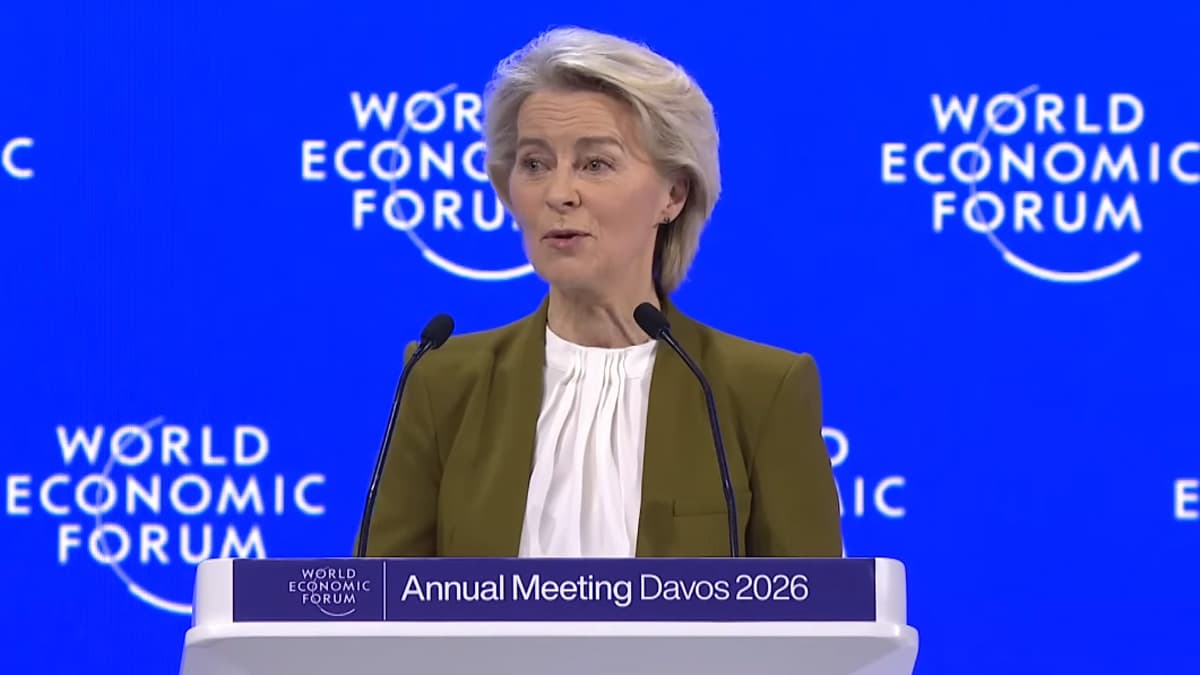
- European Commission President Ursula von der Leyen urges a permanent shift toward European independence in trade, defence, energy, and regulatory reform.
- She highlights breakthrough trade agreements, including the EU-Mercosur deal and upcoming negotiations with India.
- Europe commits to supporting Ukraine and strengthening Arctic security, including direct investment in Greenland and a broader EU security strategy.
European Commission President Ursula von der Leyen delivered a wide-ranging speech at the World Economic Forum in Davos on 20 January 2026, calling for a "new European independence" in response to lasting global instability and shifting geopolitical realities.
Marking 55 years since the first Davos meeting, von der Leyen acknowledged the fractured global order and stated that Europe must treat today’s changes as permanent. "Nostalgia will not bring back the old order,” she said. “If this change is permanent, then Europe must change permanently too.”
Trade as a tool of resilience
Von der Leyen highlighted recent successes in the EU’s trade agenda, notably the finalisation of the EU-Mercosur trade agreement, signed on 18 January 2026 in Asunción. She described it as a “breakthrough after 25 years of negotiations” and the world’s largest free trade zone, encompassing over 700 million people and 20% of global GDP.
She confirmed that the EU is progressing on trade agreements with Australia, the Philippines, Thailand, Malaysia, and the UAE. Upcoming talks with India are also expected to result in a landmark deal that she referred to as “the mother of all deals.”
These agreements, she said, signal Europe's commitment to “fair trade over tariffs,” and its strategy to de-risk supply chains and strengthen global partnerships.
Reforming the EU’s internal market
Turning to structural reforms, von der Leyen emphasised the need for regulatory simplification. She announced the EU’s intention to launch its “28th regime,” a uniform business structure known as EU Inc., to allow companies to operate seamlessly across Member States.
This would permit online registration of companies within 48 hours and establish a harmonised capital regime across the Union. “Business must be able to move just as freely as capital and data,” she said, citing current fragmentation as a barrier to growth.
Mobilising European capital and energy
Von der Leyen reaffirmed the European Commission's drive to deepen the EU’s capital markets. The ongoing development of the Savings and Investment Union aims to create a liquid, integrated market to lower costs and attract global capital.
In the energy sector, she announced the Affordable Energy Action Plan, focused on expanding interconnectors and grids, and accelerating investments in nuclear and renewable energy. “Energy is a chokepoint,” she said, referencing volatile electricity prices across the bloc.
She underlined that homegrown, reliable, and affordable energy is key to economic resilience and strategic autonomy.
Defence spending and tech development
On defence, von der Leyen said Europe has “done more in the last year than in decades before.” EU Member States are projected to spend €800 billion on defence by 2030.
The increased investment has seen a surge in the European defence-tech sector, with three startups reaching unicorn status, including those specialising in AI-powered battlefield intelligence and dual-use drone technology.
She stressed the increasing overlap between economic power and security capabilities, stating that “Europe is in the race for the key technologies of tomorrow.”
Support for Ukraine remains firm
Addressing security challenges, von der Leyen reaffirmed the EU’s support for Ukraine as Russia’s war approaches its fourth anniversary. A €90 billion loan package has been earmarked for 2026 and 2027 to support Ukraine’s defence and essential services.
She stressed the importance of Ukraine being in a strong position before entering peace negotiations and confirmed the EU’s decision to permanently immobilise Russian assets, reserving the right to make use of them.
“Europe will always stand with Ukraine – until there is a just and lasting peace,” she said.
Arctic security and US relations
Von der Leyen concluded her address by focusing on Arctic security and the sovereignty of Greenland, responding to emerging tensions with the United States over proposed tariffs. She argued that trade disputes between allies risk “plunging us into a dangerous downward spiral” that benefits adversaries.
Asserting full solidarity with Greenland and Denmark, von der Leyen outlined four initiatives:
-
Investment in Arctic security infrastructure, including a European icebreaker capability.
-
Economic support packages for Greenland.
-
Deeper partnerships with Arctic allies including the US, UK, Canada, Norway, and Iceland.
-
A forthcoming EU security strategy, including an updated Arctic strategy.
She emphasised that “sovereignty and integrity of their territory is non-negotiable,” and reiterated Europe’s commitment to partnerships based on mutual respect and shared values.
A call for urgency and ambition
Von der Leyen closed by urging Europe to maintain momentum, framing the current moment as a rare and necessary shift: “We must speed up our push for independence – from security to economy, from defence to democracy.”
She reaffirmed that dialogue remains central to Europe's approach – whether with allies or adversaries – and underlined that the continent must meet permanent global change with permanent transformation.