Spain declares national mourning as at least 40 die in high-speed train collision near Adamuz
A high-speed train derailed in southern Spain and was struck by another train, killing at least 39 and injuring over 120. The cause of the deadly incident, which occurred on a renovated section of track, remains under investigation.
- At least 40 killed and over 120 injured in a train collision near Adamuz, Spain, on 18 January.
- A faulty rail joint is under investigation as a potential cause; 43 people remain unaccounted for.
- Spain has declared national mourning; rescue efforts are complicated by remote terrain and wreckage.
Spain has declared a period of national mourning following a catastrophic high-speed train accident that killed at least 40 people and left over 120 injured in one of Europe’s worst rail disasters in decades.
The collision occurred on Sunday night, 18 January, near Adamuz in Cordoba province. A train operated by Iryo, travelling at 110 kilometres per hour from Malaga to Madrid, derailed after encountering what investigators now suspect to be a faulty joint in the rails.
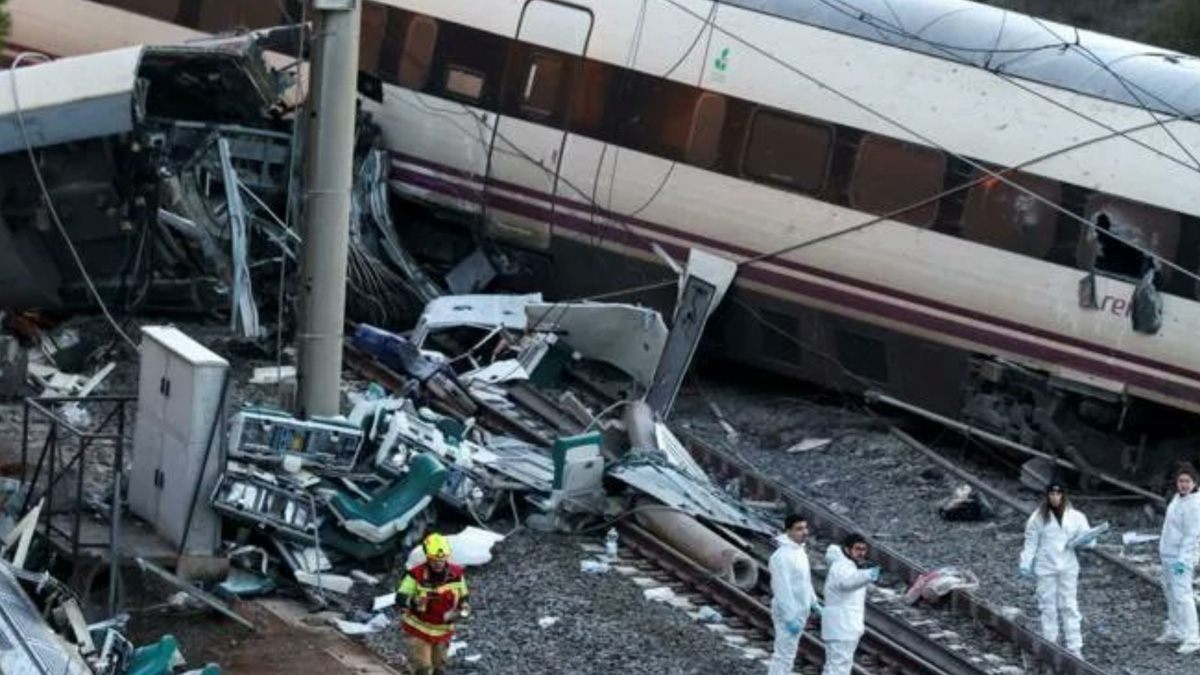
Seconds later, a second train operated by Renfe, en route to Huelva at 200 kilometres per hour, either struck the derailed train’s final carriages or debris strewn across the line. The resulting collision left carriages crushed, split in two, and hundreds trapped in twisted wreckage.
Spanish Prime Minister Pedro Sánchez cancelled his attendance at the World Economic Forum in Davos and visited the site. Transport Minister Oscar Puente and Andalusia’s regional president Juan Manuel Moreno also attended. Moreno confirmed the death toll had reached at least 40 and warned it could still rise, as 43 people remain officially unaccounted for.
Emergency services faced major obstacles due to the crash site's location in a hilly olive-growing region accessible only via a narrow track. This significantly hampered ambulance access and delayed the arrival of heavy rescue equipment, according to Iñigo Vila, national emergency director at the Spanish Red Cross.
Twelve injured passengers remain in intensive care. Police have opened identification offices in Cordoba to assist with DNA matching of victims.
Ana Garcia Aranda, a 26-year-old survivor being treated at a Red Cross centre, described the moment of derailment: “The train tipped to one side... then everything went dark, and all I heard was screams.” Covered in blood and limping, she said passengers pulled her from the train, while firefighters rescued her pregnant sister from the wreckage.
“There were people who were fine and others who were very, very badly injured... you knew they were going to die, and you couldn’t do anything,” she said.
Drone footage released by police showed the trains coming to rest approximately 500 metres apart. One locomotive was severely deformed, and several carriages were left in mangled piles of metal.
A preliminary investigation has revealed a broken rail joint may have caused the derailment. A source briefed on the inquiry said the joint had progressively widened, potentially destabilising the train.
Ignacio Barron, head of the Commission of Investigation of Rail Accidents (CIAF), told RTVE: “What always plays a part in a derailment is the interaction between the track and the vehicle, and that is what the commission is currently looking into.”
Iryo’s train, a Frecciarossa 1000 model, was under four years old and had passed its last inspection on 15 January. The rail line near Adamuz had been renovated in May 2025.
Renfe President Álvaro Fernandez Heredia stated the Iryo train lost a wheel in the incident, which has not yet been located. He described the crash as occurring under “strange conditions,” while ruling out human error at this stage of the investigation.
The collision is Spain’s deadliest rail disaster since 2013, when a train derailed in Santiago de Compostela, killing 80. According to Eurostat, it is among the 20 deadliest rail accidents in Europe in the last 80 years.
Officials also noted that Spanish train drivers had previously warned of “severe wear and tear” on the Madrid-Andalusia line. The train drivers’ union, Semaf, sent a letter to state-owned rail infrastructure operator Adif in August 2025, calling for stricter speed restrictions. Adif has not responded publicly to the warning or to recent media queries.
Spain’s high-speed rail network, the largest in Europe and second only to China globally, spans 3,622 kilometres. The government has faced criticism in recent years over frequent service disruptions, including power outages and copper cable thefts.
Since 2020, Spain has opened its high-speed rail system to private operators to improve affordability and service competition. Iryo is a joint venture between Italy’s Ferrovie dello Stato, airline Air Nostrum, and investment fund Globalvia.
Local residents were among the first to assist survivors. One, identified only as Paqui, said her husband “found a dead child inside, another child calling for his mother. You're never ready to see something like this.”
Support services have been activated for victims’ families, and a hotline has been opened for those searching for missing relatives. In addition, police are collecting DNA samples to aid with victim identification.
The Taiwanese Ministry of Foreign Affairs confirmed on 19 January that no Taiwanese nationals were reported among the dead or injured. It reiterated emergency contact information for Taiwanese citizens and extended condolences on behalf of the government and people of Taiwan.
A full investigation into the incident is ongoing, with forensic teams and engineering experts focusing on the condition of the rail infrastructure and mechanical records of both trains.