Singapore top destination as over 61,000 Malaysians renounce citizenship in five years
More than 61,000 Malaysians renounced their citizenship in the past five years, with Singapore emerging as the dominant destination, driven mainly by economic opportunities and family considerations, according to the National Registration Department.

- More than 61,000 Malaysians renounced their citizenship over the past five years, with Singapore accounting for nearly 94 per cent of cases.
- Economic opportunities and family considerations were cited as the main reasons, with women forming the majority of those giving up citizenship.
- Figures revealed in Aug 2025 M'sian Parliamentary sitting show the trend has intensified, with 2024 recording the highest annual number of Malaysians renouncing citizenship.
PUTRAJAYA, Malaysia: More than 61,000 Malaysians relinquished their citizenship over the past five years, with Singapore emerging as the preferred destination for the overwhelming majority, according to data from the National Registration Department.
The department’s director-general, Datuk Badrul Hisham Alias, said 61,116 Malaysians renounced their citizenship in the five-year period ending on 17 December 2025. He noted that the figure averaged about 10,000 cases annually.
Speaking to local media on 7 January 2026, Badrul said Singapore accounted for 93.78 per cent of all cases during the period, making it by far the most common destination among applicants.
Australia followed distantly with 2.15 per cent of cases, while Brunei accounted for 0.97 per cent.
Other countries collectively made up the remaining 3.1 per cent, according to figures provided by the department.
Badrul said economic considerations and family-related reasons were the primary drivers behind the decision to relinquish Malaysian citizenship.
He noted that Singapore’s labour market played a significant role in shaping migration choices.
“The decision to relinquish Malaysian citizenship is largely driven by economic and family factors. In the case of Singapore, many Malaysians are employed there, and employment prospects and income levels make it easier for them to obtain citizenship,” he told Malaysian media.
He added that family considerations were especially prominent among Malaysians who married foreign nationals and later migrated overseas before choosing to adopt their spouse’s nationality.
Women accounted for the highest proportion of those renouncing their citizenships.
According to Badrul, 35,356 women gave up Malaysian citizenship during the five-year period, making up more than half of all cases recorded.
The largest age group among applicants was those aged between 31 and 40, totalling 19,287 individuals, or 31.6 per cent of the total. This was followed by those aged 21 to 30, with 18,827 applicants, representing 30.8 per cent.
Applicants aged between 41 and 50 numbered 14,126, accounting for 23.1 per cent of cases. Those aged above 50 made up the smallest group, with 8,876 applicants, or 14.5 per cent of the total.
Badrul said most cases involved voluntary relinquishment, although there were also instances of citizenship revocation. These cases, he said, were significantly fewer in comparison.
Revocation could occur when Malaysians acquired foreign citizenship and exercised the rights of that nationality, such as voting, as Malaysia does not recognise dual citizenship under the Federal Constitution.
“When a Malaysian citizen exercises the rights of a foreign country, such as voting in its elections, they are deemed to have acquired that country’s citizenship, and their Malaysian citizenship must be revoked,” he said.
Nearly 99,000 Malaysians gave up citizenship for Singapore nationality from 2015 to mid-2025
The issue of Malaysians renouncing their citizenship has previously been raised in Parliament, reflecting broader public and political concern over the trend.
In August 2025, opposition Member of Parliament Datuk Seri Takiyuddin bin Hassan questioned the government on the number of Malaysians who had applied to become Singapore citizens between 2015 and 2025, with a breakdown by year.
Responding to the query, Home Minister Datuk Seri Saifuddin Nasution Ismail confirmed that more than 98,000 Malaysians had renounced their nationality between 2015 and June 2025 in order to obtain Singapore citizenship.
According to the minister, 2024 recorded the highest annual number of Malaysians giving up their citizenship, with 16,930 individuals doing so in that year alone.
In a written reply, Saifuddin provided the following breakdown:
| Year | Number of Malaysians who renounced citizenship for Singapore citizenship |
| 2015 | 7,394 |
| 2016 | 8,654 |
| 2017 | 7,583 |
| 2018 | 7,665 |
| 2019 | 13,362 |
| 2020 | 5,591 |
| 2021 | 7,956 |
| 2022 | 5,623 |
| 2023 | 11,500 |
| 2024 | 16,930 |
| 2025
(as of 30 June) |
6,060 |
| Total: | 98,318 |
23,472 individuals granted Singapore citizenship in 2023
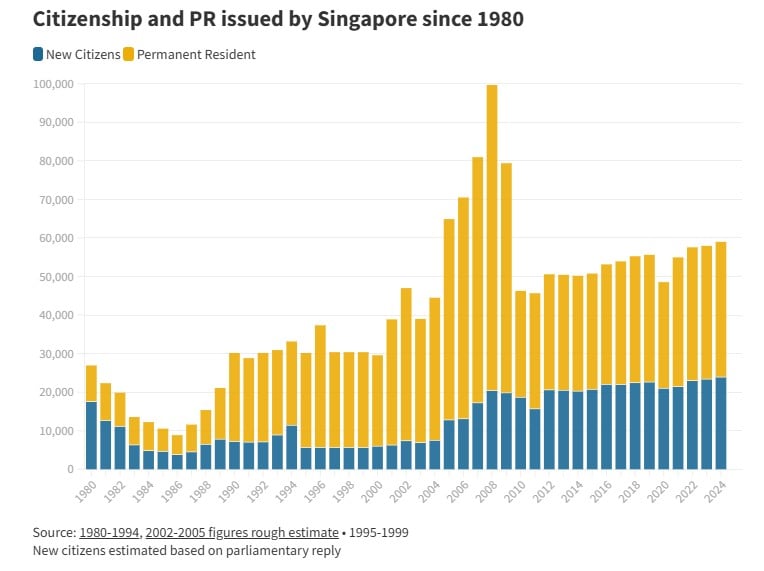
According to Singapore’s National Population and Talent Division (NPTD), 23,472 individuals were granted Singapore citizenship in 2023. The information was published on 24 September 2024.
The number of new citizenships granted for 2024 is not yet available.
From 2019 to 2023, Singapore granted an average of 22,400 citizenships per year, slightly above the average of 21,600 in the previous five years.
The Ministry of Home Affairs of Singapore reported that, in 2023, 2,776 new citizens were aged 21 to 30, while 6,150 were aged 31 to 40.
Approximately 20 per cent of the new citizenships were granted under the Family Ties Scheme to foreign spouses of Singapore citizens, according to a written reply on 7 January 2025 by Home Affairs Minister K. Shanmugam to then-Ang Mo Kio GRC MP Gan Thiam Poh.
In total, between 2019 and 2023, Singapore granted 111,890 individuals citizenship.