Chan Chun Sing says drones have long shaped Singapore’s defence thinking amid evolving warfare
Defence Minister Chan Chun Sing told Parliament that drones and advanced technologies have long shaped Singapore’s military thinking, stressing resilience, early warning and diversified capabilities amid evolving battlefield threats.
- Defence Minister Chan Chun Sing said drones and advanced technologies have long been factored into Singapore’s military planning.
- He stressed Singapore’s lack of geographical depth requires unique defence concepts, including early warning, hardened infrastructure and asset dispersion.
- The relocation of Paya Lebar Air Base was a considered decision, with mitigation measures taken against evolving threats such as drone warfare.
SINGAPORE: Coordinating Minister for Public Services and Minister for Defence Chan Chun Sing said drones and other advanced technologies have long been integrated into Singapore’s military thinking, amid rapid changes in the nature of warfare.
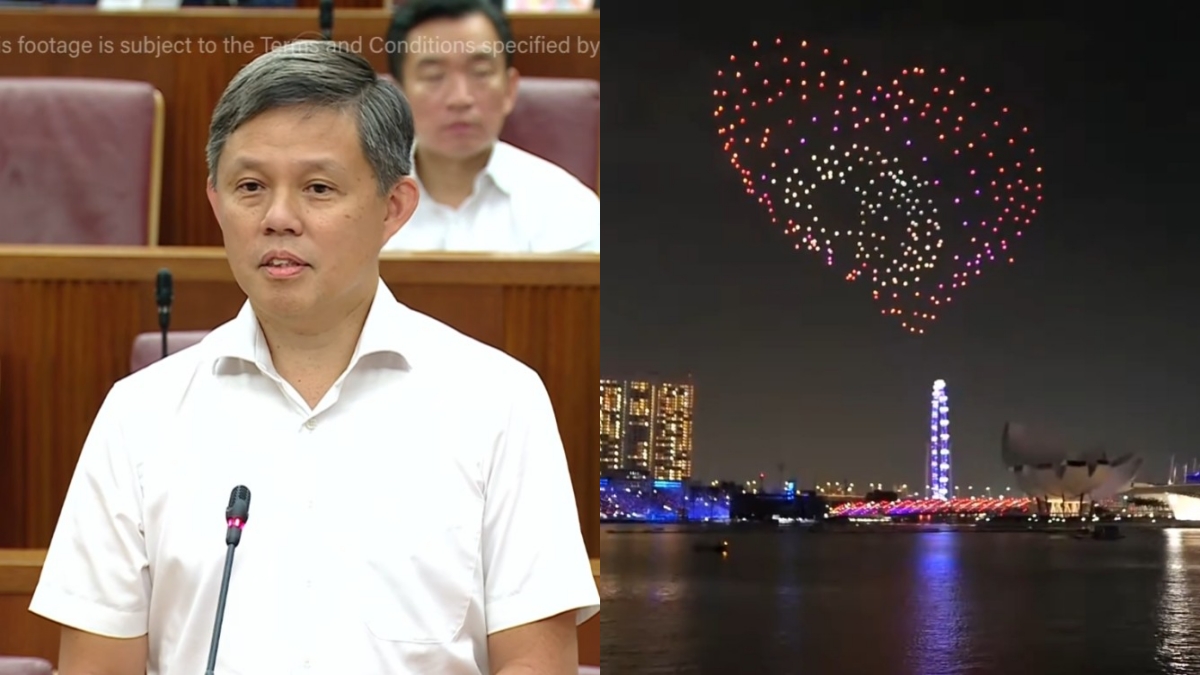
He was responding to a supplementary question by Aljunied GRC Member of Parliament Kenneth Tiong during a parliamentary sitting on 14 January 2026, which focused on evolving drone-enabled threats and Singapore’s defence survivability.
According to Chan, Singapore faces a perpetually high risk of attack because of its lack of geographical depth, a reality that has shaped the country’s defence strategy and operational concepts for decades.
He said discussions about drone warfare were not new to the Singapore Armed Forces, adding that such technologies had been studied and incorporated even during his earlier years as an active SAF officer.
“To many people, drone warfare appears new, but it is something we have been looking at for many years,” Chan told Parliament, emphasising long-term planning rather than reactive policymaking.
To illustrate this point, he cited the 2017 National Day Parade, where 300 drones formed a heart shape in the sky during the closing segment of the ceremony.
While the display impressed the general public as a technological spectacle, Chan said informed observers within the defence community already understood its implications for the future character of warfare.
“To those in this line of business, we already knew what that meant for the nature of warfare,” he said, referring to the operational potential of coordinated drone swarms.
Chan was responding to Tiong’s question on how Singapore assesses evolving threats, including drone-enabled strikes demonstrated in recent global conflicts such as the United States’ operation involving Venezuela.
Tiong earlier asked whether the Ministry of Defence had conducted a strategic review of the decision to relocate Paya Lebar Air Base, in light of conflicts showing the vulnerability of concentrated air assets.
He further questioned whether consolidating Republic of Singapore Air Force assets into fewer air bases could significantly increase operational risks during a first-strike scenario involving mass drones or long-range munitions.
In response, Chan said Singapore’s status as a small island with no strategic depth or hinterland required defence solutions uniquely suited to its circumstances.
He said the SAF must balance operational needs with competing demands on limited land and finite human resources, shaping how infrastructure and capabilities are developed.
According to Chan, Singapore’s defence posture relies heavily on robust intelligence, effective threat detection and early warning systems operating at range.
These capabilities allow the SAF to mount timely and decisive responses using a diversified suite of assets deployed across multiple layers and distances, where necessary.
Even so, Chan acknowledged that no defence system could prevent all threats from reaching Singapore’s shores in every scenario.
For this reason, he said critical infrastructure and key facilities are hardened against potential attacks, while essential assets can be dispersed in peacetime and especially during contingencies.
He added that reserve capacities have been factored into defence planning to ensure resilience in situations where some assets may be destroyed or damaged.
Addressing the relocation of Paya Lebar Air Base, Chan said the decision was carefully considered and took into account both national development needs and emerging security threats.
He said the move was not taken lightly and involved trade-offs, but mitigation measures had been implemented to manage the associated risks.
These measures include significant investments in expanding Tengah Air Base and Changi Air Base, as well as lengthening the contingency runway at Pulau Sudong.
Chan said Tengah and Changi air bases are also being upgraded with enhanced detection, response and resilience capabilities, including against emerging drone threats.
He added that other parts of the SAF are similarly undergoing enhancements to keep pace with technological developments and evolving threat profiles.
The Defence Minister said the SAF would continue to assess its operational infrastructure and capability requirements, taking into account threats on the horizon and available technologies.
These assessments would involve carefully weighing costs and risks to Singapore, he said, stressing the importance of prudent long-term planning.
Chan noted that for operational and security reasons, many defence efforts are conducted out of the public eye and are not disclosed in detail.
He said public announcements would be made at appropriate junctures when there were clear operational or deterrence reasons to do so.
According to Chan, this balance between transparency and security was necessary to safeguard Singapore’s defence effectiveness in an increasingly complex security environment.