55kg rhino horns seized in Johannesburg as Singapore–South Africa probe nets two Nigerians
Two Nigerian men were arrested in Johannesburg after 55.4kg of rhinoceros horns and 26.2kg of big cat parts were seized following a controlled return operation coordinated by Singapore’s NParks and South African authorities.
- Two Nigerian men were arrested in Johannesburg after authorities seized 55.4kg of rhinoceros horns and 26.2kg of big cat parts.
- The haul followed a controlled return of a suspicious shipment coordinated by Singapore’s NParks and South African authorities.
- Investigations are ongoing into a wider transnational wildlife trafficking network.
Two Nigerian men have been arrested in Johannesburg following the seizure of 55.4kg of rhinoceros horns and 26.2kg of big cat parts in a joint operation involving Singapore’s National Parks Board (NParks) and South African authorities.
The haul was uncovered after NParks facilitated the controlled return of a suspicious wildlife shipment from Singapore to South Africa, a move aimed at dismantling a wider transnational trafficking network rather than intercepting a single consignment.
On 11 November, NParks was alerted to a shipment originating from South Africa that was transiting through Singapore Changi Airport.
The consignment raised red flags as it shared key similarities — including the same country of origin and final destination — with another shipment seized just days earlier on 8 November.
That earlier seizure contained 35.7kg of rhinoceros horns, the largest haul of its kind ever intercepted in Singapore, along with about 150kg of other animal parts such as bones, teeth and claws.
Instead of seizing the 11 November shipment immediately, NParks contacted South Africa’s Directorate for Priority Crime Investigation (DPCI) to coordinate a controlled return of the cargo to its source country to enable further investigation.
“The shipment was not opened at all because there were similarities with the earlier case, so we suspected there could be contraband inside,” said Dr Anna Wong, senior director of wildlife trade at NParks. “We then coordinated with the logistics company to send it back.”
Following the return of the shipment, South African authorities carried out an operation on 1 December at a storage facility in Johannesburg.
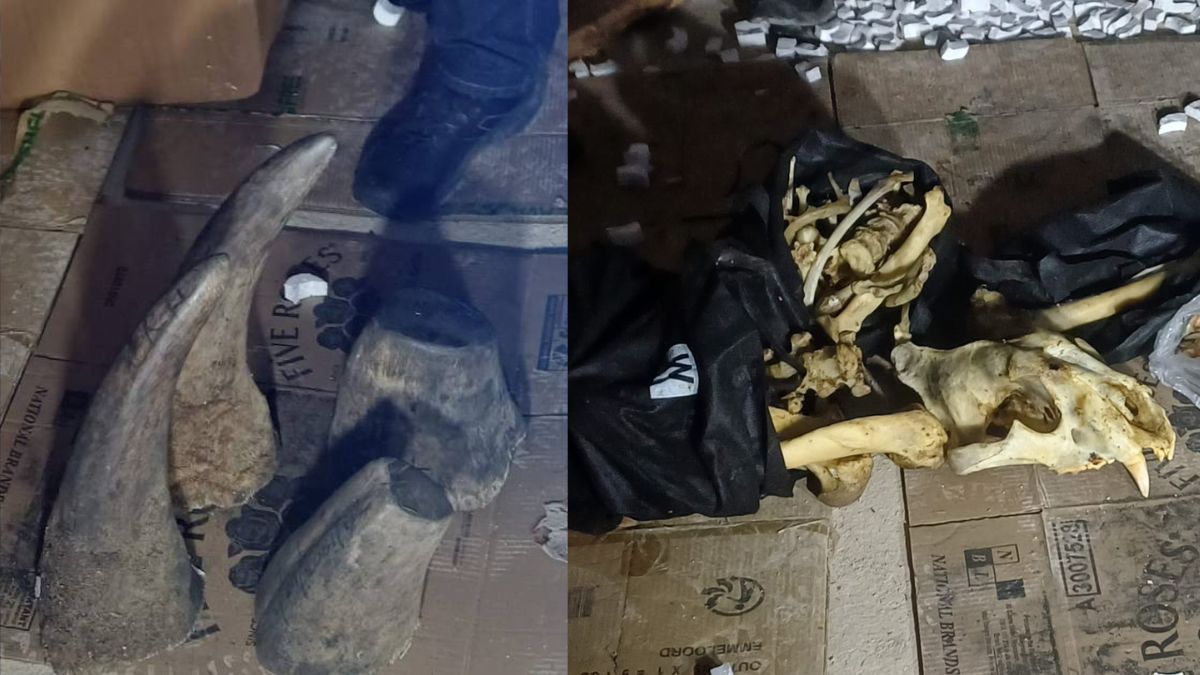
There, officers discovered four boxes containing 17 rhinoceros horns weighing 55.4kg, as well as 26.2kg of lion and tiger bones, skulls and claws.
Two Nigerian men were arrested and later charged under Section 57(1) of South Africa’s National Environmental Management: Biodiversity Act, which prohibits restricted activities involving listed threatened or protected species.
NParks said on 30 December that the recovered horns and animal parts are believed to be linked to a broader transnational trafficking network smuggling wildlife products from South Africa to foreign markets.
The Commercial Affairs Department of Singapore Police Force (SPF) is also investigating possible money laundering offences linked to the 11 November shipment under the Corruption, Drug Trafficking and Other Serious Crimes (Confiscation of Benefits) Act 1992, NParks said.
Rhinoceroses are protected under the Convention on International Trade in Endangered Species of Wild Fauna and Flora (CITES), and international trade in rhinoceros horns is prohibited worldwide.
NParks said the controlled return of the shipment allowed investigators to pursue leads in the source country, increasing the chances of identifying and dismantling the wider criminal network rather than stopping a single shipment in transit.
The operation required extensive multinational coordination between NParks and the DPCI to ensure the shipment could be tracked and monitored throughout its journey.
“This approach demonstrates the importance of international cooperation in combating transnational wildlife crime, where targeting criminal networks at their source can yield more significant long-term results than isolated seizures,” NParks said.
Forensic analysis and international cooperation
Further analysis by NParks’ Centre for Wildlife Forensics confirmed that animal parts seized in the 8 November shipment — alongside the rhinoceros horns — originated from lions and tigers. NParks is also working with the University of Pretoria to determine the provenance of the rhinoceroses from which the horns were taken.
Addressing concerns about Singapore’s role as a transit hub, Dr Wong said the country has “very strong enforcement measures to combat illegal wildlife trade”, adding that a multi-pronged approach has enabled such detections and seizures.
NParks said investigations are ongoing and that intelligence has been shared with international partners, including INTERPOL, the World Customs Organization and authorities in Laos, the stated destination of the shipment.
Singapore’s role in global wildlife enforcement
On 11 December, INTERPOL announced that its multi-country Operation Thunder, conducted in September and October and involving Singapore, resulted in the seizure of nearly 30,000 live animals — the highest number recorded in the operation’s ninth run in 2025.
As a signatory to CITES, Singapore said it remains committed to stamping out illegal wildlife trade.
At the 20th Conference of the Parties (COP) to CITES held in Samarkand, Uzbekistan, from 24 November to 5 December, Dr Wong was appointed chair of Committee II, which oversees strategic and procedural matters and makes recommendations on the implementation of the convention.
“This is the first time a Singaporean has been appointed to chair one of the two main committees at a COP,” NParks said.
In her role, Dr Wong presided over discussions on more than 100 agenda items, guiding debates among nearly 3,500 participants from over 160 countries and overseeing the adoption of more than 350 decisions.
These covered financial and strategic matters, including livelihoods, species conservation and trade — particularly elephants — as well as efforts to mitigate the risk of zoonotic disease transmission.
Singapore was also elected as one of three Asian representatives on a senior committee that provides strategic direction and oversight for CITES’ work, NParks added.