District Court dismisses negligence and by-law claims in fatal fall involving pet Corgi
A Singapore district judge ruled that a Corgi’s presence did not constitute negligence or by-law breach after a man fell and sustained fatal injuries. The court found the dog was leashed, calm, and not proven to have barked or lunged.

- The estate of Tan Kut Fai sued his neighbour for negligence after a fall allegedly caused by a pet Corgi.
- The District Court found no proof the dog lunged or barked, and the dog was leashed properly.
- The court also ruled the condominium by-laws did not prohibit keeping a Corgi.
The Singapore District Court has dismissed a negligence and by-law breach claim brought by the estate of Tan Kut Fai, who suffered a traumatic brain injury after falling in his condominium's carpark lobby on 21 March 2019. The fall occurred after Tan was startled by a neighbour’s Corgi dog emerging from a lift.
Tan, who was unable to recover from his injuries, passed away in 2025. The claim was continued by his daughter, Tan Shuh Lin, as administrator of his estate. The estate alleged that Loong Kai Jun Matthew, the Corgi's owner, was negligent and in breach of condominium by-laws for allowing the dog to exit the lift ahead of him.
However, in a judgment delivered on 11 December 2025, District Judge Samuel Wee dismissed the claim, finding that the Corgi had been leashed, was not proven to have barked or lunged, and was not shown to fall outside the permitted breed restrictions.
Incident captured on CCTV, but footage inconclusive
The incident took place when Loong took his Corgi for a walk. The dog was secured on a 4ft leash, which Loong had shortened to 3ft as they exited the lift.
As the lift door opened at the basement carpark, the Corgi stepped out slightly ahead of Loong. Tan, who was waiting outside, appeared shocked, fell backwards and hit his head.
Closed-circuit television footage from the lift area captured the sequence, but the judge noted it was recorded at only one frame per second. As a result, it did not reveal the detailed nature or timing of the dog’s movements.
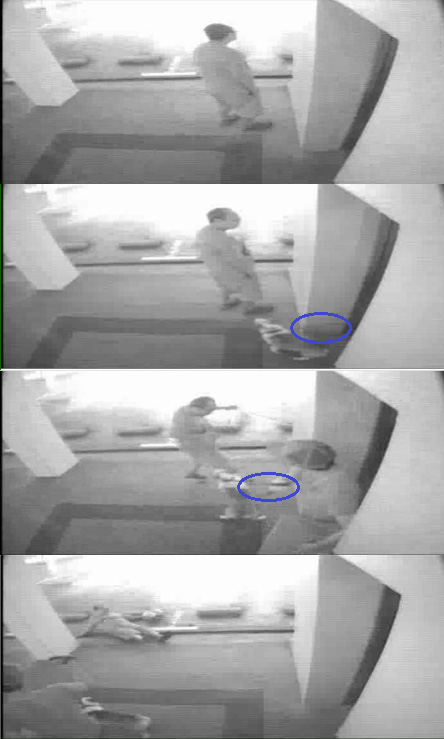
Sequence of CCTV frames shows the Corgi exiting the lift on a short leash, veering slightly towards Tan, who then falls backwards; no lunging or physical contact can be discerned from the low-resolution footage.
No proof of lunging, barking or aggression
The estate alleged that the Corgi barked and lunged aggressively at Tan. However, Judge Wee found that the estate failed to prove either action occurred.
Loong testified that the Corgi merely veered slightly to the right and remained on a short, taut leash. He said he pulled the dog back promptly. His account was found to be credible and consistent during cross-examination.
The judge rejected evidence from the estate’s dog behaviour expert, who had not personally observed the dog. In contrast, veterinary evidence described the Corgi as calm, and it had passed a temperament test after the incident to qualify as a therapy dog with Therapy Dogs Singapore.
On the question of barking, the judge found no definitive evidence. The CCTV footage lacked audio, and while some reports referred to barking, they were based on hearsay. The judge noted that barking alone, without aggressive behaviour, would not breach the standard of care.
“I therefore have difficulty seeing how the defendant could have breached his duty to Mr Tan merely because the corgi barked (without lunging towards Mr Tan),” said Judge Wee.
Defendant assisted Tan after fall
After the fall, Loong immediately released the leash and assisted Tan. He accompanied him to hospital, explaining in court that Tan’s wife had refused to do so as she had earlier warned him not to leave the house. The judge accepted that Loong’s actions were an act of concern and did not constitute an admission of guilt.
Tan was diagnosed with a traumatic brain injury at Changi General Hospital. As he was no longer able to function independently, his daughter was appointed deputy under court order to act on his behalf. Following his passing, she continued the suit as estate administrator.
Corgi not proven to breach by-laws
The estate also alleged that Loong breached the condominium's by-laws by owning a dog that was not a “small breed as defined by the relevant authorities”, and by failing to keep it under control in common areas.
The by-laws, however, did not specify who the “relevant authorities” were. The estate relied on guidelines from the Housing and Development Board (HDB), which excludes Corgis from its list of permitted small breeds.
The National Parks Board (NParks) clarified that there is no universal classification of dog sizes in Singapore, apart from the HDB’s internal guidelines. Corgis, due to their weight, are typically categorised as medium-sized dogs and are not on HDB’s list.
Despite this, the judge ruled that the HDB’s standards could not be read into private condominium rules.
“There is simply no basis for HDB's guidelines to be read into the small breed condo by-law,” he stated.
The judge also found that the leash was of reasonable length and that the dog was under control. He held that had the leash been made any shorter, it would have been impracticable for Loong to walk the dog and may have endangered the animal.
Sympathy expressed, but no liability found
While expressing sympathy for Tan’s family, Judge Wee concluded that legal liability could not be established based on speculation or emotional impact.
“I extend my sympathy to Mr Tan’s family, who have endured the daily consequences of the unfortunate Incident and the anguish of witnessing Mr Tan’s declining health and faculties,” he said.
He dismissed the estate’s claim in full and ordered parties to file submissions on legal costs within 14 days of the judgment.