Singapore’s ERP 2.0 design draws renewed scrutiny after viral comparison with Japan’s toll system
A Facebook video by a Singapore content creator comparing ERP 2.0 with Japan’s ETC system has sparked online discussion. Critics renewed concerns over ERP’s bulky on-board unit and safety, while others noted the systems serve different purposes, highlighting ongoing public unease over ERP 2.0’s rollout and user experience.
- A Facebook video comparing Singapore’s ERP 2.0 and Japan’s ETC system has gained traction online.
- Critics focused on design, safety and driver visibility, while others highlighted differing system purposes.
- The discussion reflects broader public frustration over the ERP 2.0 rollout and on-board unit design.
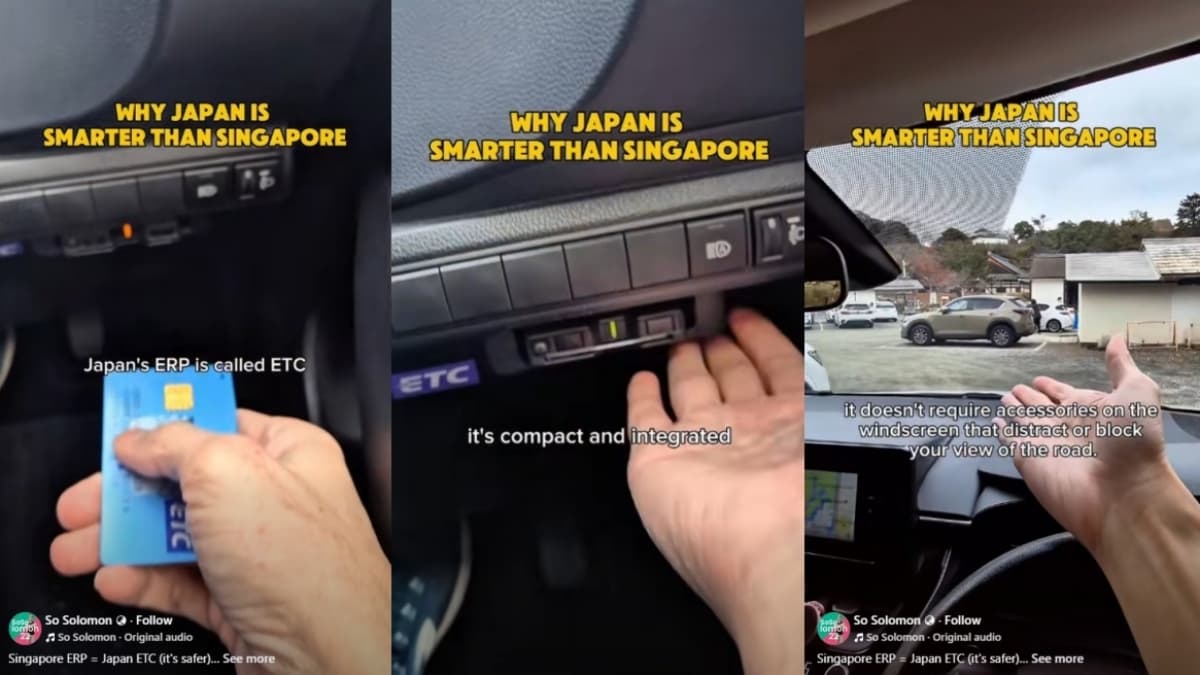
A video posted on Facebook by Singapore-based content creator So Solomon has prompted renewed scrutiny of Singapore’s Electronic Road Pricing system, following comparisons with Japan’s Electronic Toll Collection card.
The video, titled “Why Japan is smarter than Singapore”, was shared recently and gained traction online. Its caption reads: “Singapore ERP = Japan ETC (it’s safer)”.
The post contrasts Singapore’s ERP 2.0 on-board unit with Japan’s ETC system, a smart card-based solution for automatic, cashless toll payments on expressways, allowing vehicles to pass through toll gates without stopping.
Managed by the Land Transport Authority, Singapore’s ERP charges vehicles for entering busy roads during peak hours to manage traffic flow rather than fund highway construction.
Under ERP 2.0, charges are calculated using satellite-based positioning instead of physical gantries. Fees vary depending on time, location and vehicle type, reflecting prevailing traffic conditions.
Several commenters noted that these contrasting objectives complicate direct comparisons between the two systems.
Focus on design and driver visibility
Much of the online discussion centred on the physical design of Singapore’s ERP 2.0 on-board unit. The current model consists of three components, including a display mounted on the windscreen.
In the video, So Solomon highlighted that Japan’s ETC unit is compact, integrated and equipped with an eject button. He emphasised that it does not require accessories attached to the windscreen, which he said could distract drivers or obstruct their view.
Many commenters echoed these views, describing Singapore’s device as bulky and outdated.
Some said it felt out of place at a time when consumer technology has become smaller and less intrusive.


Comparisons with regional systems
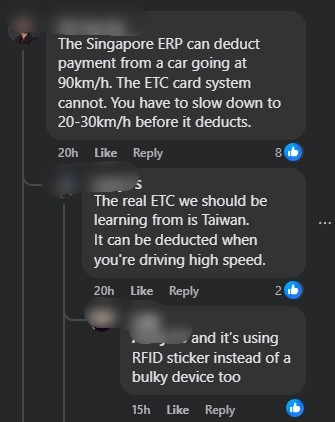
Beyond Japan, some users pointed to Malaysia’s RFID toll system as an example of a more straightforward and driver-friendly approach.
These commenters framed Singapore’s system as insufficiently attentive to user experience.
Some questioned why a city known for technological ambition appeared to lag behind regional peers in design simplicity.
Others highlighted Japan’s use of voice prompts, suggesting that audible guidance allows drivers to keep their eyes on the road.
Responses highlighting technical distinctions
Not all responses were critical. Some users argued that ERP and ETC systems should not be assessed by the same standards, given their different functions and technologies.
They pointed out that Singapore’s satellite-based system enables seamless charging at highway speeds, unlike some toll gate arrangements that require vehicles to slow down.
So Solomon acknowledged this distinction in his replies, agreeing that the two systems were built for different policy goals.
Views on speed reduction at toll gates
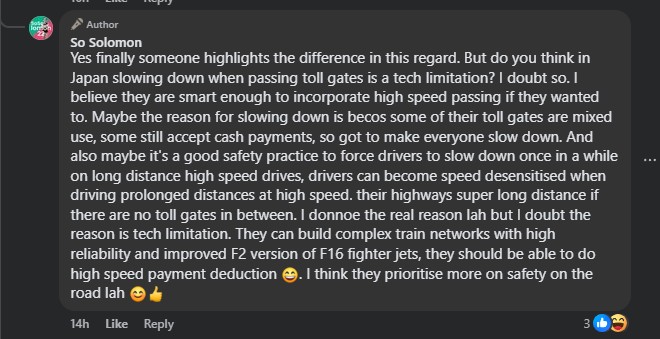
He questioned, however, whether Japan’s requirement for drivers to slow down at toll gates reflected a technological constraint.
In a lengthy response, he suggested that Japan could implement high-speed tolling if it chose to.
He attributed the slower speeds to mixed-use toll gates that still accept cash payments.
He also suggested that enforced slowing could serve as a safety measure on long-distance highways, helping drivers recalibrate after prolonged high-speed travel.
While he noted uncertainty over the precise rationale, he rejected the idea that Japan lacked the technical capability to support faster tolling.
Manufacturing and integration challenges
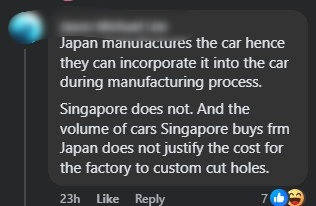
Another thread of discussion addressed vehicle manufacturing. One netizen argued that Japan’s advantage lies in producing its own cars, allowing ETC systems to be integrated during manufacturing.
Singapore, which imports vehicles, does not have this option.
The relatively small number of cars purchased from Japan also limits the feasibility of factory-level customisation.
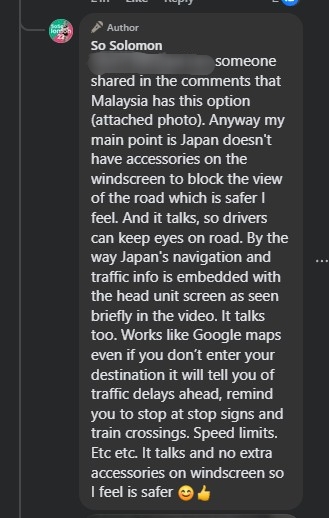
So Solomon responded that his main concern remained driver safety. He reiterated that Japan’s approach avoids windscreen-mounted accessories and relies heavily on voice alerts.
He added that Japanese vehicles often integrate navigation and traffic information directly into the head unit, providing real-time updates even without a set destination.
Longstanding criticism of ERP 2.0 rollout
The renewed attention comes amid broader public dissatisfaction with ERP 2.0. The S$500 million system attracted criticism when phased installations began in late 2023.
First announced in 2013, the satellite-based ERP was originally slated for launch in 2020. The timeline was pushed back repeatedly due to technical challenges and the global microchip shortage.
The system is intended to support distance-based charging and couponless street parking, replacing the older gantry-based ERP infrastructure.
Nationwide completion is targeted by the end of 2025.
Ministerial response and public reception
Criticism has largely focused on the three-piece on-board unit, which replaced the earlier one-piece in-vehicle unit.
Motorists have described the design as inconvenient and visually intrusive, arguing that it represents a step backwards. Some also criticised the lack of alternatives available to users.
Then-Transport Minister Chee Hong Tat defended the design in Parliament, citing operational and technical considerations.
His explanation, however, was widely rejected online, with many portraying it as unconvincing and out of touch with everyday driving experiences.