Singapore sees record permanent employment in 2025 amid shrinking labour force
Singapore's Ministry of Manpower’s advance labour force report shows a continued shift towards permanent employment among resident workers in 2025, even as participation rates fall for the fourth consecutive year amid ongoing demographic changes
- Permanent employment among residents reached a historic 90.8% in 2025, especially among youths.
- Resident labour force participation rate declined to 67.9%, continuing a four-year downward trend.
- Income rose at both lower and median tiers, but fewer residents are switching jobs or planning to join the workforce.
The share of Singapore citizens and permanent residents (PRs) in permanent employment rose to 90.8% in 2025, the highest since such data was recorded, according to the Ministry of Manpower’s (MOM) Labour Force in Singapore Advance Release 2025, published on 28 November 2025.
The increase was most marked among youths aged 15 to 24, with the share of permanent job holders rising by nearly 8 percentage points. Within this age group, fixed-term contract employment fell from 29.3% to 27.4%, and casual or on-call jobs dropped from 12.6% to 6.8% .
Residents aged 25 to 29 also saw a 1 percentage point increase in permanent employment. Gains were observed across industries, including Professional Services, Health and Social Services, and Information and Communications.
Four-year decline in labour force participation continues
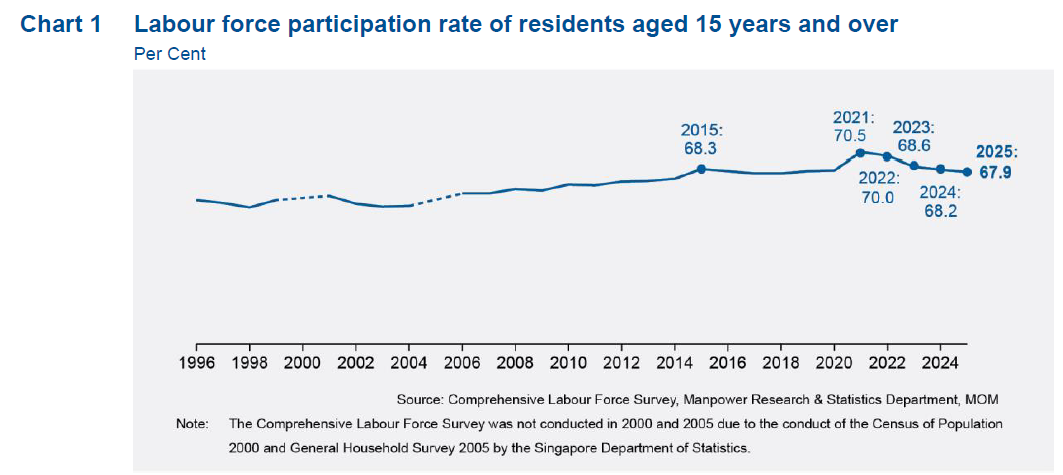
Despite greater job stability, the resident labour force participation rate (LFPR) declined for the fourth consecutive year to 67.9%, down from 68.2% in 2024 . MOM attributed this to ongoing population ageing.
In 2025, 37.9% of residents aged 15 and over were aged 55 or above, compared to 30.2% in 2015. The old-age support ratio — defined as residents aged 20 to 64 per one resident aged 65 and over — fell from 5.7 in 2015 to 3.3 in 2025, and is projected to fall to 2.7 by 2030 .
The number of residents outside the labour force rose to 1.16 million, up by 20,000 from 2024. Among them, 30.1% cited retirement, 22% cited family responsibilities, and 15.8% reported housework as reasons for not participating in the labour market .
Shifting age and gender profiles
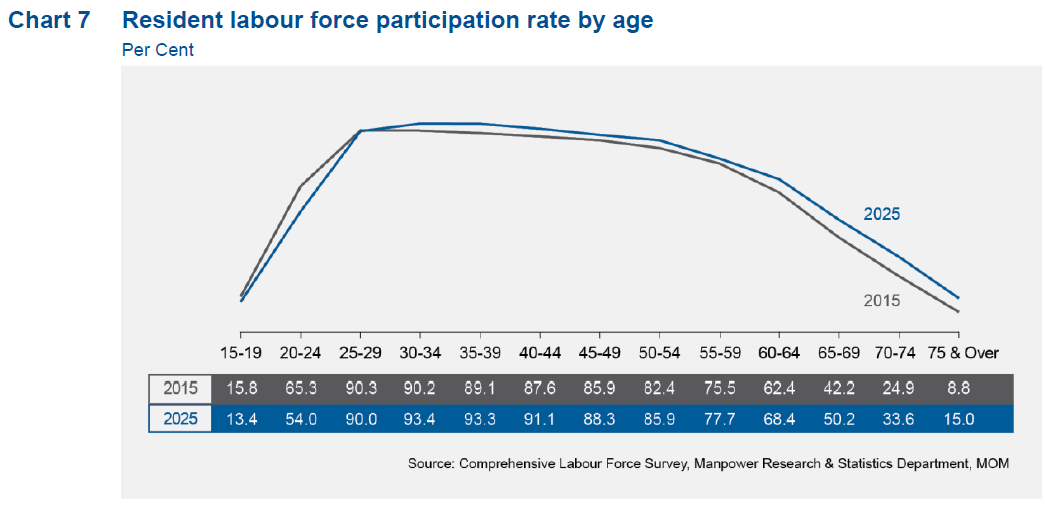
While fewer residents are participating overall, some demographic groups expanded their labour force involvement. The share of seniors aged 60 and over in the labour force increased from 12.3% in 2015 to 19.3% in 2025, supported by initiatives like the Senior Employment Credit and career conversion programmes.
Conversely, participation among residents under 30 fell from 19.1% in 2015 to 13.6% in 2025, due to falling birth rates and longer education enrolment .
Among the core working-age group (25–64), female participation rose from 74.1% to 80.5%, while male participation remained high at 91.8%. As a result, women now account for 47.7% of the labour force, up from 45.5% in 2015.
However, Singapore’s female part-time employment rate remains low at 5.9%, significantly below the OECD average of 13.7%, which MOM notes may limit further growth in participation .
Employment rates stable, unemployment low
The employment rate for core working-age residents (25–54) remained relatively stable, edging down from 87.7% in 2024 to 87.5% in 2025. The rate for seniors aged 55–64 rose slightly to 70.8%, while that for those 65 and older declined marginally to 31.5% .
The resident unemployment rate remained low at 2.8% for both PMETs and non-PMETs. Long-term unemployment dropped to 0.6% for PMETs and 0.5% for non-PMETs.
The time-related underemployment rate, which tracks those wanting more work hours, fell to 1.9%, its lowest since 2009, from 2.3% in the two previous years.
The number of discouraged workers — residents not seeking jobs because they believe opportunities are lacking — stood at 7,400, or 0.3% of the resident labour force. Most were aged 60 and above, followed by those in their 50s.
Job switching rates continue to decline
The share of employed residents who changed jobs in the past year fell from 7.6% in 2024 to 6.2% in 2025, continuing a three-year decline. The drop was most noticeable among residents aged 25 to 29.
Despite this, six in ten full-time employed residents aged 25 to 64 who switched jobs saw real income gains, often moving into higher-productivity sectors like Professional Services, Financial Services, and Information & Communications.
Real and nominal incomes increase
Incomes rose for both lower- and middle-income earners. The 20th percentile (P20) real income increased by 3.8%, while the median (P50) rose by 4.3%.
In nominal terms, monthly income for P20 rose from S$3,026 in 2024 to S$3,164 in 2025, while the median rose from S$5,500 to S$5,775 .
Over the 10-year period from 2015 to 2025, P20 incomes grew at 2.9% per annum, while median incomes increased by 2.1% annually. The P20-to-median income ratio improved from 0.51 to 0.55, reflecting a narrowing of wage disparities supported by the Progressive Wage Model (PWM).
Tertiary education and PMET share rise
The proportion of employed residents in PMET roles increased from 63.8% to 64.2% in 2025. At the same time, the share of employed residents with tertiary education rose to 64.0%, up from 51.6% in 2015 .
Overseas work and informal employment
For the first time, MOM reported data on overseas work experience. About 76,000 residents (3.1%) had worked full-time overseas for at least six months. These individuals were typically older, in managerial positions, and from Professional Services or ICT sectors.
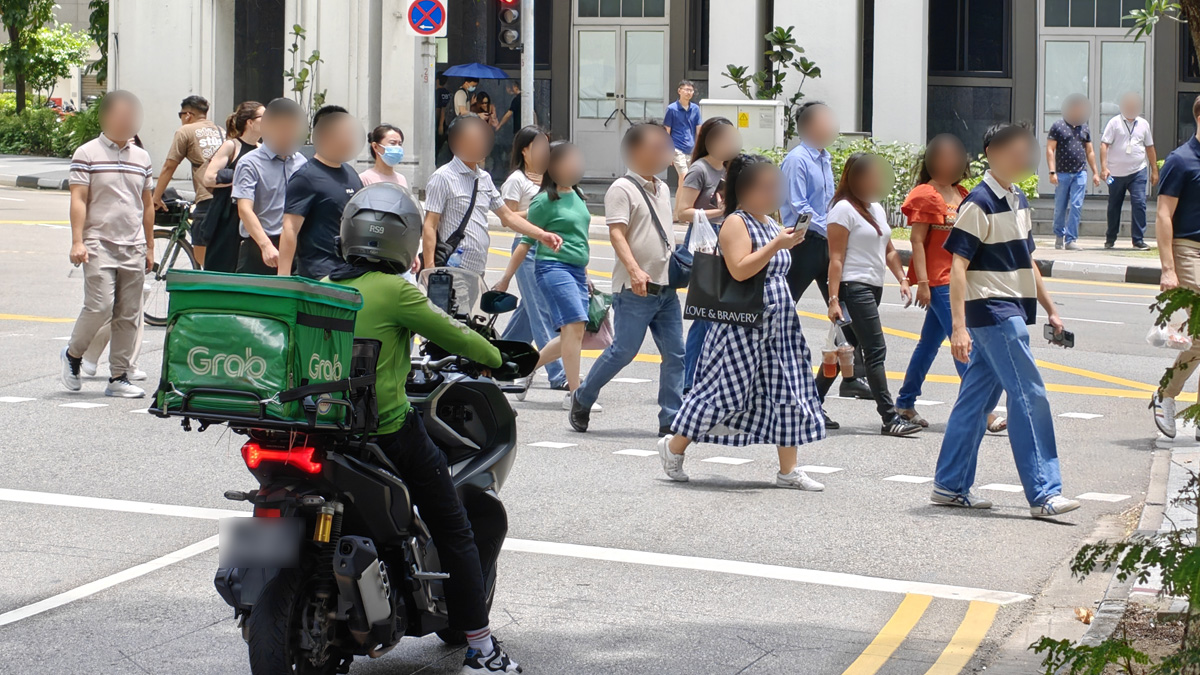
The share of self-employed residents remained at 11.8%. This includes 179,200 own-account workers (7.3%) and 71,600 platform workers (2.9%) such as ride-hailing and delivery workers.
Among platform workers, 92.5% indicated a preference for this work type, citing autonomy and flexibility.
Labour supply outlook and potential entrants
While employment remained stable, labour supply pressures persist. The number of potential entrants — residents who intend to join the workforce within two years — fell from 118,500 in 2024 to 101,300 in 2025, representing 8.7% of those outside the labour force, down from 10.4% the year before.
Most of these potential entrants were under 50 and held tertiary qualifications, but the overall decline suggests fewer residents are preparing to join or return to the workforce.
MOM’s 2025 labour force report highlights a labour market characterised by greater employment stability, real income growth, and low unemployment. The ministry attributes continued declines in labour force participation primarily to demographic ageing and notes that this trend is expected to persist until the population age structure stabilises.
At the same time, MOM underscores the importance of continued support for inclusive employment, skills upgrading, and workforce adaptability to strengthen labour market resilience amid long-term demographic shifts.