Trump family cryptocurrency firm’s US$500m Emirati deal sparks ethics concerns
A US$500 million Emirati investment in Donald Trump's crypto firm shortly before his 2025 inauguration has raised concerns about potential conflicts of interest, especially after the administration reversed policy and allowed sensitive AI chip exports to the UAE.
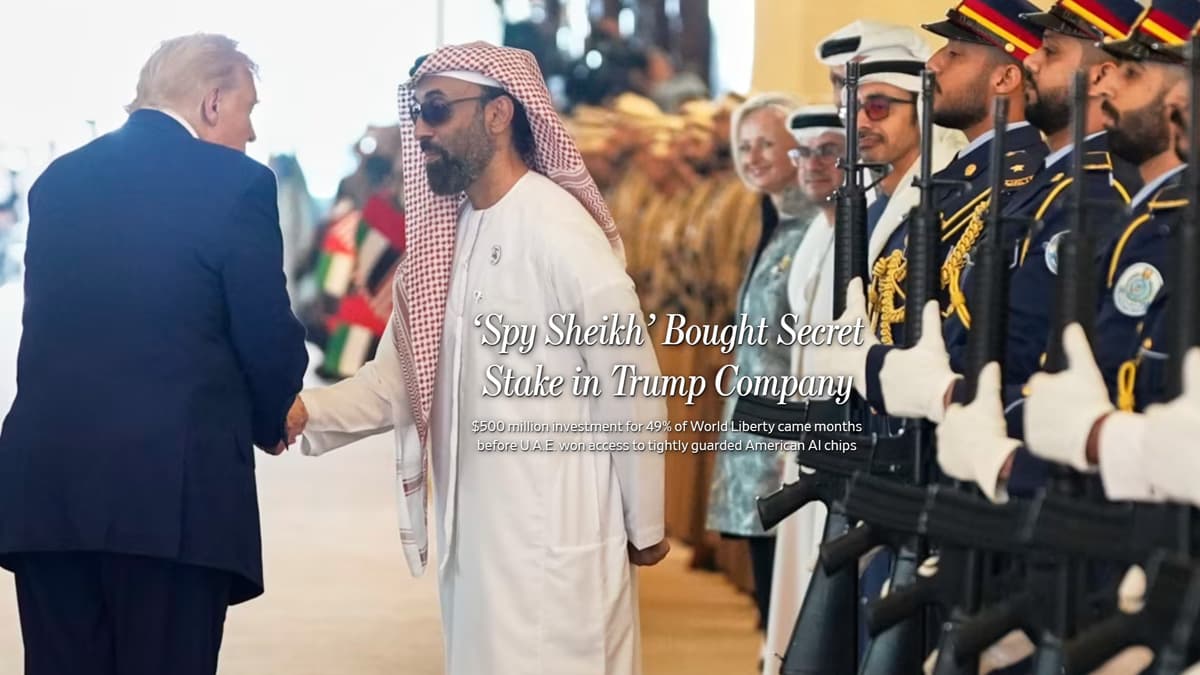
- A UAE royal-linked firm acquired a 49% stake in Donald Trump's cryptocurrency company, World Liberty Financial, days before his January 2025 inauguration.
- Months later, the Trump administration authorised the export of sensitive Nvidia AI chips to the UAE, reversing prior US policy.
- Ethics experts and Democratic lawmakers warn of a potential constitutional violation and conflict of interest, urging congressional investigation.
A major investment into Donald Trump’s cryptocurrency firm by a company linked to a senior Emirati royal just days before his 2025 inauguration is drawing renewed scrutiny after the administration approved the export of sensitive AI technologies to the United Arab Emirates.
According to The Wall Street Journal, which reviewed previously undisclosed documents, Aryam Investment—a firm tied to Sheikh Tahnoon bin Zayed Al Nahyan—acquired a 49% stake in World Liberty Financial for US$500 million on 16 January 2025, four days before Trump’s return to office.
Sheikh Tahnoon, the UAE’s national security adviser and brother of the Emirati president, also chairs MGX, a state-backed technology investment firm and one of World Liberty’s key partners.
Documents indicate that the Trump family received as much as US$187 million from the initial payment, with an additional US$31 million directed to co-founder Steve Witkoff, Trump’s envoy to the Middle East.
World Liberty Financial has since become one of the Trump family’s most profitable ventures.
ABC News previously reported that the firm generated a US$5 billion windfall upon launch of its digital token. While the investment itself was not publicly disclosed at the time, it preceded a significant policy reversal.
In May 2025, the Trump administration authorised the export of high-performance Nvidia AI chips to the UAE, which the prior administration had blocked over concerns the chips might ultimately benefit China.
MGX, which is chaired by Sheikh Tahnoon, announced shortly before the chip export approval that it would use World Liberty’s USD1 digital token to fund a US$2 billion investment into the crypto exchange Binance—an arrangement that further benefited the Trump-linked firm.
The White House has denied any connection between the investment and its AI export policy. David Warrington, White House counsel, told ABC News that President Trump “has no involvement in business deals that would implicate his constitutional responsibilities” and operates “in an ethically sound manner.”
World Liberty spokesperson David Wachsman echoed that sentiment, stating that Trump and Witkoff “had no involvement whatsoever” in the transaction and that any suggestion linking it to chip exports is “100% false.”
Nevertheless, ethics watchdogs and Democratic lawmakers have expressed grave concern. Donald Sherman, president of Citizens for Responsibility and Ethics in Washington, called the deal a “blatant, disgraceful conflict of interest” and possibly a violation of the Constitution’s Federal Emoluments Clause.
“This latest monetisation of the White House raises questions over whether US foreign policy is being shaped in the interests of the public or to benefit a foreign government padding the president’s finances,” Sherman added.
Government ethics rules typically require presidents to place their assets in blind trusts, operated by independent parties. Trump instead entrusted business control to his sons, Donald Trump Jr and Eric Trump—a move experts argue does not adequately prevent conflicts.
Richard Briffault, a Columbia Law School professor, described the arrangement as a “structural conflict of interest.”
“Even without a direct quid pro quo, there is no way to be certain that policy decisions weren’t influenced by financial ties,” Briffault told The Guardian.
Kedric Payne, ethics counsel at the Campaign Legal Center, added: “This is beyond unprecedented. No modern president has operated with this level of international business entanglement.”
Following the revelations, several Democratic senators condemned the transaction. Elizabeth Warren called the deal “corruption, plain and simple,” while Chris Van Hollen said it amounted to foreign bribery of the president.
Senator Chris Murphy described the arrangement as “mind-blowing corruption,” and urged congressional investigation. “Congress needs to grow a spine and put a stop to Trump’s crypto corruption,” Warren added in a statement.
Despite the backlash, the Trump administration continues to maintain that no ethical lines have been crossed. White House spokesperson Anna Kelly stated that “the president only acts in the best interests of the American public” and insisted that “there are no conflicts of interest.”
Still, concerns remain about the growing overlap between the Trump family’s business operations and foreign policy. Since returning to office, Trump has expanded his family’s business portfolio across digital media, nuclear energy, and now AI-related crypto ventures.
Photos circulated last year showed Donald Trump Jr, Eric Trump, and World Liberty CEO Zach Witkoff outside the Nasdaq building during the firm’s digital token debut in August 2025.
In March 2025, Trump hosted Sheikh Tahnoon and an Emirati delegation at the White House, describing the meeting as a celebration of “long-standing ties” between the two nations.
Critics argue that such interactions blur the lines between private interests and public duty—raising questions not just of legality, but of transparency and governance in a second Trump administration.
As debate over AI export policy intensifies, watchdogs say the ramifications of this deal go beyond a single transaction. “If China gets their hands on these chips,” warned Peter Wildeford of the AI Policy Network, “they could close the military technology gap that’s currently keeping us safe.”