Trump launches Board of Peace amid scepticism over rival to UN
Donald Trump launched a new Board of Peace at Davos, positioning it as a global conflict-resolution body. The move has drawn scepticism from allies and critics who fear it could rival the United Nations and reshape international diplomacy.
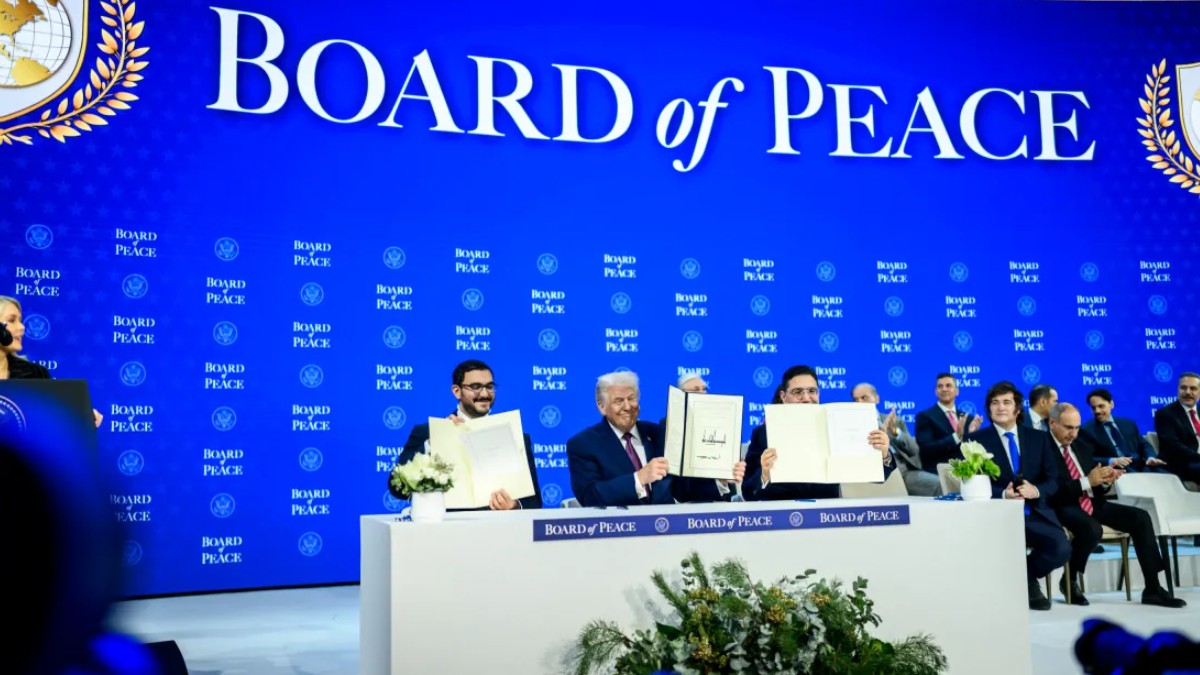
- Donald Trump unveiled a new Board of Peace at the World Economic Forum in Davos on 22 January 2026.
- The initiative has raised concerns it could undermine or rival the United Nations’ role in global conflict resolution.
- The board’s early focus on Gaza reconstruction has expanded into broader ambitions covering multiple international crises.
DAVOS, SWITZERLAND: US President Donald Trump unveiled his newly created Board of Peace in Davos on 22 January 2026, portraying it as a transformative body for resolving global conflicts.
The announcement was made during the World Economic Forum in Switzerland.
Trump cast himself once again as a global peacemaker, despite widespread scepticism from allies and observers.
Critics questioned whether the initiative could undermine the United Nations and disrupt established international diplomatic structures.
The launch ceremony featured leaders and senior officials from 19 countries signing the board’s founding charter.
Trump described the moment as historic, claiming the body could become “one of the most consequential ever created”.
The Board of Peace was initially conceived to oversee a truce in Gaza and coordinate post-war reconstruction following the conflict between Hamas and Israel. However, its remit has since expanded significantly.
According to the board’s 11-page charter, Gaza is not mentioned directly.
Trump nevertheless said the body could extend its work to “pretty much whatever we want to do”, suggesting ambitions far beyond its original scope.
Concerns over rivalry with UN
The shift has fuelled concerns that the initiative is intended as a rival to the United Nations.
Global conflict resolution has traditionally fallen within the UN’s mandate.
Trump attempted to address those concerns during his remarks.
He said the Board of Peace would work “in conjunction” with the United Nations and other international institutions.
“I’ve always said the United Nations has tremendous potential,” Trump said, adding that it had failed to fully realise its capabilities. His comments reflected long-standing criticism of the organisation.
The US president praised officials involved in brokering the Gaza ceasefire. “We have peace in the Middle East. Nobody thought that was possible,” he said, without elaborating on long-term arrangements.
He added that success in Gaza would allow the board to expand into other global crises. Observers noted the statement reinforced fears of institutional overlap with the UN.
The Board of Peace will be chaired by Trump himself.
A founding executive council has been established to guide its work and strategic direction.
Members of the council include US Secretary of State Marco Rubio, Jared Kushner, former UK prime minister Tony Blair, and US envoy Steve Witkoff. Also included are Robert Gabriel, Ajay Banga and Apollo Global Management chief executive Marc Rowan.
25 countries have reportedly agreed to join
Reports have suggested that countries were asked to contribute US$1 billion for permanent membership. US officials said contributions were voluntary but expected for Gaza reconstruction efforts.
Foreign ministers from Pakistan, Egypt, Jordan, the United Arab Emirates, Indonesia, Turkiye, Saudi Arabia and Qatar confirmed their participation in a joint statement issued on Wednesday. Kuwait also accepted the invitation.
Other participating states include Morocco, Argentina, Hungary, Armenia, Bahrain, Kazakhstan, Kosovo, Uzbekistan, Vietnam and Belarus. In total, around 25 countries have reportedly agreed to join.
China, India, Japan, Thailand and many European nations have yet to respond. Invitations were reportedly sent to between 50 and 60 countries.
The United Kingdom declined to sign on, according to British Foreign Secretary Yvette Cooper. France, Norway, Sweden and Slovenia have also opted out.
Singapore said on 20 Jan that it is reviewing a US invitation to join Trump’s “Board of Peace.”
Putin invite sparks backlash
The invitation extended to Russia’s President Vladimir Putin has generated controversy. Trump said Putin had agreed to join, though the Russian leader stated he was still reviewing the proposal.
During the ceremony, significant attention was devoted to Gaza’s future. Gaza’s newly appointed administrator announced that the Rafah border crossing would reopen in both directions next week.
Jared Kushner presented a reconstruction “master plan” for Gaza. The proposal featured new settlements, seafront hotels and residential developments under the title “New Gaza”.
“It could be a hope. It could be a destination,” Kushner said, describing Gaza as an opportunity for redevelopment after years of conflict.
Trump issues Hamas disarm ultimatum, signals openness to talks with Iran
Trump warned Hamas to disarm under the next phase of the ceasefire or face what he described as “the end of them”.
He also said he was prepared to engage in talks with Iran.
Israeli Prime Minister Benjamin Netanyahu had indicated he would attend but was absent. Netanyahu is facing an International Criminal Court arrest warrant related to the Gaza conflict.
Among those on stage were Hungary’s Viktor Orban and Argentina’s Javier Milei, both close populist allies of Trump. Several Middle Eastern monarchies were also represented.
Trump joked about the popularity of the attending leaders, saying some were “very popular” while others were “not so popular”. He predicted eventual membership of around 50 countries.
Board of Peace signatories on 22 January 2026
-
Argentina: President Javier Milei
-
Armenia: Prime Minister Nikol Pashinyan
-
Azerbaijan: President Ilham Aliyev
-
Bahrain: Sheikh Isa bin Salman Al Khalifa
-
Bulgaria: Prime Minister Rosen Zhelyazkov (caretaker)
-
Hungary: Prime Minister Viktor Orban
-
Indonesia: President Prabowo Subianto
-
Jordan: Deputy Prime Minister Ayman Safadi
-
Kazakhstan: President Kassym-Jomart Tokayev
-
Kosovo: President Vjosa Osmani
-
Mongolia: Prime Minister Gombojavyn Zandanshatar
-
Morocco: Foreign Minister Nasser Bourita
-
Pakistan: Prime Minister Shehbaz Sharif
-
Paraguay: President Santiago Pena
-
Qatar: Prime Minister Sheikh Mohammed bin Abdul Rahman Al Thani
-
Saudi Arabia: Foreign Minister Faisal bin Farhan Al-Saud
-
Turkey: Foreign Minister Hakan Fidan
-
United Arab Emirates: Khaldoon Al Mubarak
-
Uzbekistan: President Shavkat Miromonovich Mirziyoyev