Thailand and Cambodia sign ceasefire in Chanthaburi after renewed border clashes
Thailand and Cambodia have agreed to a new ceasefire during talks in Chanthaburi, ending 20 days of deadly clashes and committing to a 72-hour pause monitored by ASEAN observers. The truce includes the return of 18 Cambodian prisoners of war.
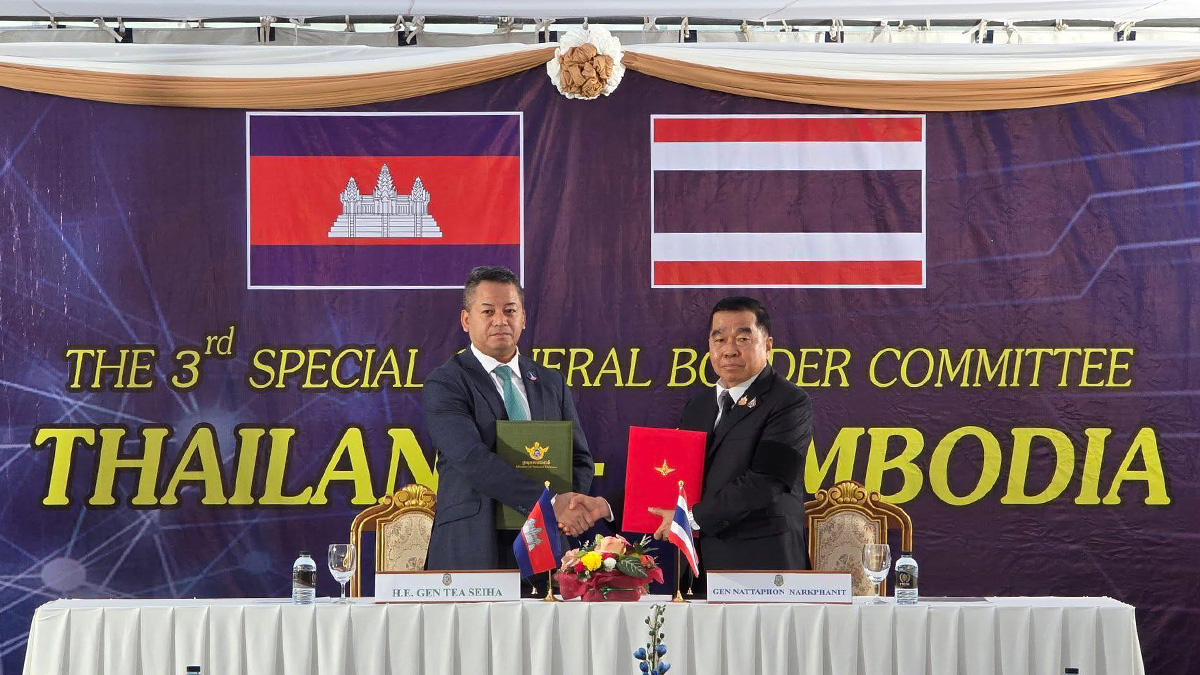
- Thailand and Cambodia signed a ceasefire agreement on 27 December 2025 in Chanthaburi, tied to the repatriation of 18 Cambodian soldiers.
- The agreement followed 20 days of deadly clashes, resulting in over 100 deaths and mass displacement.
- ASEAN observers will monitor compliance under the Kuala Lumpur arrangement, with a 72-hour pause taking effect at 12 PM.
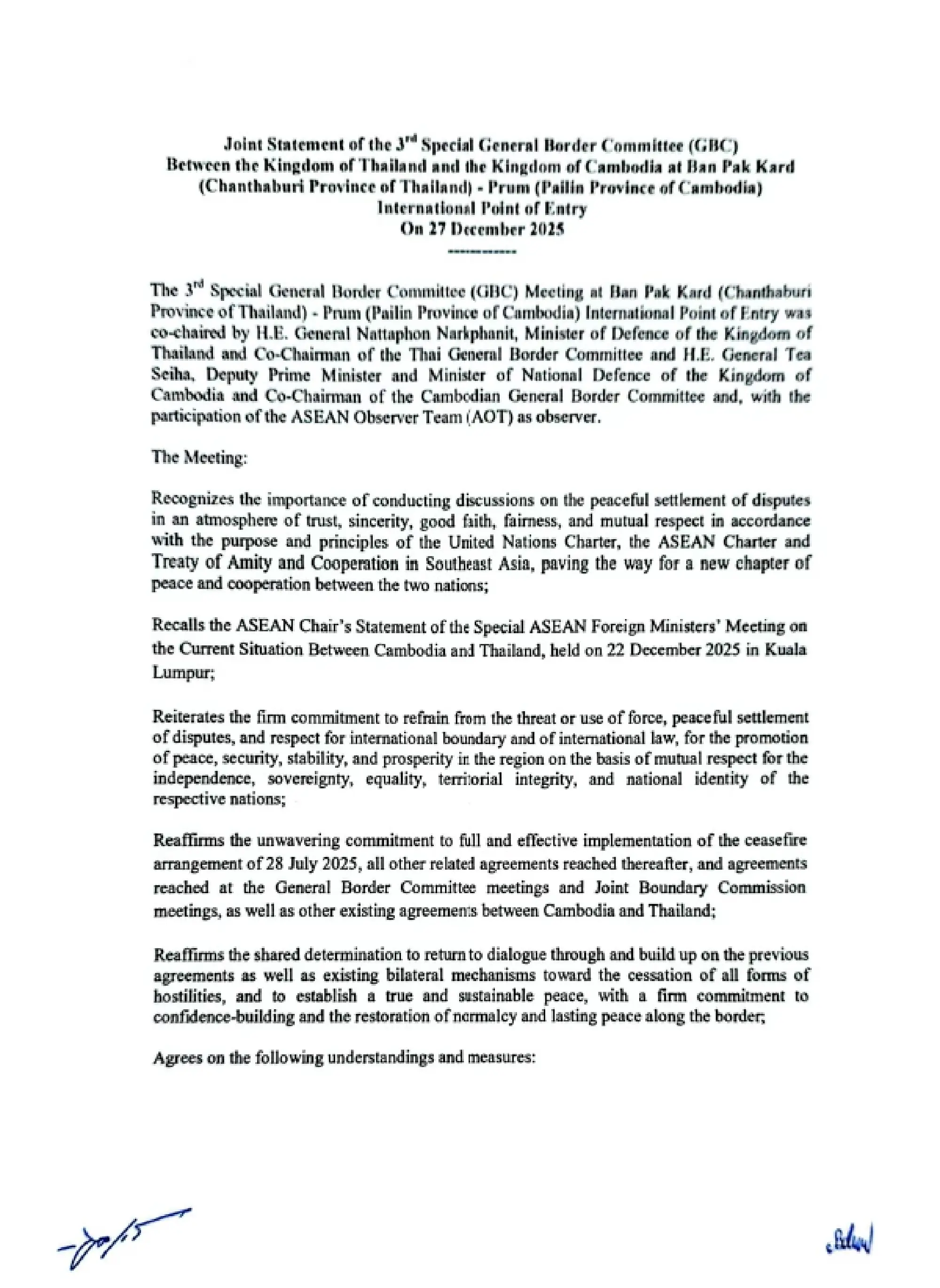
Thailand and Cambodia signed a ceasefire agreement on 27 December 2025 at the Ban Phak Khat permanent border checkpoint in Pong Nam Ron district, Chanthaburi province, following renewed hostilities along their shared border.
The agreement was formalised by Thailand’s Defence Minister Gen Natthaphon Narkphanit and Cambodia’s Deputy Prime Minister and Defence Minister Gen Tea Seiha during a meeting of the Thai-Cambodian General Border Committee (GBC), attended by senior military officials from both countries.
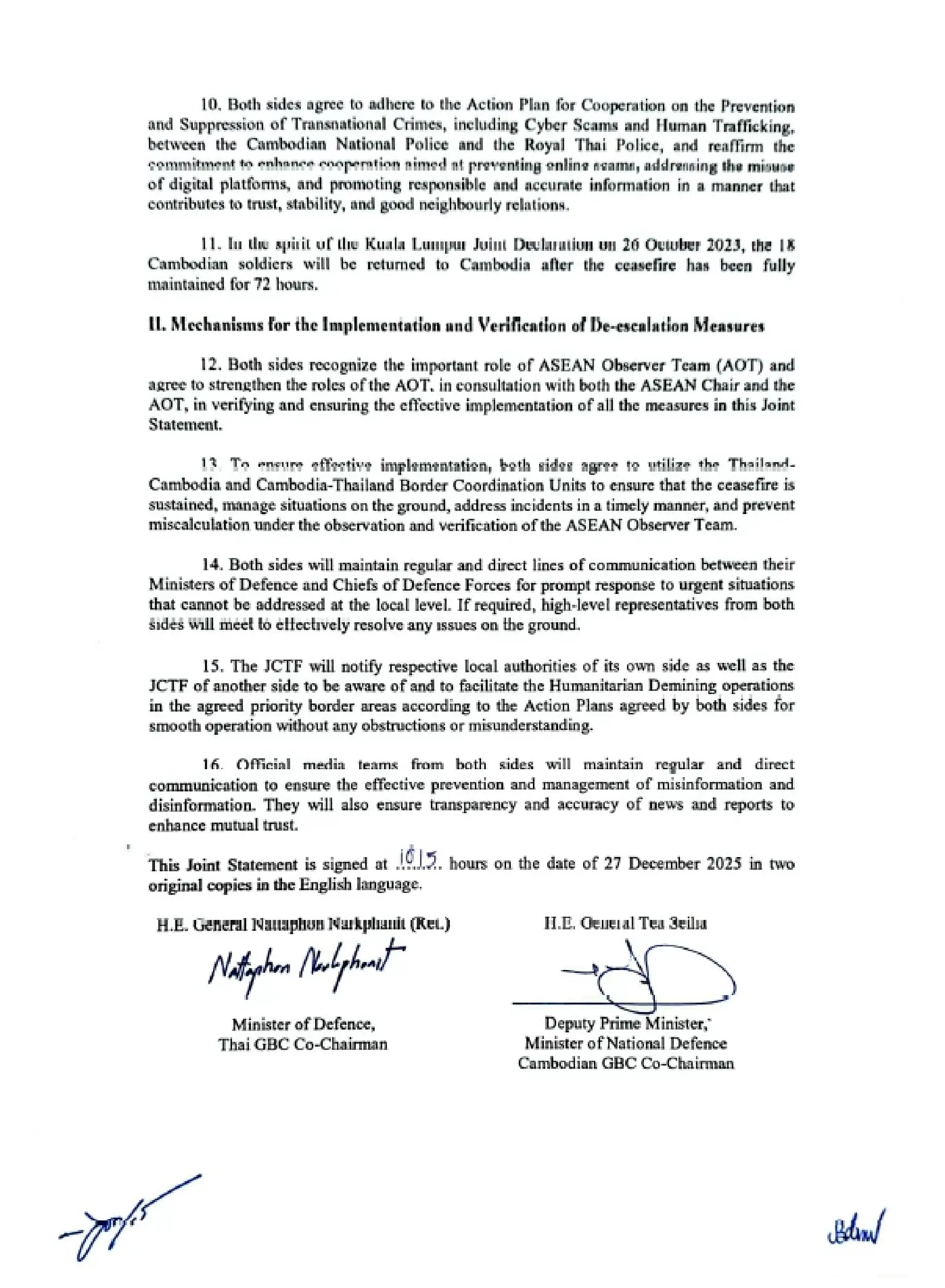
The ceasefire, set to take effect at 12.00 PM local time on the same day, was signed at approximately 10.15 AM. It follows Cambodia’s acceptance of the full terms set out in the Kuala Lumpur arrangement agreed on 26 October 2025.
A core condition of the agreement involves the return of 18 Cambodian soldiers held as prisoners of war. Cambodia agreed to observe a 72-hour ceasefire in exchange for their release, as previously discussed at the secretary-level talks.
The agreement also ends 20 days of cross-border clashes, which have resulted in at least 101 confirmed deaths and displaced more than 500,000 people across both nations. These latest hostilities began in early December after the collapse of a prior ceasefire, originally brokered by then-US President Donald Trump in July 2025.
According to Cambodia’s Ministry of National Defence, the agreement reaffirms both nations’ commitments to restoring peace, stability, and cooperation along the border, with the ceasefire being a critical first step in preventing further escalation.
An ASEAN Observer Team (AOT), led by Brig Gen Samsul Rizal bin Musa, Malaysia’s Assistant Defence Attaché to Thailand, was present to monitor the discussions and will oversee implementation of the ceasefire measures.
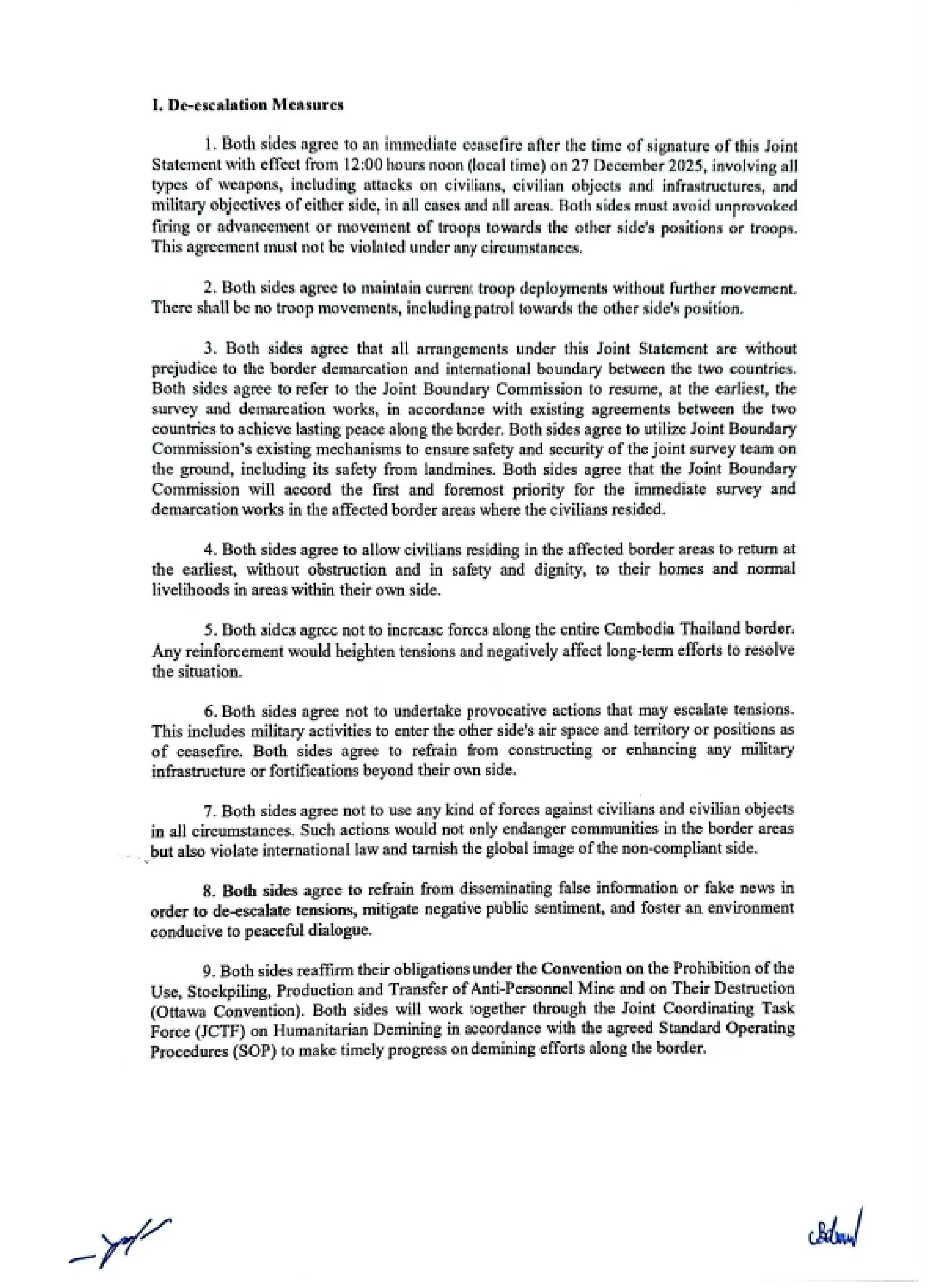
The joint statement sets out detailed de-escalation measures, including:
-
Immediate cessation of all hostilities involving any type of weapon
-
No movement or rotation of troops during the ceasefire
-
Return of displaced civilians to their homes in safety and dignity
-
Refraining from provocative actions and dissemination of misinformation
-
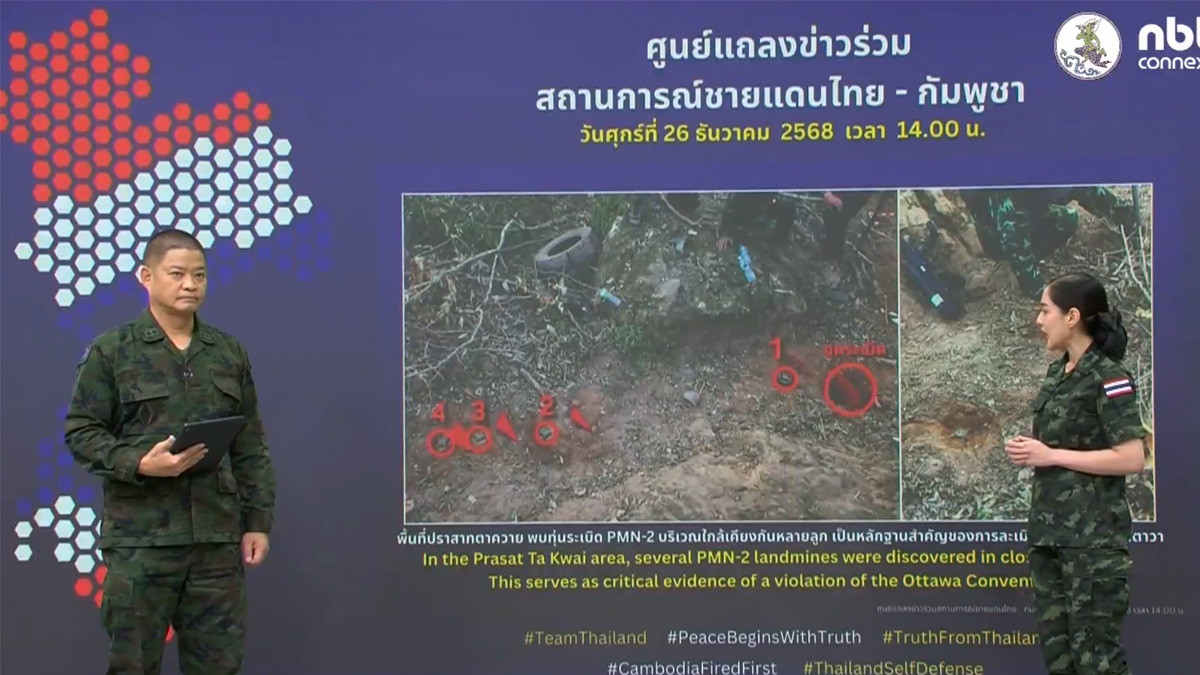
Strict adherence to humanitarian demining protocols under the Ottawa Convention
Additionally, both parties reaffirmed their respect for the existing international boundary and agreed to resume border demarcation under the Joint Boundary Commission, prioritising areas where civilians previously resided.
The agreement also calls for continuous communication between the defence ministries and chiefs of defence forces to prevent further miscalculations, along with enhanced media cooperation to combat disinformation.
Speaking to reporters after the agreement was signed, Gen Natthaphon noted that Cambodia had accepted all four key provisions agreed in Kuala Lumpur. He also stressed that the ceasefire is conditional on the full implementation of those points, including the safe return of prisoners.
However, Thai Prime Minister Anutin Charnvirakul, speaking the day before the agreement, warned that Thailand would not accept any reversion to pre-conflict territorial positions. “Thailand cannot retreat from secured areas,” he said, reiterating the government's stance following a rocket attack on Ban Nong Chan in Surin province that killed three Thai soldiers and injured 17 others.
The joint statement explicitly reaffirms the commitment to non-violence, mutual respect for sovereignty and international law, and peaceful settlement of disputes through dialogue, in line with ASEAN principles and the UN Charter.
It also calls for enhanced ASEAN observer roles and stronger coordination through the Joint Coordinating Task Force (JCTF) to oversee demining efforts, including progress under agreed Standard Operating Procedures (SOP).
The success of the ceasefire is expected to be closely watched by regional stakeholders, especially given the scale of recent violence and displacement.
No timeline has been provided for the resumption of long-term peace talks, though both sides agreed to continue cooperation through existing GBC and bilateral mechanisms.