Thailand–Cambodia GBC talks stall on third day as ceasefire terms remain rejected
Talks between Thailand and Cambodia under the General Border Committee entered a third day without progress, as Cambodia continued to reject Thailand’s three key conditions for a ceasefire.
- Cambodia continued to reject Thailand’s three conditions for a ceasefire during GBC talks.
- Thai PM Anutin called a National Security Council meeting to discuss next steps.
- Over 100 homes and nearly 1,000 hectares of farmland were damaged by shelling.
The secretary-level talks between Thailand and Cambodia under the General Border Committee (GBC) entered a third day on 26 December, 2025, without any signs of progress.
The discussions, taking place at the Immigration Bureau office at Ban Phakkad permanent border checkpoint in Chanthaburi, have so far failed to yield consensus.
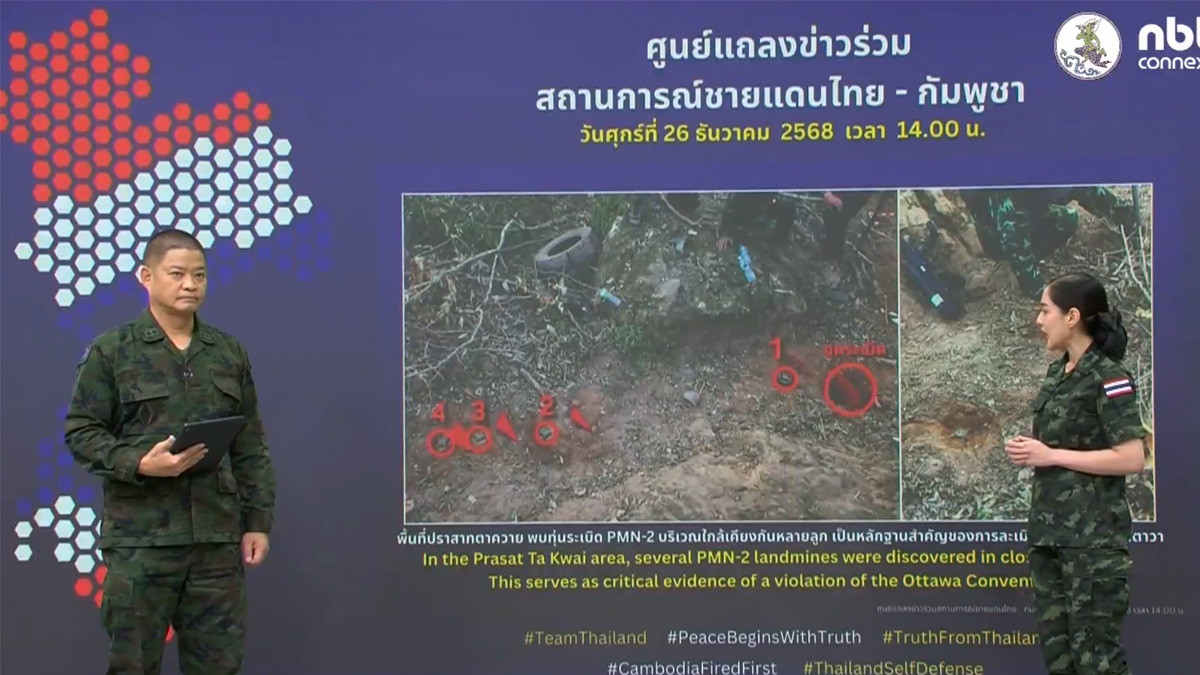
Thailand continues to insist on three conditions for any ceasefire with Cambodia: that Cambodia announce a ceasefire first, that the ceasefire be genuine and continuous, and that Cambodia cooperate in good faith on demining.
Cambodia has rejected all three conditions and offered a counterproposal.
The talks are being observed by the ASEAN Observer Team (AOT) from Malaysia, which is based in Thailand.
Stalled progress despite prolonged sessions
On 24 December, the first day of talks, the meeting lasted only 30 minutes. Thailand submitted its three conditions and awaited a response.
On 25 December, Cambodia submitted a counterproposal. However, multiple delays followed. The afternoon session was postponed twice, and a final evening session began at 7.40pm, marked by tense expressions from the Cambodian delegation.
Despite extended discussions, Cambodia maintained its refusal to accept Thailand’s preconditions.
The Thai delegation, led by Gen Nattapong Praokaew, Deputy Chief of Staff at the Royal Thai Armed Forces Headquarters, has stood firm on the original proposals.
The Cambodian side is headed by Maj Gen Nhem Boraden.
PM Anutin calls National Security Council meeting
As the stalemate continued, Prime Minister Anutin Charnvirakul, who also serves as Interior Minister, called a meeting of the National Security Council (NSC) at 3.00pm on 26 December.
The meeting was expected to include senior officials from the Foreign Ministry, Defence Ministry, and the armed forces.
The purpose was to determine Thailand’s course of action if Cambodia continues to reject its demands.
Earlier, Defence Minister Gen Natthaphon Narkphanit stated that Thailand would not attend further GBC meetings or sign any agreement if the current proposals were not accepted.
Cambodian Prime Minister appeals to the United States
Cambodian Prime Minister Hun Manet announced on social media that he had spoken with US Secretary of State Marco Rubio the night before.
According to Hun Manet, he requested US assistance in pushing for an immediate ceasefire and the implementation of a peace agreement.
He quoted Rubio as stating that the United States wishes to see sustainable peace and is willing to help facilitate a ceasefire.
There has been no independent confirmation from the US State Department on the conversation at this time.
Rising damage and humanitarian concern
As diplomatic efforts stalled, the impact of the conflict on civilians continued to escalate.
Thailand’s First Army Region reported that 112 houses in Khon Sung and Ta Phraya districts in Sa Kaeo province have been destroyed or heavily damaged by Cambodian shelling between 8 and 26 December.
Approximately 960 hectares of farmland have also been affected. Public utilities have sustained damage, although details remain limited.
The Thai army stated that the attacks on civilian targets reflected Cambodia’s lack of sincerity in resolving the conflict and demonstrated a disregard for humanitarian norms.
Future of talks uncertain
A final round of GBC talks is expected on 27 December. However, Defence Minister Natthaphon has indicated he will not attend if Cambodia maintains its current stance.
No agreement has yet been reached on how to de-escalate the situation, and the risk of further cross-border incidents remains high.
The coming days will likely determine whether diplomatic or military paths take precedence in resolving this growing border crisis.