Radio Free Asia resumes China broadcasts after private transmission deal
Radio Free Asia has restarted Mandarin, Tibetan and Uyghur broadcasts into China using privately contracted transmission services, after funding cuts last year forced it to scale back. Its CEO said stable congressional funding is still needed to rebuild.
- RFA says it has resumed broadcasts to China in Mandarin, Tibetan and Uyghur, using privately contracted transmission services.
- The restart follows a disruption last year after USAGM grants were terminated, triggering layoffs and reduced operations.
- A new US spending law provides US$653 million for USAGM, but RFA says predictable funding is still needed to rebuild.
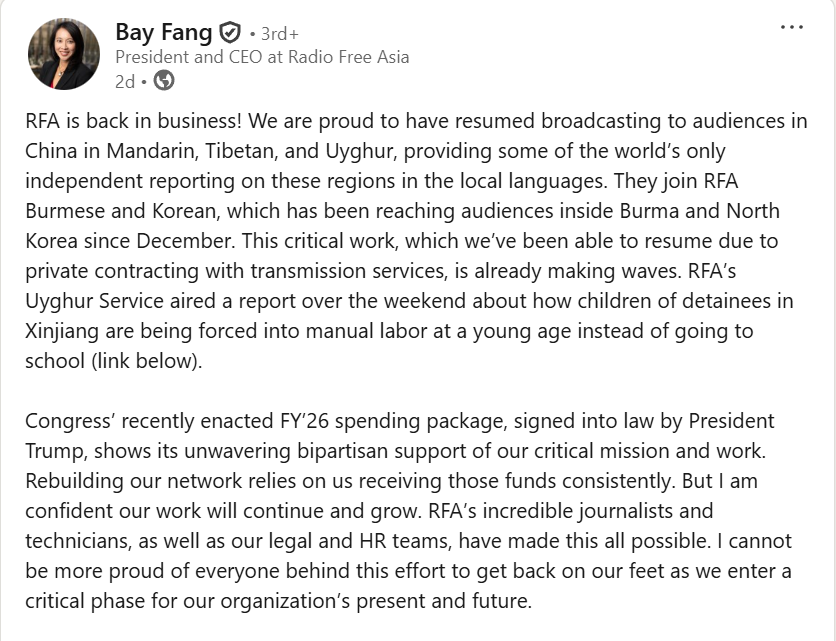
Radio Free Asia has resumed broadcasts into China in Mandarin, Tibetan and Uyghur, its president and chief executive, Bay Fang, said on Tuesday, after earlier funding cuts forced the outlet to cease operations.
Fang said the return would restore some of the only independent reporting available in local languages for audiences in regions where media is heavily restricted.
She said the resumption was possible because the organisation privately contracted transmission services, though she did not name providers or give operational details.
RFA and sister outlets such as Voice of America have traditionally relied on funding approved by the US Congress and administered through the US Agency for Global Media, which oversees several US international broadcasters.
The broadcasts were disrupted last year after the Trump administration moved to end grants for RFA and other outlets, with USAGM’s then-acting leadership alleging waste of taxpayer funds and anti-Trump bias.
The move drew criticism from lawmakers, press-freedom advocates and rights groups, who argued it weakened Washington’s ability to reach audiences in tightly controlled information environments while rivals, including China, expand their overseas media influence.
Fang said rebuilding the broader network would depend on the consistent receipt of newly approved congressional funding, suggesting the private transmission arrangement is a stopgap rather than a full restoration.
A bipartisan spending law signed by President Donald Trump earlier this month included US$653 million for USAGM, down from the US$867 million appropriated in each of the previous two years, but above the US$153 million the administration had sought as part of a push to shut the agency.
US lawmakers from both major parties have said efforts to dismantle the outlets diminish US influence abroad at a time when Beijing is expanding its own reach.
China’s embassy in Washington declined to comment on the operational changes, describing the matter as US domestic policy, but accused RFA of anti-China bias and of spreading falsehoods about China-related issues.
RFA spokesman Rohit Mahajan said the outlet had also contracted private companies to transmit programming to audiences in Tibet, North Korea and Myanmar.
He said the outlet’s Mandarin audio output is currently online only, with the intention of resuming regular over-the-air broadcasts soon.
Mahajan added that Tibetan, Uyghur, Korean and Burmese programming is airing over short- and medium-wave frequencies, while previous satellite transmissions routed via USAGM have not yet resumed.
Rights activists have long argued that RFA reporting has drawn attention to alleged abuses in China and other authoritarian states, including the treatment of oppressed minorities such as Uighur Muslims, while Chinese state media praised last year’s cuts.