Bulgarian government resigns after mass protests ahead of eurozone entry
Prime Minister Rosen Zhelyazkov's centre-right minority government resigned on 11 December, 2025, after nationwide protests against corruption and political influence. The decision precedes Bulgaria’s planned eurozone accession on 1 January, 2026.
- Prime Minister Rosen Zhelyazkov’s government resigned on 11 December, 2025, following mass protests across Bulgaria.
- Demonstrations were driven by anger over corruption and the influence of sanctioned oligarch Delyan Peevski.
- The resignation comes just weeks before Bulgaria is set to adopt the euro on 1 January, 2026.
On 11 December, 2025, Bulgarian Prime Minister Rosen Zhelyazkov announced the resignation of his government following mass protests across the country.
The decision was made just minutes before a scheduled parliamentary vote of no confidence and three weeks ahead of Bulgaria’s planned entry into the eurozone on 1 January, 2026.
Zhelyazkov, whose centre-right GERB-led minority coalition had governed since January, stated, “We hear the voice of the citizens. We must rise to the demands,” during an extraordinary session in the National Assembly.
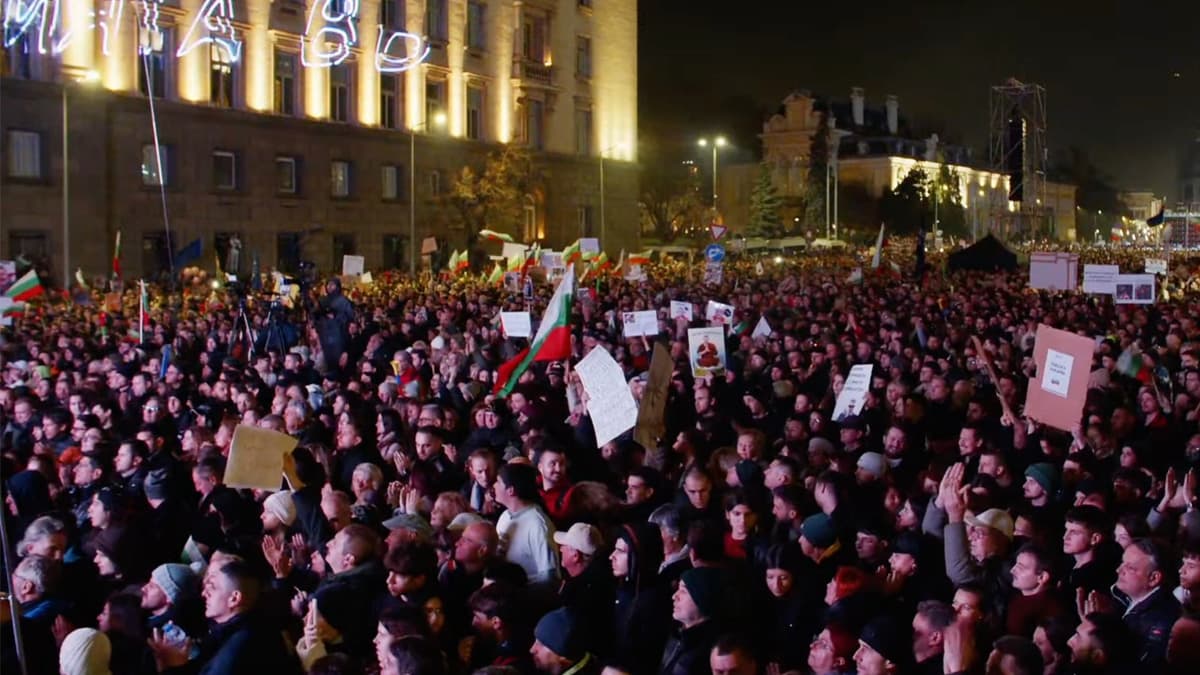
His statement followed a night of demonstrations on 10 December, where more than 100,000 people gathered in central Sofia, according to media drone estimates. Organisers claimed the number exceeded 150,000 nationwide, with protests also held in over 25 major cities including Plovdiv, Varna, and Burgas.
Protesters demanded the resignation of the government, fair elections, and an end to political corruption. Students from Sofia’s universities joined the rallies, highlighting widespread discontent across age groups.
The immediate trigger was the government’s now-withdrawn 2026 draft budget, which proposed higher taxes, increased social security contributions, and higher public spending. However, public anger soon shifted towards deeper issues, particularly the alleged influence of oligarch Delyan Peevski on government decisions.
Peevski, a key figure in the Movement for Rights and Freedoms (DPS), has long been accused of wielding outsized power behind the scenes. Although DPS is not formally part of the ruling coalition, its parliamentary support has been vital to the government’s legislative success.
In June 2021, Peevski was sanctioned by the United States under the Global Magnitsky Act for corruption, including alleged bribery and influence peddling. The UK followed suit in 2023, reinforcing international concerns about his role in Bulgarian politics.
Critics argue that Peevski shapes national policy to favour oligarchic interests, with opponents pointing to longstanding links between him and GERB leader Boyko Borissov. Borissov, a former prime minister who resigned following anti-corruption protests in both 2013 and 2021, continues to exert significant political influence.
During the protests in Sofia, activists used laser projections to display the words “Resignation”, “Mafia Out”, and “For Fair Elections” onto the parliament building. Symbolic props such as a yellow sofa labelled “Divan, Divan” were used to criticise Peevski and his allies.
In Burgas, nearly 10,000 people gathered outside the municipality building, while protests abroad took place in Brussels, London, Vienna, Zurich, Berlin, and New York, showing the international reach of Bulgarian civil discontent.
The protests remained largely peaceful, although 57 individuals were detained in Sofia. Police stated that a group of provocateurs was responsible for disturbances near the DPS headquarters, with large sums of money found on several detainees.
President Rumen Radev, a vocal critic of the government, described the demonstrations as a “vote of no confidence in the cabinet.” He called on lawmakers to “listen to the people” and act with integrity.
Opposition leader Assen Vassilev of the We Continue the Change – Democratic Bulgaria (WCC–DB) coalition welcomed the resignation, calling it “the first step in making Bulgaria a normal European state.” He stressed the need for transparent elections, free from manipulation.
Zhelyazkov’s administration had previously survived six no-confidence votes. However, the sheer scale of the latest protests marked a shift in the political landscape.
The formal resignation will be submitted to parliament on 12 December. Following this, President Radev will begin the process of attempting to form a new government by offering the mandate to the largest parliamentary group. If that fails, the second-largest will be invited to try.
If all attempts are unsuccessful, which analysts consider likely given the fragmented state of Bulgaria’s legislature, a caretaker government will be appointed ahead of fresh elections. This would mark the country’s eighth general election since 2021.
As Bulgaria prepares to join the eurozone on 1 January, concerns remain over public scepticism. A Finance Ministry survey in June 2025 showed that 46.8% of Bulgarians opposed adopting the euro, while 46.5% supported the move.
Analysts suggest that unless a stable and transparent government can be formed, Bulgaria’s integration into the eurozone may face renewed political friction.