Farmers disrupt Brussels as protests target EU-Mercosur trade deal and agricultural reforms
Thousands of farmers protested in Brussels on 18 December 2025, opposing EU agricultural policies and the proposed EU-Mercosur trade deal. The demonstration caused widespread traffic and public transport disruptions, and was marked by clashes with police and acts of vandalism.
- Over 10,000 farmers protested in Brussels, targeting EU agricultural reforms and the Mercosur trade agreement.
- The demonstration caused significant disruptions, with roads blocked, metro access limited, and clashes reported near EU summit venues.
- Farmers demand fair trade rules, citing unequal standards and threats to the European agricultural sector.
BELGIUM: Traffic in central Brussels came to a standstill on 18 December 2025 as more than 10,000 farmers from across the European Union protested against the EU’s agricultural policies and a proposed trade agreement with Mercosur countries.
The demonstration, which coincided with a key EU summit, began near Brussels North Station and extended toward Place du Luxembourg. Despite a formal dispersal around 1.45pm, hundreds of protesters continued toward the European Quarter, resulting in isolated clashes with police and reports of vandalism.
Heavy disruption across the capital
The protest caused significant traffic delays. Major roads including Rue de la Loi, Avenue du Régent and Boulevard Roi Albert II were closed. Tunnels such as Reyers-Centre, Trône and Botanique were also shut.
Public transport was severely disrupted. Brussels transport operator STIB/MIVB closed metro station entrances and diverted multiple bus and tram lines. As of mid-day, tram lines 39, 44 and 81 had resumed normal service, though disruptions in the European Quarter continued.
Police urged residents to work from home if possible and avoid using cars in the city.
Anger over trade pact and policy reforms
The protest was triggered by mounting frustration with the EU-Mercosur trade deal, which would eliminate tariffs on goods traded between the EU and five South American nations—Brazil, Argentina, Uruguay, Paraguay, and Bolivia—over 15 years.
Farmers argue that the agreement would permit imports from countries with weaker environmental and labour standards, threatening the competitiveness and viability of EU agricultural production.
"We have a lot of rules to respect and they are not respecting, and yet (the EU) is willing to import more," one farmer told Euronews.
A joint statement from nine agri-food groups stated that the current safeguards in the proposed deal “remain insufficient to prevent market disruptions” and fail to provide “a genuine level playing field” for EU producers.
Police and protester confrontations
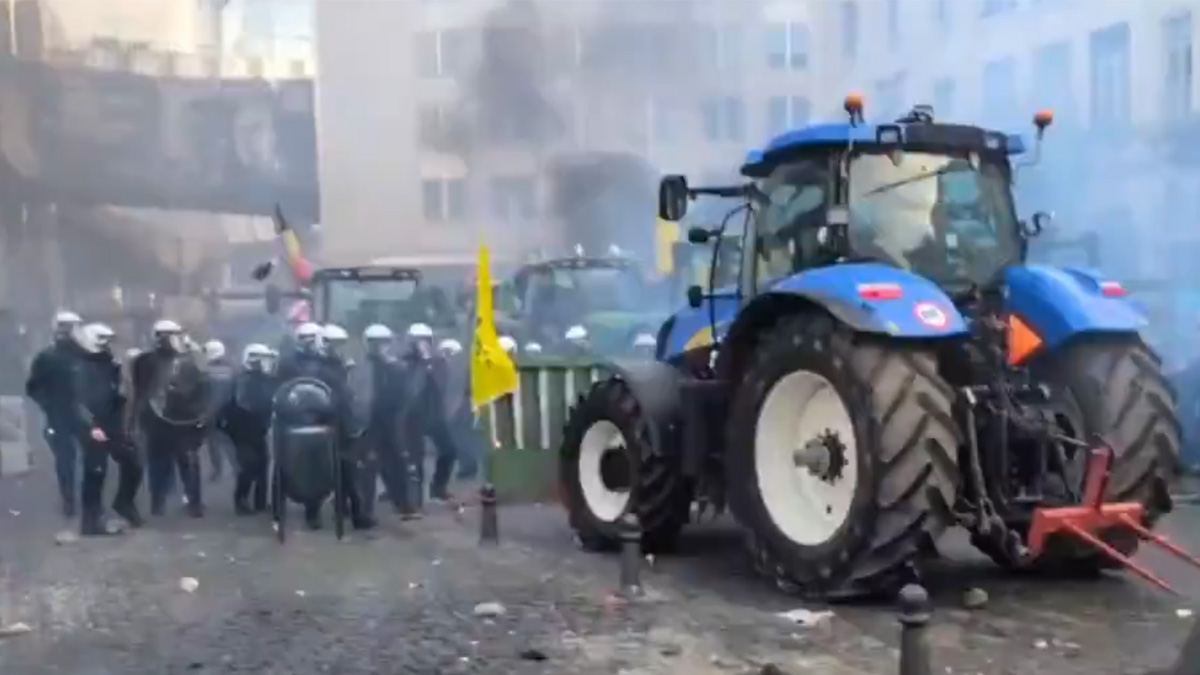
The protest escalated in parts of the city, with some farmers hurling potatoes and eggs, and blocking roads with tractors. Police deployed water cannons and tear gas to manage the crowds near the Europa building, where EU leaders were convening.
Visuals from the day showed fires near Place du Luxembourg and significant property damage, though organisers had not initially planned blockades on the Brussels ring road. Nonetheless, about 100 tractors were reported blocking traffic near Sint-Stevens-Woluwe.
A controversial deal amid political divisions
The EU-Mercosur agreement has been under negotiation for over two decades and would affect a combined market of 780 million people. Supporters argue it would reduce dependence on Chinese exports and US tariffs, and boost EU trade credibility.
However, opposition is growing. Italy joined France in rejecting the deal as premature. Italian Prime Minister Giorgia Meloni demanded reciprocal guarantees for EU farmers. French President Emmanuel Macron echoed similar concerns, stating the deal “doesn't add up” and calling for further negotiations in January.
European Commission President Ursula von der Leyen and European Council President António Costa remain scheduled to sign the agreement in Brazil this weekend, despite the pushback. Von der Leyen emphasised the need to "get the green light for Mercosur" to avoid over-dependence on global powers.
Geopolitical implications and internal Mercosur tensions
While the EU remains divided, Mercosur leaders are pushing forward. Brazilian President Luiz Inácio Lula da Silva, who will host the summit in Brazil, has made the deal a diplomatic priority ahead of upcoming elections.
Argentinian President Javier Milei, a libertarian aligned with former US President Donald Trump, also supports the deal. He called for Mercosur to be used as a “spear” to access global markets rather than a shield from competition.
Uruguay’s finance minister Gabriel Oddone expressed optimism that the agreement would still be signed this Saturday.