Swiss voters overwhelmingly reject tax on large inheritances and compulsory national service for women
Swiss voters have decisively rejected proposals for a 50% tax on large inheritances and the extension of compulsory national service to women, with both referendums failing to gain significant support.
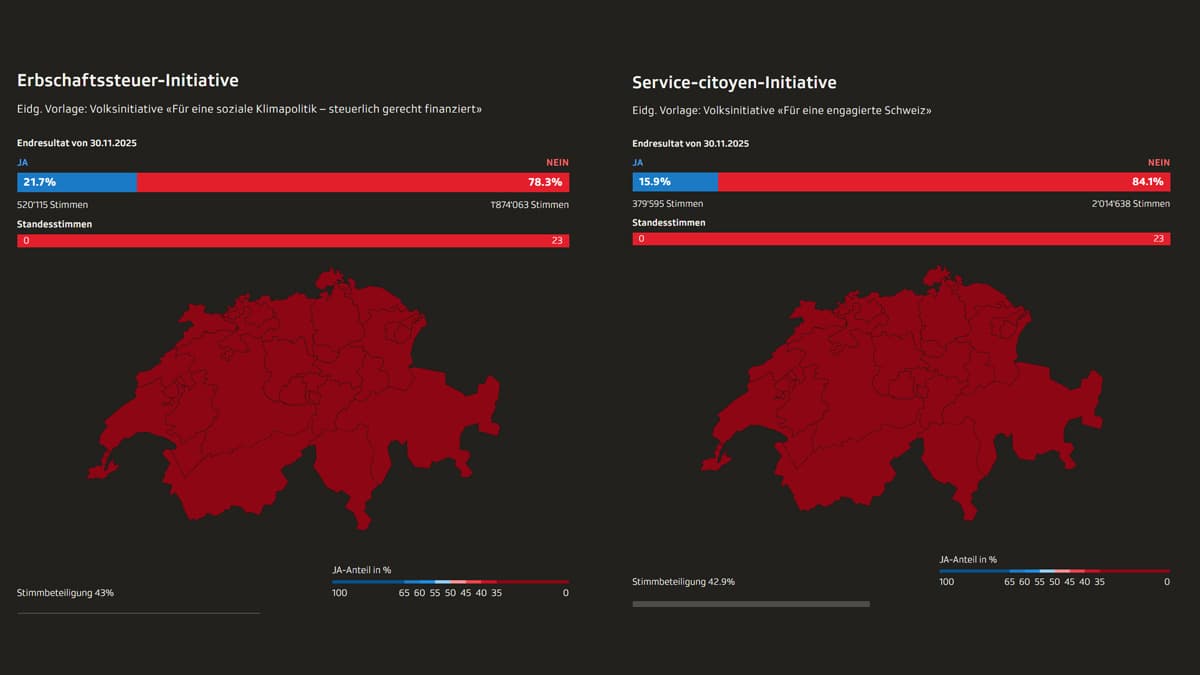
- 79% of Swiss voters opposed a proposed 50% inheritance tax on fortunes above CHF 50 million.
- 84% rejected an initiative to expand compulsory national service to include women.
- Both proposals failed to gain support from major political parties or the Swiss federal government.
In a national referendum held on Sunday (30 Nov), Swiss voters resoundingly rejected two initiatives—one proposing a 50% tax on ultra-wealthy inheritances and the other aiming to extend compulsory national service to women.
Initial results showed around 79% of voters were against the tax initiative, while 84% opposed the national service expansion. These outcomes surpassed the already significant opposition projected in pre-vote polling.
The inheritance tax proposal was spearheaded by the youth wing of the Social Democratic Party (Juso), targeting wealth transfers above CHF 50 million (approximately €53.5 million or US$62 million). The revenue, according to the proposal, would have been allocated to climate change mitigation projects. Campaign materials featured the slogan: “The ultra-rich inherit billions, we inherit crises.”
The tax would have impacted an estimated 2,500 individuals. Despite this narrow scope, critics raised concerns about economic consequences, including the potential exodus of high-net-worth individuals from Switzerland. The federal government also opposed the measure, warning that it would undermine Switzerland’s economic competitiveness and tax policy stability.
Business groups and legal experts warned the proposal could discourage investment and complicate succession planning for family-owned firms. Peter Spuhler, owner of Stadler Rail, called the initiative “a disaster for Switzerland.”
The proposal’s initial design included retroactive taxation, which further intensified opposition from business associations and tax professionals. Although this clause was later softened, the damage to public perception had already been done.
The second failed initiative, titled “For a committed Switzerland,” sought to expand mandatory national service beyond men to include women, and to offer alternative social service paths such as environmental protection, support for vulnerable populations, and disaster prevention.
The initiative was led by the Geneva-based association servicecitoyen.ch and backed by over 107,000 petition signatures. It received support from a mix of political groups including the Liberal Greens, Evangelical Party, Pirate Party, and youth wing of the Centre Party. However, it failed to attract support from major federal parties or the broader electorate.
Currently, Swiss law mandates military or civil defence service for men, with women permitted to volunteer. Around 35,000 men fulfil this obligation annually. Those refusing all forms of service pay a substitute fee.
Supporters of the proposal argued that expanding service obligations would promote gender equality and improve Switzerland’s resilience to challenges like natural disasters, cyber threats, and geopolitical instability. Noémie Roten, a prominent advocate, stated that universal service would “strengthen Switzerland’s security and cohesion.”
However, a broad alliance of political parties across the spectrum opposed the initiative, citing concerns over cost, potential labour market disruption, and the burden placed on women, who already contribute disproportionately to unpaid care work. As a result, the proposal failed to reach 20% support in most cantons.
The outcome of both referendums reinforces Switzerland’s traditionally cautious approach to structural reforms involving wealth redistribution and national obligations. It also reflects the strength of its direct democratic system, which enables citizens to influence national policy directly, albeit often conservatively.
Referenda are a regular feature of Swiss political life. Since the adoption of the optional referendum in 1874, more than 200 such votes have been held. About 40% of these proposals have been rejected, underscoring the challenge of securing broad national consensus for major policy shifts.
In the aftermath of this referendum round, attention now turns to future proposals that may seek more moderate or incremental approaches to address wealth inequality, gender equity, and national preparedness.