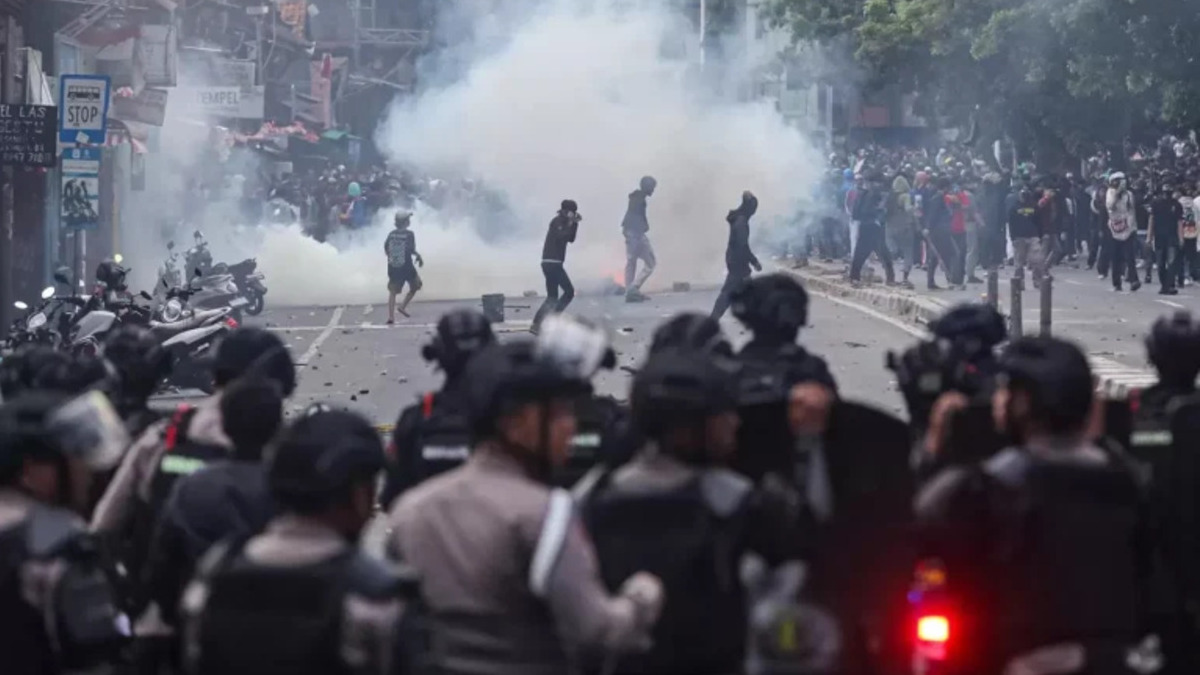
Cyber attacks and threats shake University of Indonesia after disputed 2026 student elections campus fears
A series of cyber attacks and physical threats following the University of Indonesia’s 2026 student elections has raised concerns over student safety and democratic participation, with organisers and elected leaders reporting hacking, intimidation, and involvement of law enforcement.
- A wave of cyber attacks and physical intimidation has been reported following the University of Indonesia’s 2026 student elections.
- Election organisers, newly elected student leaders, and their families were targeted through hacking, threats, and unsolicited package deliveries.
- The university has formed a joint investigative team and involved police as concerns grow over campus democratic space.
A series of cyber attacks and physical threats has emerged in the aftermath of the University of Indonesia’s 2026 student elections, prompting concern over safety and democratic space on one of Indonesia’s most prominent campuses.
The incidents began shortly after the Grand Closing of the University of Indonesia Student Election (Pemira UI) on 12 January and have since affected election organisers, newly elected student leaders, and members of their families.
Threats Against Election Organiser
Muhammad Nur Ihsan, the Project Officer (PO) of Pemira UI 2025, was the first to publicly disclose intimidation.
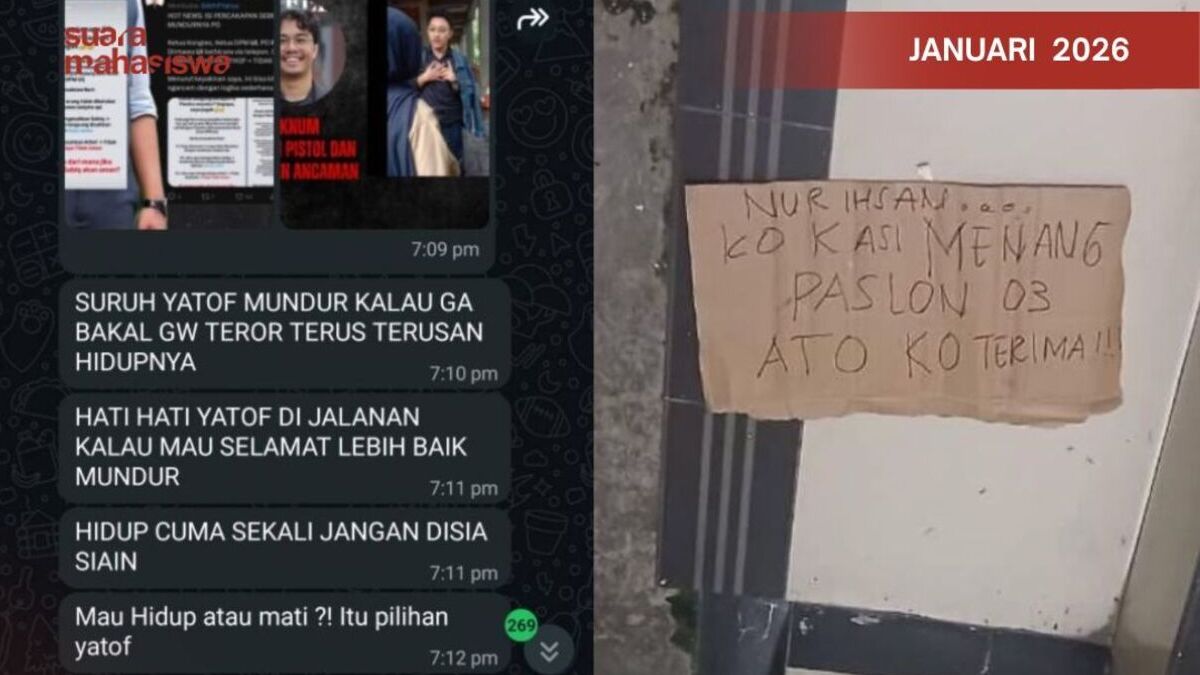
One day after the closing ceremony, he reported receiving a series of threatening WhatsApp messages from unknown individuals.
Screenshots shared on his Instagram account showed warnings instructing him not to side with a particular candidate pair and urging him to remain “fair and impartial” in a manner that Ihsan described as coercive.
Ihsan said the messages accused him of bias and election manipulation.
He rejected the claims, stating that they were unsubstantiated and had been repeatedly levelled against him during his tenure despite the committee’s efforts to maintain neutrality and independence throughout the election process.
Escalation to Physical Intimidation
According to Ihsan, the intimidation later moved beyond online messages.
A cardboard box containing threatening notes was left outside his boarding house, demanding that he ensure the victory of a specific candidate pair and warning of “retaliation” if the demand was ignored.
The package was discovered by a housemate while Ihsan had been away from the residence for several days.
Ihsan also reported a separate incident inside the campus area in the early hours of 13 January.
At around 12.30 am, while travelling back to his boarding house, he was stopped by an unidentified motorcyclist riding without a licence plate and with the headlamp switched off.
Ihsan said the individual pointed an object he believed to be a firearm at him and issued a warning not to “do anything funny”.
Because the campus gates were already closed, Ihsan said he had been forced to take a quieter route, where the encounter occurred.
He added that he could not identify the perpetrator and has not speculated on who may be responsible due to the lack of evidence.
Newly Elected BEM Leaders Targeted
The intimidation later extended to the newly elected President and Vice-President of the Student Executive Board, or BEM UI, who were announced as winners on 13 January.
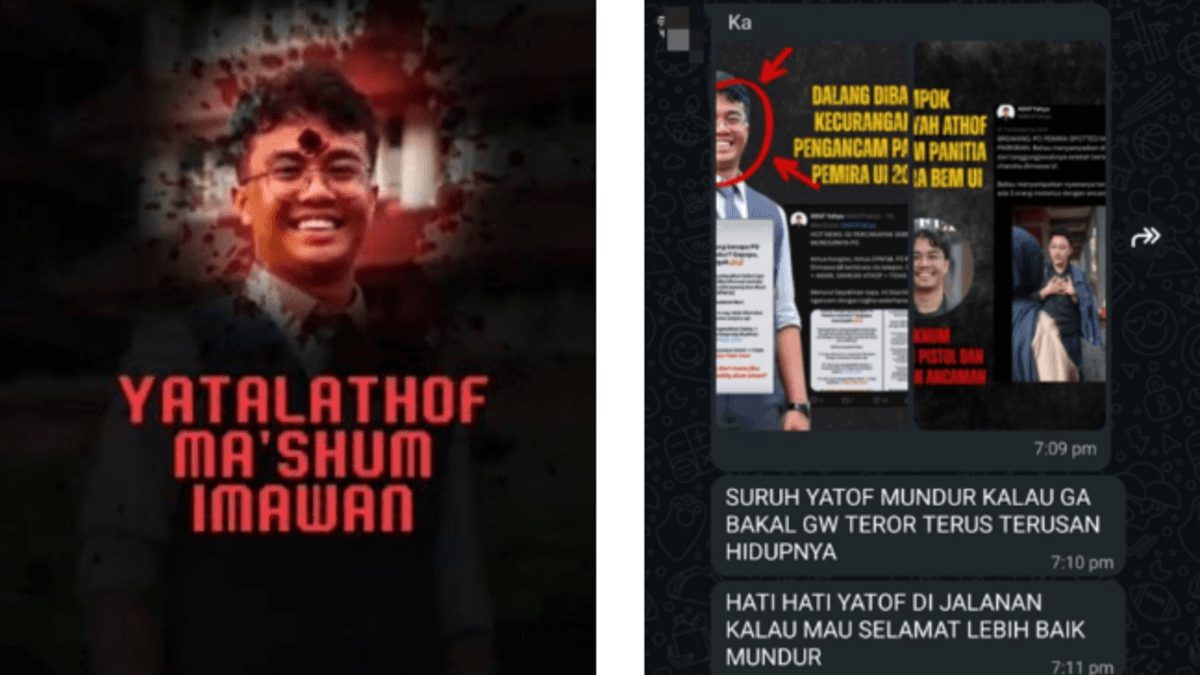
The President of BEM UI for 2026, Yatalathof Ma’shum Imawan, reported that his personal WhatsApp account was hacked shortly after the election.
The account was used to send threatening messages to family members and contacts, demanding that he resign from his position. Some messages were accompanied by videos depicting his photograph as a shooting target.
Yatalathof said his account remains compromised and cannot yet be used normally.
In addition, his family received several unsolicited cash-on-delivery (COD) packages. Two packages, with a combined value of approximately Rp 2 million (US$118), were found to contain masks. Subsequent deliveries were reportedly small in size but carried unusually high transaction values.
Concerned about potential scams or intimidation, Yatalathof instructed his family to refuse further packages they had not ordered.
Intimidation Extends to Families
The Vice-President of BEM UI for 2026, Fathimah Azzahra, reported similar experiences.
She said her father’s WhatsApp account was hacked and used to distribute threatening messages and videos portraying her as a target for execution.
According to Fathimah, the messages were circulated not only within family groups but also in neighbourhood RT–RW groups and workplace chats linked to her parents, causing confusion and alarm among recipients.
Fathimah also received unsolicited COD packages. One reportedly contained a plant-cutting tool valued at around Rp 200,000 (US$12), while another was a wheelchair of undetermined price. Fearing intimidation or fraud, she and her mother refused the deliveries.
Like the other victims, Fathimah said she does not know who is behind the threats and stressed that there is insufficient evidence to determine whether the perpetrators are organised groups or individuals acting independently.
Other Students Affected
Several other University of Indonesia students, including some not directly involved in the election, have also reported intimidation. At least two students said they were subjected to doxxing and received mysterious package deliveries after expressing opinions or sharing content related to Pemira UI on social media.
These reports suggest that the intimidation may not be limited to election officials or candidates but may also target broader student participation and commentary.
University Response
The University of Indonesia has stated that it does not tolerate intimidation that threatens campus democracy or student safety. The university has formed a Joint Investigative Team involving internal units and external law enforcement authorities.
UI’s Advocacy Team and Campus Security Office have accompanied affected students in filing reports with the Depok Metro Police. The university has also raised its security response, provided escorts for students who feel threatened, and opened a direct reporting hotline to collect and document evidence.
University officials have said that firm academic and criminal sanctions will be pursued against any individuals proven to be involved.
Statement from another candidate
Sabiq, a candidate in the BEM UI student election, also issued a public statement addressing the wave of intimidation. In a video posted on his personal Instagram account on 15 January, he condemned the threats and said they should not be used to frame or delegitimise any candidate.
Sabiq stated that he deeply regretted attempts by certain parties to exploit the situation and warned against directing unfounded accusations at fellow students.
According to Sabiq, several of his close associates also experienced intimidation during the period surrounding the Grand Closing of Pemira UI 2025. He said some were confronted by individuals believed to be external to the University of Indonesia student community, incidents that nearly jeopardised their safety while they were participating in election-related activities.
Sabiq urged members of the student body to remain calm, avoid mutual suspicion, and continue to look out for one another, stressing that the intimidation risked sowing division within the campus rather than resolving electoral disputes.
Previous Incidents of Intimidation at UI
The latest cases have revived memories of earlier intimidation experienced by student leaders at the University of Indonesia, reinforcing long-standing concerns that political engagement on campus has carried personal risks.
In late 2023, the then President of BEM UI, Melki Sedek Huang, reported a series of digital attacks and alleged surveillance following student protests and public criticism of a controversial ruling by Indonesia’s Constitutional Court on the minimum age requirement for presidential and vice-presidential candidates. Melki said the intimidation intensified as BEM UI became more vocal, amid heightened national debate over the ruling.
According to Melki, the pressure extended beyond online harassment. Members of his family in Pontianak, West Kalimantan, were reportedly visited by several men claiming to be security personnel, who asked detailed questions about household routines, daily activities, and movement patterns.
He also said a teacher at his former senior high school informed him that unknown individuals had made inquiries about his behaviour and routines during his school years, which he interpreted as an attempt to map his personal background.
Despite the seriousness of the allegations, Melki chose not to file a police report at the time, saying the matter was discussed internally within BEM UI while the leadership adopted a “wait-and-see” approach.
Military authorities later said they had no confirmed information regarding the alleged involvement of security personnel. The case was never formally resolved, but it has remained a reference point for students who view the current incidents as part of a recurring pattern of intimidation linked to campus activism.