Trump announces 25% tariff hike on South Korean imports over trade deal delays
US President Donald Trump has announced a tariff increase to 25% on South Korean imports, accusing Seoul of stalling a bilateral trade agreement. South Korea has called for urgent talks, warning of economic impacts and diplomatic tension.
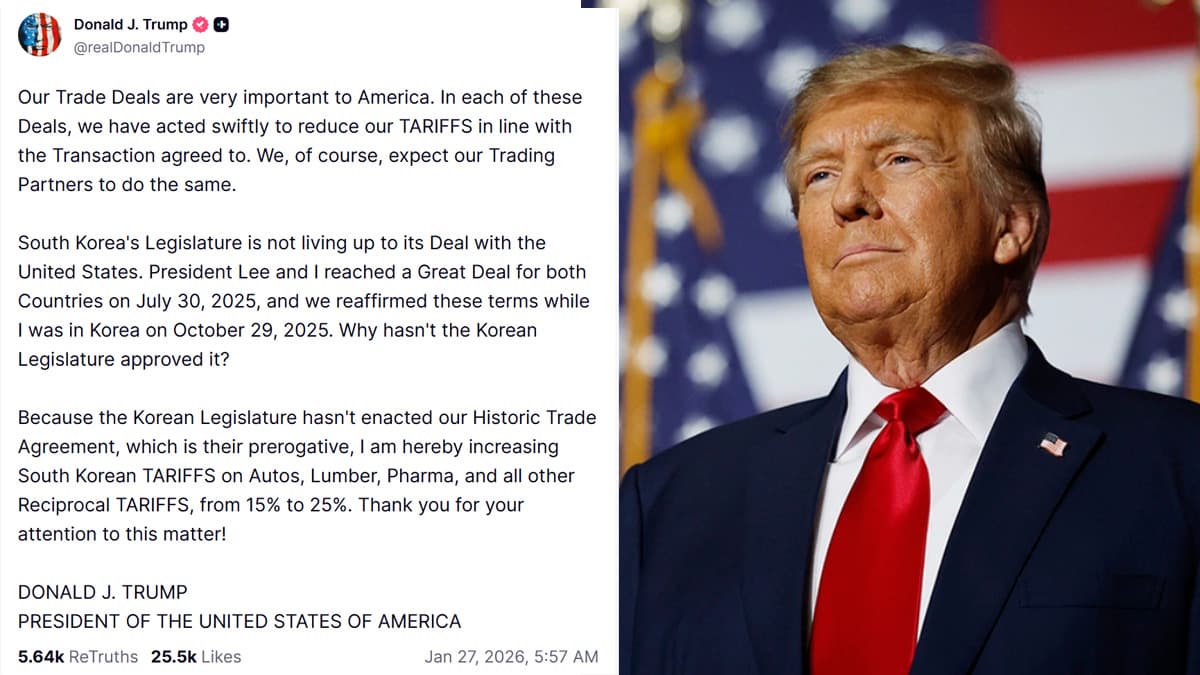
- President Trump raised tariffs on South Korean goods from 15% to 25%
- Move prompted by Seoul’s delayed ratification of a US–South Korea trade deal
- South Korea seeks urgent talks; markets react with exporter share losses
US President Donald Trump has announced a surprise decision to raise tariffs on South Korean imports to 25%, accusing Seoul of failing to meet its commitments under a bilateral trade agreement reached in 2025.
The move marks a significant escalation in tensions between the two allies and could impact billions of dollars in traded goods, including automobiles, lumber, pharmaceuticals and other industrial products.
In a post on social media platform Truth Social on 26 January, 2026, Trump stated that South Korea’s legislature had not yet passed legislation required to implement the trade agreement, despite prior commitments made during bilateral meetings in July and October 2025.
"South Korea's Legislature is not living up to its Deal with the United States," Trump wrote. "Because the Korean Legislature hasn't enacted our Historic Trade Agreement... I am hereby increasing South Korean TARIFFS... from 15% to 25%."
The trade deal in question was formally submitted to South Korea’s National Assembly on 26 November, 2025, and remains under review. It is widely expected to pass by February, according to local media reports.
Under the terms of the agreement, South Korea pledged to invest US$350 billion in the United States, including contributions to shipbuilding and other key industries. In return, the US agreed to reduce tariffs on a range of South Korean goods to 15%.
Seoul has responded with alarm, with Cheong Wa Dae convening an interagency meeting following the announcement. The Ministry of Trade, Industry and Energy confirmed that Industry Minister Kim Jung-kwan, currently visiting Canada, will travel to Washington urgently to meet US Commerce Secretary Howard Lutnick.
South Korea's government said it had not received formal notification from Washington about the tariff hike, and called for immediate high-level consultations to resolve the dispute.
Markets responded quickly to the development. Shares in South Korean exporters fell during Tuesday’s morning session, with Hyundai Motor Company dropping approximately 2.5%. Pharmaceutical and timber-related stocks also declined.
Observers suggest the tariff increase is intended to exert pressure on Seoul to expedite the legislative process and deliver on its promised investment. Trump, in his post, emphasised that the US had “acted swiftly to reduce our TARIFFS in line with the Transaction agreed to” and expects trading partners to reciprocate.
In addition to economic concerns, the trade deal included provisions for security cooperation. These included US backing for South Korea’s pursuit of nuclear-powered submarines and civil uranium enrichment for peaceful purposes, as outlined in a joint fact sheet released in November.
While the precise implementation date of the new tariffs remains unclear, the White House has not yet responded to requests for clarification.
The development also comes amid broader unease in Washington over South Korea's domestic regulatory actions. US-listed e-commerce firm Coupang Inc. is currently under investigation in Seoul over a significant data breach. American lawmakers and the State Department have criticised the inquiry as potentially discriminatory, particularly in light of South Korea’s treatment of online platform companies.
This is not the first instance in recent weeks where President Trump has used tariffs as diplomatic leverage. On 24 January, he threatened to impose 100% tariffs on Canadian goods if Ottawa proceeded with a trade deal involving China. Canada has since denied pursuing such an agreement, with Prime Minister Mark Carney stating there were no such negotiations.
Trump also previously threatened eight countries, including the United Kingdom, with tariffs over their opposition to US plans to seize Greenland. He later withdrew that threat following talks with Denmark and NATO allies.
The new tariff announcement risks inflaming already fragile economic relations and may set back recent progress in US–South Korea cooperation. Analysts warn that if enacted, the increased tariffs could inject renewed uncertainty into one of the United States' most important bilateral trade relationships in Asia.