Trump’s Military Deployment and Immigration Crackdown Fuel Legal and Political Battles
President Donald Trump’s use of federal troops and expansion of immigrant detention has sparked legal battles, economic scrutiny, and growing concerns about profiteering in the U.S. immigration system.
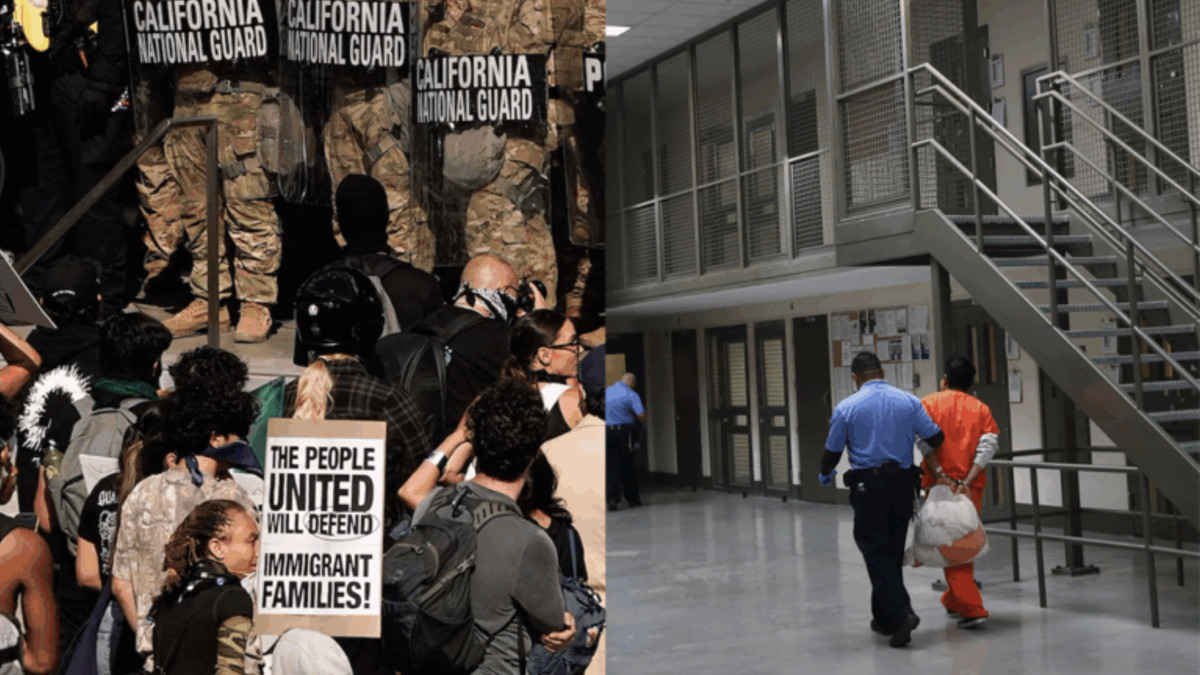
- Deployment: Trump federalised California’s National Guard on 7 June, sending 4,700 troops to Los Angeles protests.
- Court case: The 9th Circuit on 19 June extended his temporary control despite a lower court ruling it unlawful.
- ICE data: 75% of 185,000 detainees in 2025 had no serious criminal record; fewer than 10% had violent convictions.
- Private prisons: Over 90% of detainees are held in corporate-run facilities like GEO Group and CoreCivic.
- Labour dispute: GEO faces a US$23m judgment for underpaying detainees US$1/day, now on appeal.
- Conditions: Suspension of detainee labour has worsened sanitation, food service, and living standards.
- Oversight: DHS now requires 72-hour notice for congressional visits, raising legal concerns.
- Profits: GEO earned over US$2.4b in 2024; contracts include guaranteed bed quotas that incentivise mass detentions.
- Outlook: Pending court rulings could reshape presidential authority and the economics of immigrant detention.
President Donald Trump’s decision to federalise California’s National Guard and deploy U.S. Marines to Los Angeles in response to immigration-related protests is under intense legal and political scrutiny.
On 19 June 2025, the 9th U.S. Circuit Court of Appeals allowed Trump to retain temporary control over California’s National Guard while litigation continues. The move extended a stay on an earlier ruling by U.S. District Judge Charles Breyer, who had concluded the president acted unlawfully when he federalised the Guard on 7 June without Governor Gavin Newsom’s consent.
Courts weigh legality of federalisation
Judge Breyer noted that federal law allows presidents to assume control of state guards only under extreme circumstances such as rebellion, conditions that “clearly did not exist” in Los Angeles.
Despite this, Trump’s emergency orders have kept 4,000 National Guard soldiers and 700 Marines deployed across Los Angeles since early June. They were mobilised to support Immigration and Customs Enforcement (ICE) operations amid widespread protests against mass deportations.
Data contradicts official rhetoric
The administration has repeatedly framed the crackdown as a public safety measure. Homeland Security Secretary Kristi Noem described ICE raids in Los Angeles as targeting “murderers” and “human traffickers.” Trump himself called the operation “a national emergency” and vowed to deliver “the single largest Mass Deportation Program in history.”
Yet ICE’s own data, obtained by CNN, tells a different story. Of 185,000 immigrants detained in fiscal year 2025, more than 75% had no criminal convictions beyond immigration or traffic offences. Fewer than 10% were convicted of violent crimes.
Advocates argue that this discrepancy reveals a system designed not to protect public safety but to feed the private detention industry.
Profits in private detention
Over 90% of ICE detainees are held in privately run facilities, operated by corporations such as GEO Group and CoreCivic. These firms hold federal contracts worth billions of dollars and have seen profits surge under Trump’s immigration policies.
At GEO’s Northwest ICE Processing Center in Tacoma, Washington, detainees were paid as little as US$1 per day for essential labour such as cooking and cleaning. In 2021, a federal jury ruled that GEO violated Washington state’s minimum wage law, awarding US$23 million in damages and penalties.
GEO has refused to pay and is appealing the verdict, claiming federal immigration authority overrides state labour laws. Meanwhile, the company reported gross profits of US$20 million annually from the Tacoma facility alone.
Deteriorating conditions
Following the lawsuit, GEO suspended its detainee work program. The result, according to advocates, has been deteriorating living conditions. Reports describe meals delayed for hours, dirty living quarters, and shortages of basic hygiene products.
“Dinner used to be at 5. Then 6. Now it’s 9,” said Maru Mora Villalpando, founder of La Resistencia, which monitors detainee conditions. The ACLU of Southern California also reported cases of long-term residents with no criminal record being detained during ICE sweeps, including parents of U.S.-born children.
Political pressure and restricted oversight
While ICE publicises arrests of immigrants accused of serious crimes, critics say these represent only a small fraction of detentions. Even some Republicans have joined calls for greater transparency. Six GOP members of the Congressional Hispanic Conference recently warned ICE against “diverting resources away from actual threats.”
Congressional oversight of detention centres has also faced new barriers. This month, the Department of Homeland Security issued internal guidelines allowing ICE to deny or delay congressional visits, requiring lawmakers to give at least 72 hours’ notice.
Legal experts warn the policy may violate federal statutes guaranteeing members of Congress unrestricted access to detention facilities.
A system built for profit
Financial records show that private prison companies have benefited enormously. GEO Group’s revenue topped US$2.4 billion in 2024, boosted by guaranteed minimum bed quotas that require taxpayers to pay whether facilities are full or not.
“There’s a perverse incentive to keep these facilities full,” said Lauren-Brooke Eisen of the Brennan Center for Justice. “The business model depends on large-scale detention, not on targeting real threats.”
Advocates argue that the system is less about national security and more about sustaining a cycle of profit. “Portraying immigrants as criminals is both inaccurate and dangerous,” said Sui Chung of Americans for Immigrant Justice. “The real crisis is how we are treating people once they’re detained.”
Legal battles ahead
The 9th Circuit’s forthcoming rulings on both the National Guard case and the Tacoma labour lawsuit will have far-reaching implications.
If courts strike down Trump’s authority, it could limit future presidents’ ability to deploy state guards unilaterally. And if private prison firms are forced to pay minimum wages or hire external workers, the economics of immigration detention could shift dramatically.
For now, Trump continues to defend his policies as protecting jobs and safety. But critics argue they have delivered only one clear outcome: steady profits for private prison corporations.