Law Society members vote to mandate elected presidents after historic EGM
Law Society members passed a binding resolution requiring that future presidents must be elected council members, with 88.52% voting in favour. The vote followed weeks of tension over the appointment of a ministerial appointee as president-elect.
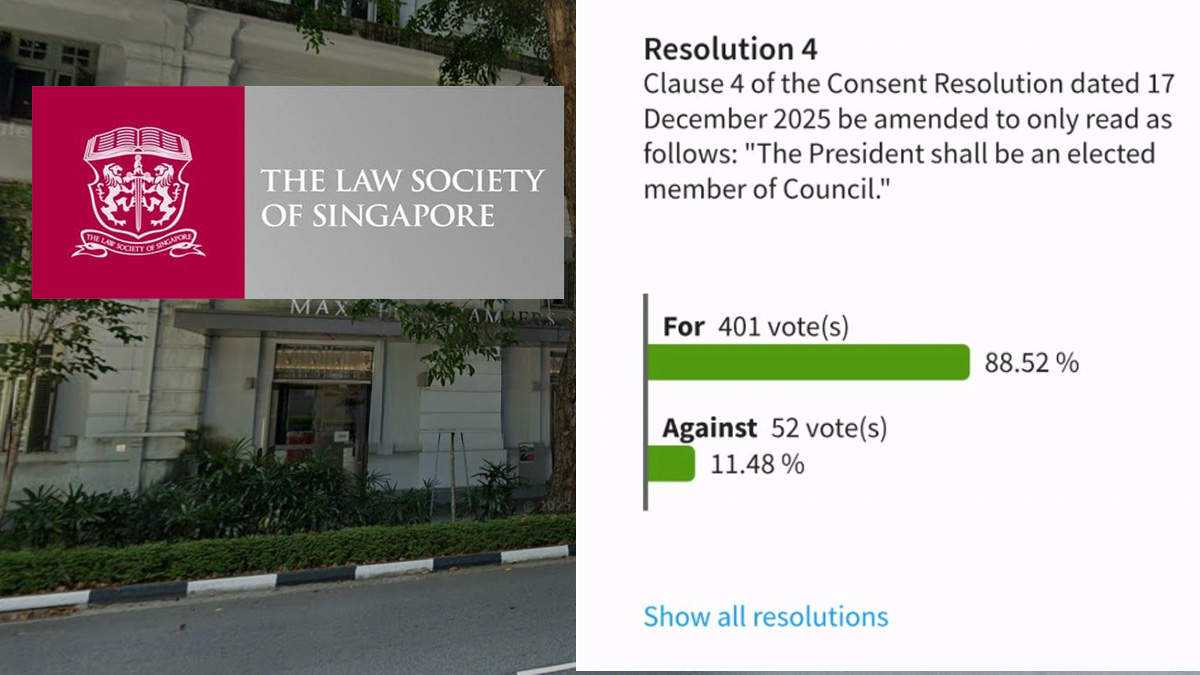
- Law Society members voted decisively to require that the president be an elected council member.
- The resolution received 88.52% approval at a highly attended extraordinary general meeting (EGM).
- The vote followed public debate over governance and independence after a ministerial appointee was named president-elect.
Members of the Law Society of Singapore (LawSoc) have voted to make it a binding rule that the Society’s president must be an elected member of its governing council.
The vote took place during an extraordinary general meeting (EGM) held on 22 December 2025, following weeks of internal debate over governance and representation within the legal profession.
The resolution passed with overwhelming support — 401 votes in favour and 52 against — representing 88.52% of the valid ballots cast. A total of 554 members were in attendance at the Wyndham Singapore Hotel, reflecting one of the highest turnouts for a general meeting in recent memory.
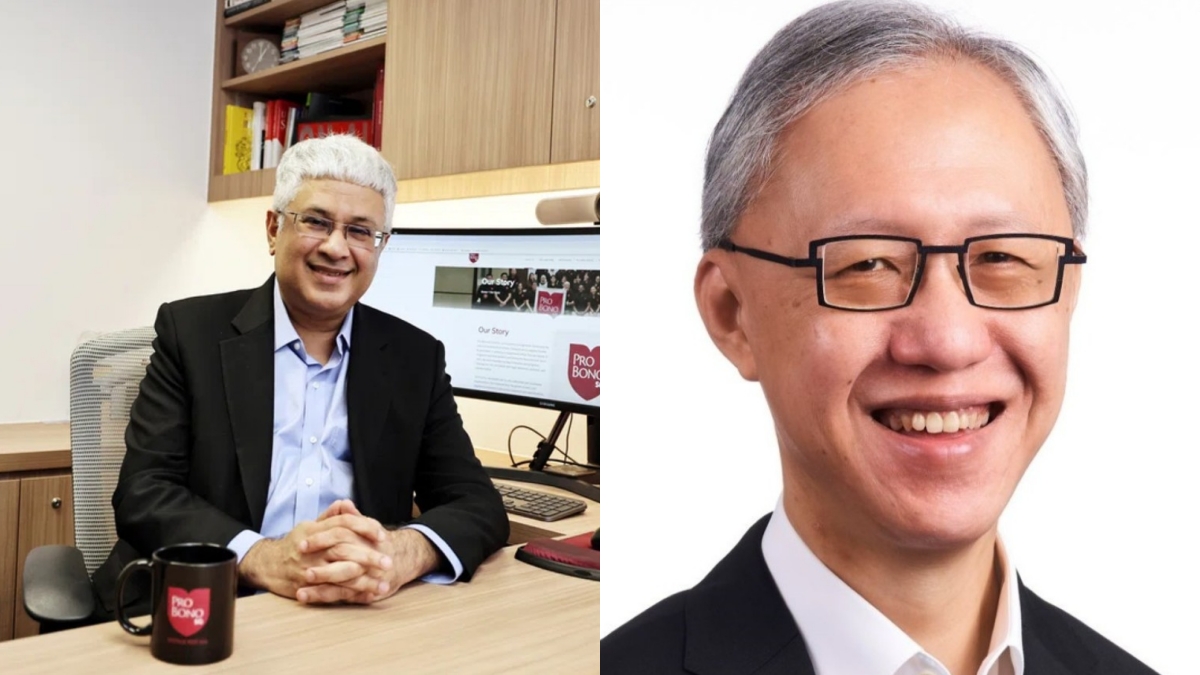
At issue was the appointment of Dinesh Singh Dhillon as president-elect for 2026. Mr Dhillon, a senior partner and co-head of international arbitration at Allen & Gledhill, had been elected to the presidency by the LawSoc council in November.
However, he was not himself elected by members. He joined the council as a statutory appointee under Section 48(1)(b) of the Legal Profession Act, nominated by the Minister for Law.
His appointment triggered disquiet across the Bar, with critics arguing that the presidency — the Society’s highest office — should be filled only by those who have been directly elected by members. Two former Law Society presidents, Peter Cuthbert Low and Chandra Mohan K Nair, led a group of requisitionists to formally call for the EGM to address this concern.
Clause 4 of the original consent resolution, circulated on 17 December as part of a proposed compromise, had contemplated a future process where Council 2026 would draft and consult on eligibility criteria for office-bearers.
However, during the EGM, members voted to amend and replace Clause 4 entirely, adopting new language that took immediate effect:
“The President shall be an elected member of Council.”
This wording was voted on and passed as a binding resolution. As a result, the previously proposed review process for the presidency was discarded in favour of a clear and enforceable rule.
The vote is being seen by many in the profession as a reaffirmation of democratic governance within LawSoc. It follows a period of internal strain, including questions about the Society’s independence and concerns that members were being sidelined in decisions affecting leadership succession.
The presidency will now be assumed in 2026 by Professor Tan Cheng Han, who had earlier been appointed as a vice-president. Prof Tan, a senior consultant at WongPartnership and chief strategy officer at NUS Law, is himself an elected council member and was present at the EGM.
Mr Dhillon, who also attended, had already agreed to step aside as part of a pre-meeting understanding among several stakeholders. That agreement — originally reflected in the 17 December consent resolution — was effectively superseded when members voted to assert their collective position more directly through the amended resolution.
The meeting itself was conducted in a closed-door setting, with multiple rounds of voting. Attendees described long queues at registration and a packed ballroom that required additional seating.
Although the vote closed the immediate question of presidential eligibility, the events leading up to the EGM have raised broader questions about transparency and member engagement.
One of the more prominent figures in the public discourse was lawyer Luo Ling Ling, who had been among the requisitionists.
In the weeks before the EGM, Luo took the unusual step of posting publicly on LinkedIn about the meeting, after the Council failed to issue a timely notice within the 14-day statutory window under the Legal Profession Act.
Her posts attracted criticism from some quarters, including during a LawSoc “tea session” on 10 December, where one senior member reportedly expressed “disgust” that internal matters had been aired on social media.
Luo defended her actions in a 11 December post: “I posted on social media because an uninformed Bar cannot vote,” she wrote. “How do I contact 6,000 practising Singapore lawyers to inform them of a crucial vote for EGM?”
Following the successful vote at the EGM, she returned to LinkedIn to reflect on the outcome:
“A decisive majority of 401 members voted in favour of the resolution that the President of the Law Society of Singapore shall be an elected member of Council,” she wrote. “I feel completely vindicated just by the huge turnout.”
She also credited Peter Low and Chandra Mohan for their leadership of the requisitioning group.
The decision on 22 December now sets a precedent for future leadership transitions within LawSoc and affirms the authority of its 6,434-strong general membership in shaping institutional governance.