Stomp review of closing Toa Payoh hawker stall draws backlash from F&B community
A Stomp article criticising the pricing of a soon-to-close Toa Payoh yong tau foo stall has sparked backlash from food operators and critics. Industry figures argue the piece ignored rising costs and unfairly targeted a 40-year family-run hawker business already facing closure.
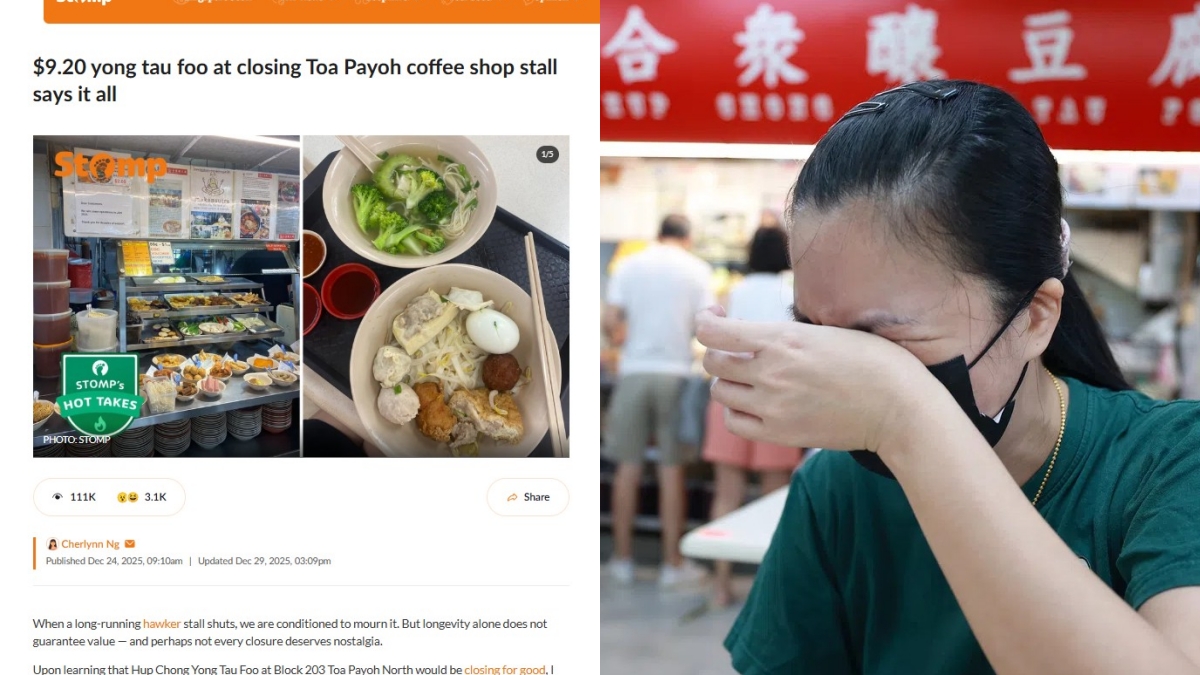
- A STOMP review questioning the pricing and closure reasons of Hup Chong Yong Tau Foo sparked widespread backlash, with critics saying it lacked empathy and ignored the economic pressures facing hawkers.
- F&B operators and food critics, including Lim Jialiang and KF Seetoh, highlighted rising costs from rent, labour and ingredients, arguing that hawkers cannot absorb these increases while keeping food cheap.
- The stall owners responded emotionally, saying the article misrepresented their pricing details and turned their planned quiet closure after 40 years into a painful public ordeal.
SINGAPORE: A review published by citizen journalism platform Stomp days before Christmas has triggered widespread criticism from food and beverage operators, food critics and members of the public, after it targeted a long-running yong tau foo stall that is set to close early next year.
The article, written by assistant editor Cherlynn Ng, focused on Hup Chong Yong Tau Foo, a family-run stall in Toa Payoh with a history spanning four decades.
The stall is scheduled to cease operations in January 2026, with its owners citing rising costs and declining footfall.
Ng’s commentary questioned both the stall’s pricing and its reasons for closure, prompting accusations that the piece lacked empathy and failed to reflect the economic realities faced by hawkers in Singapore.
Stomp operates as a digital news platform and is one of several media brands under the SPH Media umbrella.
Criticism over pricing and closure rationale
In the Stomp article, Ng described paying S$9.20 for a bowl of yong tau foo, which she characterised as excessive.
She wrote that she had “braced” herself for the price, but said her family and colleagues were “shocked” by the cost.
Ng also challenged the stall’s explanation that business had been affected by nearby competition and work-from-home arrangements.
She suggested that the owners lacked “self-reflection” and implied that pricing decisions may have contributed to the stall’s difficulties.
The framing drew swift backlash online, with critics arguing that the article reduced a complex situation to a simplistic judgement about affordability, without accounting for broader cost pressures.
F&B operators highlight rising cost pressures
Among the most vocal critics was Lim Jialiang who addressed the issue in a Facebook post dated 29 December 2025.
Lim said the article reflected a wider problem of misunderstanding within public discourse about food pricing.
Lim wrote that rising living costs, job insecurity and economic anxiety had placed severe strain on workers and small businesses alike.
He noted that labour shortages and higher wage expectations had increased operating expenses, alongside consistently rising rents.
He added that hawkers were not insulated from these pressures, particularly those using fresh ingredients.
According to Lim, the cost of Borneo pork had risen by approximately 40 per cent over the past two years.
Supply shocks and global factors
Lim attributed rising meat prices to several factors, including climate change and geopolitical instability.
He said extreme heat had made it harder to rear pigs in the region, slowing growth rates and increasing feed requirements.
He also pointed to the war in Ukraine, which he said had disrupted global grain supplies used in animal feed, contributing to higher costs across meat markets worldwide.
In his post, Lim defended Hup Chong’s pricing by noting that the stall uses pork in its fish paste, following traditional Hakka methods. He said this increased protein content and satiety, distinguishing it from cheaper versions bulked out with starch, MSG and sodium.
“These are costs that are invisible,” Lim wrote, referring to rent, labour, electricity and ingredient sourcing.
Accusations of public shaming culture
Lim went further by criticising what he described as Stomp’s editorial culture. He argued that the platform encourages public shaming and erodes empathy, particularly towards small businesses and individuals with limited means to respond.
He said he could forgive ignorance about food costs, but not what he described as a lack of compassion in writing off a 40-year hawker business over what he viewed as a relatively small expense.
Lim also referenced a job advertisement for an assistant editor role at Stomp, which listed a monthly salary range of S$6,000 to S$8,000, contrasting it with the financial precarity faced by hawkers.
KF Seetoh weighs in
Food critic and hawker culture advocate KF Seetoh also criticised the article in a separate Facebook post.
Seetoh said hawkers should not be expected to absorb rising costs simply to satisfy demands for cheap food.
He listed expenses including utilities, maintenance, ingredients, labour and rent, saying hawkers typically spend about 70 cents for every dollar earned.
He added that many hawkers have no fixed salary and take home whatever remains in the till at the end of the day.
Seetoh said that while freedom of expression allows people to comment on prices, such views should be exercised responsibly.
He warned that unkind commentary could easily rebound on those making it.
Khoo Keat Hwee, 38, founder of Mentai-Ya Japanese Cuisine and an F&B consultant, said the STOMP article exposed how many consumers dismiss rising rents, labour costs and quality, caring only about cheap food.
He criticised the mindset that hawkers must absorb all cost increases or “adapt or die”, calling it a lack of self-reflection.
Khoo argued that not all customers deserve such food and reminded Hup Chong that many still support them.
He added that the stall’s food deserves better and encouraged the family to take a proper break.
Stall owners respond emotionally
The proprietors of Hup Chong Yong Tau Foo issued several Facebook posts responding directly to Ng’s article.
They said the portrayal of their pricing was misleading and lacked context.
According to the stall owners, Ng had selected 11 items, eight priced at S$0.80 and two at S$1, along with an additional serving of kway teow. They said the usual noodle charge of S$1 had been discounted by S$0.20, and bean sprouts were provided free.
They said the article failed to reflect these details and unfairly implied profiteering.
“It turned what should have been a Merry Christmas to the worst Christmas ever in our life,” one post stated.
The family said they had hoped to close their business quietly and with dignity after 40 years of operation.
Following publication, online commentary intensified, with many users defending the stall and criticising the article’s tone.
Some accused the piece of targeting a vulnerable business already preparing to shut down.
One Facebook user wrote that the article was “a personal rant disguised as reporting”, while another questioned the necessity of publicly criticising a stall on the brink of closure.