Bhumjaithai claims clear election win as progressives concede defeat
Bhumjaithai Party secures lead in Thai general election, dealing a blow to the progressive People’s Party. Anutin Charnvirakul pledges stable government formation amid ongoing vote count and political transition.
- Bhumjaithai Party, led by Anutin Charnvirakul, is projected to win 194 of 500 seats in the House of Representatives, based on early results.
- The progressive People’s Party conceded defeat after securing just 108 seats, despite earlier leads in pre-election polls.
- A new coalition government is likely to include Bhumjaithai, Klatham and Pheu Thai, with a combined majority exceeding 300 seats.
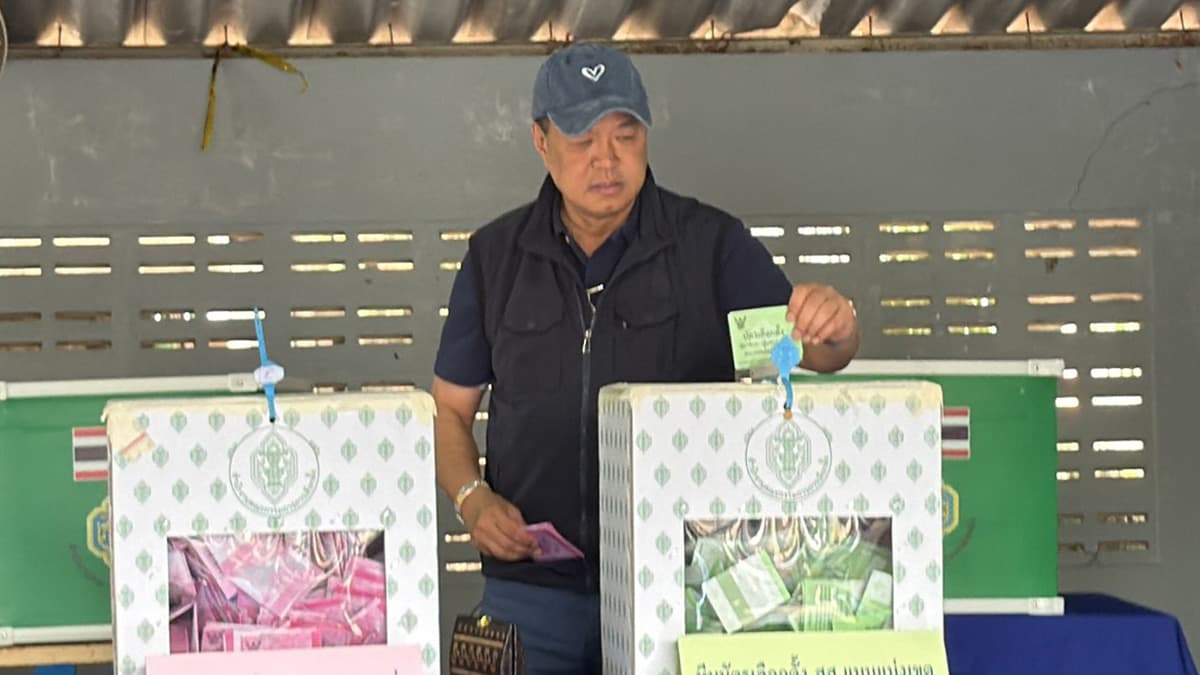
The ruling Bhumjaithai Party (BJT), led by Prime Minister Anutin Charnvirakul, emerged with a commanding lead in Thailand’s general election held on 8 February, marking a significant political realignment and a setback for the progressive opposition.
With votes from approximately 82% of polling stations counted, the Election Commission projected Bhumjaithai to win 194 seats in the 500-member House of Representatives.
This puts the party on course to form a new government, likely in coalition with Klatham and Pheu Thai, which are expected to secure 58 and 78 seats respectively.
The People’s Party, under Natthaphong Ruengpanyawut, conceded the contest after early results showed the party trailing with 108 seats — a sharp reversal from pre-election surveys that had predicted a strong performance.
Speaking from party headquarters in Bangkok, Anutin expressed gratitude for the public’s trust, stating: “We regard this as an order from the people... We have received your signal clearly.” He pledged to lead with honesty, uphold democracy, and govern in the interest of all Thais.
Despite falling short of an outright majority, Bhumjaithai’s coalition prospects are strong.
According to a source cited by the Bangkok Post, the expected tripartite alliance would command over 300 seats — enough to ensure parliamentary stability and avoid the prolonged deadlocks that have plagued Thailand’s political landscape.
Referendum on reform agenda
The election was widely seen as a referendum on the reformist platform of the People’s Party, which rose to prominence in 2023 following the dissolution of its predecessor, Move Forward, over its stance on amending the country’s lese majeste law.
Although the People’s Party moderated some of its positions to broaden appeal — nominating technocrats and civil servants for key posts — it failed to overcome the entrenched influence of Thailand’s conservative political establishment.
A parallel referendum on whether to replace the current military-drafted constitution saw nearly 60% of voters endorsing the proposal, according to preliminary figures.
This could lay the groundwork for structural reform, though its passage depends on broader parliamentary consensus.
Nationalism and local networks drive BJT’s success
Analysts attribute Bhumjaithai’s performance to a combination of strategic campaigning and timely nationalism. Anutin capitalised on rising public concern following border clashes with Cambodia, emphasising security and national sovereignty.
The party also leveraged the current first-past-the-post electoral system to consolidate votes in key constituencies. While the People’s Party led the party-list vote with 2.16 million ballots, Bhumjaithai’s dominance in local districts proved decisive.
Bhumjaithai’s success in co-opting regional political families and minimising competition among conservative factions helped maximise seat gains — a lesson drawn from the fragmented 2023 election.
Economic continuity favoured by business community
While political uncertainty has often rattled Thailand’s markets, early indications of a stable pro-establishment government have provided reassurance.
According to Krung Thai Bank strategist Poon Panichpibool, continued Bhumjaithai leadership is viewed as a “market-friendly scenario”.
Andrew Shaw, Southeast Asia Managing Director of The Asia Group, highlighted that “continuity of government and rapid implementation of policies” are essential for economic stability.
Thailand has seen ten prime ministers since 2005, with frequent leadership changes blamed for stalling growth and deterring investment.
Reaction among opposition and youth
At the People’s Party headquarters, the mood was subdued. Natthaphong confirmed his party would enter opposition, stating: “I earlier said that I would not vote for Bhumjaithai to lead the next government.”
University student Phattaranan Saengsrichai reflected the disillusionment among younger voters: “Thailand has made no progress and actually regressed... because of old political groups.”
The People's Party is expected to regroup and focus on parliamentary opposition, possibly leveraging the constitutional referendum to maintain political relevance.
Cabinet expectations and next steps
If current projections hold, Anutin is expected to retain the post of prime minister. Preliminary reports suggest Ekniti Nitithanprapas could serve as deputy prime minister and finance minister, with Suphajee Suthumpun as commerce minister and Sihasak Phuangketkeow as foreign affairs minister.
Anutin stated that decisions on government formation would follow confirmation of final vote tallies and executive discussions within Bhumjaithai’s leadership.
Thailand’s political trajectory, long defined by instability and economic underperformance, may now enter a phase of relative cohesion — though questions about democratic reform and generational change remain.