Indonesia classifies etomidate as a second-class narcotic amid surge in illegal vape misuse
Indonesia has officially classified etomidate as a second-class narcotic following its widespread misuse in illegal vape liquids and the uncovering of a Malaysia–Indonesia trafficking network producing etomidate-infused cartridges worth billions of rupiah.
- The Indonesian Ministry of Health has formally listed etomidate as a second-class narcotic under a new 2025 regulation.
- Police and BNN pushed for the change after widespread misuse of etomidate as illegal vape liquid.
- The new classification enables law enforcement to prosecute users under narcotics law and pursue international trafficking networks.
The Indonesian Ministry of Health has formally categorised etomidate as a second-class narcotic, following growing concerns over its misuse as a liquid for illegal electronic cigarettes.
The designation was issued under Ministry of Health Regulation No. 15 of 2025, signed on 21 November 2025 and enacted on 28 November 2025.
The Indonesian National Police and the National Narcotics Agency had urged the government to classify the potent anaesthetic as a narcotic. Authorities made the request after uncovering widespread illicit distribution and its use as a psychoactive vape component.
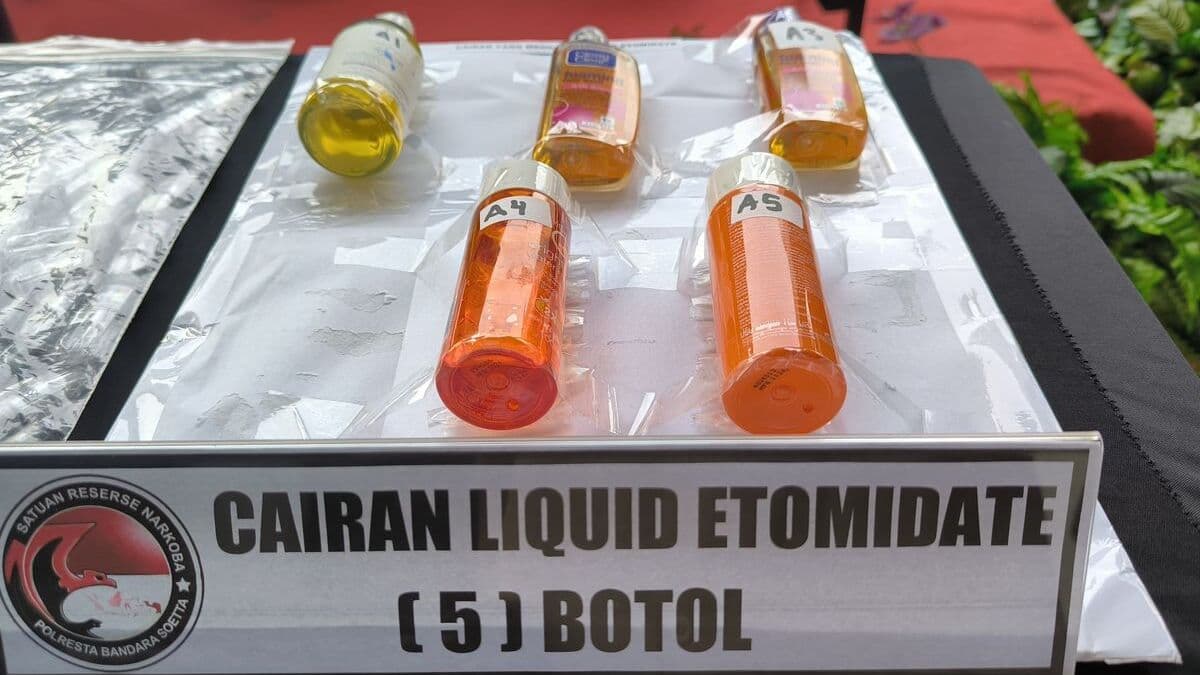
Police seized 17,611 millilitres of etomidate between January and October 2025. Officials said the substance lacked distribution approval from the National Agency of Drug and Food Control.
Bareskrim Polri Director of Drug Crimes Brigadier General Eko Hadi Santoso explained that etomidate was exploited to circumvent narcotics regulations. He said misuse can induce fainting and convulsions depending on the individual.
The new Permenkes lists etomidate as item number 90 in the second-class narcotic category.
According to detik, this class includes substances with therapeutic value but high dependency potential, used only as a last resort in treatment or research.
Eko said the updated classification now allows users to be charged under narcotics legislation. Previously, enforcement relied on the Health Law and could only target distributors or producers, not users.
He stated that users may now be eligible for rehabilitation under narcotics law. This represents a shift in enforcement options for authorities confronting the spike in misuse.
Police recently dismantled an international trafficking network operating between Malaysia and Indonesia. The network allegedly produced etomidate-infused vape cartridges valued at S$42.5 million.
According to detik, a Malaysian national, identified as B, was named a suspect and placed on a wanted list. Authorities say he acted as coordinator and buyer of contraband shipped from abroad.
National Police Chief Listyo Sigit Prabowo previously reported rising misuse of etomidate and ketamine. He told President Prabowo Subianto that both substances had not been covered by criminal law frameworks until the new regulation.
Listyo said ketamine is often inhaled, while etomidate is commonly mixed into vape liquid and consumed via pods. He warned of a concerning trend requiring urgent regulatory action.
Etomidate, a hospital-grade anaesthetic, is tightly regulated worldwide as a prescription-only medicine, with most countries restricting its use to trained clinicians in controlled settings.
In the United States and Europe, it falls under pharmaceutical regulations rather than narcotics laws, though agencies caution against risks such as adrenal suppression.
Several jurisdictions, including China, Hong Kong, and others in Asia, have moved to classify etomidate as a controlled drug as illicit use—particularly in vape liquids—gains attention. International monitoring bodies have reported growing detections of etomidate analogues, prompting calls for stricter global oversight.
The tightening stance is most visible in Singapore, where etomidate will be listed as a Class C controlled drug from 1 September 2025, bringing penalties of up to 10 years’ jail and significant fines for unauthorised possession, alongside harsher punishment for trafficking.
Malaysia, meanwhile, classifies etomidate as a Group B poison under the Poisons Act, a step that falls short of narcotics-level regulation but leaves room for future reassessment.