Indonesia’s Cesium-137 crisis: Unraveling two years of silent contamination
Indonesia is grappling with its worst industrial radiation crisis after Cesium-137 was found in shrimp exports in August 2025. Investigations revealed widespread domestic contamination linked to unsafe scrap-metal smelting, with fallout spanning years and 24 companies.
- Cesium-137 contamination in Indonesian exports triggered a national radiation emergency in August 2025.
- Investigations traced the source to local scrap-metal smelting, not imports, revealing systemic failures.
- Over 1,000 tonnes of radioactive waste were secured, with criminal charges filed against a key smelter.
Two months after radioactive Cesium-137 was first detected in Indonesia’s export goods in August 2025, the country is still racing to understand how the contamination spread, how far it has travelled, and who is responsible.
What began with the rejection of frozen shrimp in the United States has evolved into Indonesia’s largest industrial radiation emergency—one exposing years of regulatory gaps, unsafe scrap-metal handling, and a hazardous waste legacy stretching back to 2021.
A Signal From Abroad: The August 2025 Trigger
The crisis erupted when the US Food and Drug Administration (USFDA) flagged Cesium-137 in shrimp exported by PT Bahari Makmur Sejati (BMS). The company, located in the Modern Cikande Industrial Estate in Banten, soon became the epicenter of a national emergency.
Within days, Bapeten—the country’s nuclear regulator—deployed detectors across the estate. On 29 August 2025, their instruments spiked drastically near a stainless-steel smelter, PT Peter Metal Technology (PMT).
What investigators found inside the furnace changed the trajectory of the case: radiation levels at 700 μSv/hour, more than 6,000 times the safe limit for the public, which is 1 millisievert (mSv) per calendar year.
What is Cesium-137?
Cesium-137 is a man-made radioactive isotope produced through nuclear fission, with a long half-life of 30.17 years. It emits both beta and gamma radiation—high-energy particles capable of damaging human tissue.
In industrial and medical settings, Cesium-137 is normally sealed inside lead-shielded capsules or disks, where it is used for cancer therapy, equipment sterilization, and gauges that measure flow or material thickness. When those sealed sources are intact, Cesium-137 poses very little risk.
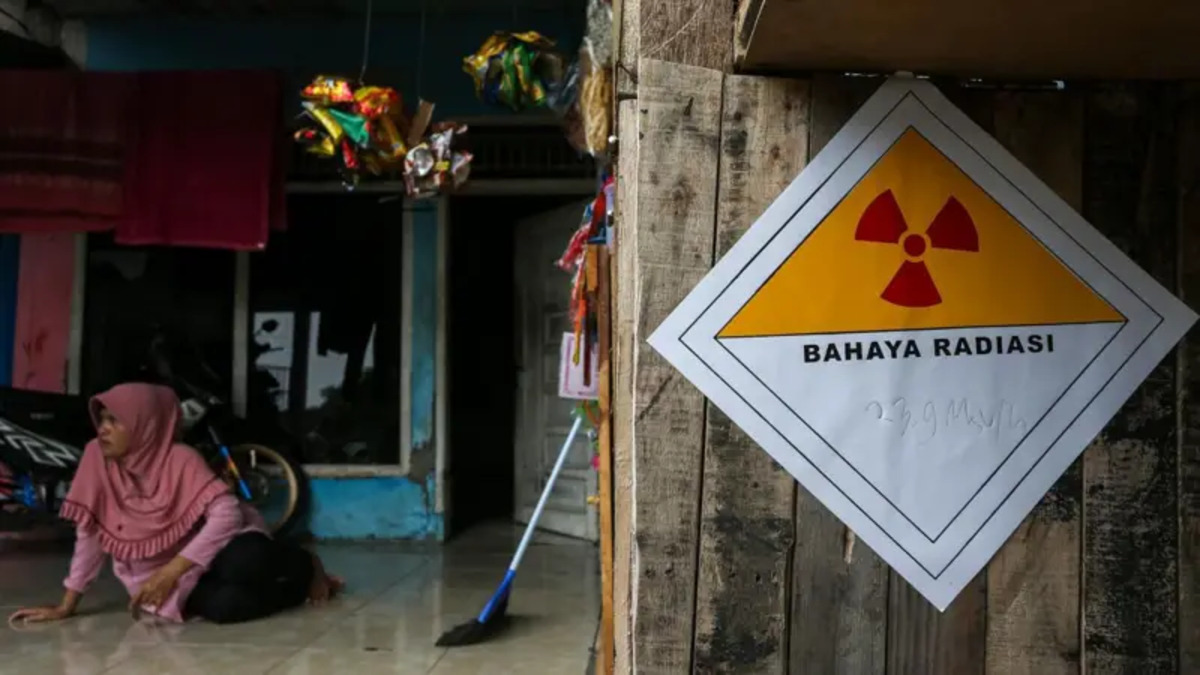
According to the Centers for Disease Control and Prevention (CDC), the danger emerges when containment fails. Cesium-137 typically forms a white, powder-like crystalline material that can disperse invisibly into soil, dust, or the air if a capsule is damaged or improperly discarded.
While everyone is exposed to tiny traces of Cesium-137 from past nuclear testing, concentrated exposure can cause radiation burns, acute radiation sickness, and long-term cancer risks—particularly if inhaled or ingested.
Tracing the Footprint: A Hotspot That Wasn’t New
As more checks followed, evidence emerged that the problem had not begun in 2025 at all.
A deeper look between October and November 2025 revealed that an older smelter, PT Vita Prodana Mandiri (VPM)—closed since 2021—had likely handled contaminated slag years earlier. Residents had unknowingly taken this slag home for construction fill, unaware it carried Cesium-137.
By November, authorities confirmed that contamination extended to 24 companies in Cikande—ranging from foundries to waste handlers to food processors.
Radiation levels varied widely:
-
152 μSv/hour at BMS
-
up to 10,000 μSv/hour at local scrap yards
It became clear the contamination was environmental, systemic, and spread through the scrap-metal economy.
The Scrap-Metal Trail: Domestic, Not Foreign
Initial suspicion pointed overseas after 14 containers of metal powder from the Philippines were seized at Tanjung Priok Port in early September, with nine containers confirmed to contain Cesium-137.
But by 4 December 2025, the government task force concluded the opposite: the primary source was domestic scrap metal, including discarded industrial or medical equipment that originally contained sealed radioactive sources.
Police investigators found that PMT had operated from September 2024 until its abrupt shutdown in July 2025 due to a shortage of raw materials. Desperate for supply, it had purchased scrap from informal collectors—some legally, some illegally—without any radiation screening. When smelted, these radioactive fragments dispersed contamination across the estate.
International Alerts: Shrimp and Sneakers
The USFDA’s detection in August was not the first foreign warning. Earlier in 2025, Dutch Customs had scanned Indonesian-made sneakers and found radiation up to 110 nSv/hour, well above background levels. Their report, later confirmed by European radiation experts, only gained attention after the shrimp incident spotlighted Cikande.
Taken together, these findings suggested a contamination chain active long before Indonesia realized it.
Mobilizing the State: Emergency Response on the Ground
By 1 October 2025, the government installed Radiation Portal Monitoring (RPM) at Cikande’s entry gates. Over 1.071 million vehicles were inspected throughout the month; 48 were contaminated in the early weeks.
On 3 December 2025, Environment Minister Hanif Faisol reported to Parliament that:
-
1,136 tonnes of radioactive material had been secured,
-
12 hotspots were fully decontaminated, and
-
one house remained unresolved because Cesium-137 might be lodged beneath its concrete foundation.
The resident was relocated while BRIN conducted further analysis.
Hanif warned that Cesium-137 has an active life exceeding 60 years. Indonesia must build a permanent interim storage site beginning in 2026—a facility it currently lacks.
Proving the Source: Science Takes Center Stage
On 14 November 2025, BRIN clarified how they verify the contamination. Contrary to public misconception, Cesium-137 doesn’t have “DNA.” Instead, scientists compare the isotopic “signature” using high-precision gamma-spectrometry:
-
shrimp samples
-
soil
-
dust
-
slag
-
industrial residue
Additional samples were shipped to Japan later in November 2025 for deeper analysis—a crucial step for prosecution and for restoring global trust in Indonesia’s exports.
Legal Fallout: Naming the Suspects
On 4 December 2025, Bareskrim officially named PT Peter Metal Technology (PMT) and Lin Jingzhang, its Chinese national director as suspects in the criminal case.
Lin faces 3–10 years of imprisonment and fines equivalent to US$500,000, though he has not been detained because he remains cooperative. The case is expected to move to the prosecutor’s office in early 2026.