YLBHI warns of deepening democratic decline and rights erosion under current administration
Indonesian Legal Aid Foundation (YLBHI) marked Human Rights Day with a warning that government policies, impunity, unresolved rights cases and the revised KUHAP signal accelerated democratic decline. The group called on the state to realign all programmes with constitutional and human-rights obligations.
- YLBHI marked Human Rights Day by warning that recent government actions under the Prabowo–Gibran administration are eroding constitutional safeguards.
- The organisation cited policy-driven rights violations, growing impunity, unresolved human-rights cases and inadequate disaster responses.
- Public alarm over the revised KUHAP has escalated, with critics warning of expanded police powers and weakened oversight.
On 10 December 2025, the Indonesian Legal Aid Foundation (YLBHI) marked Human Rights Day with a statement warning that recent state actions have eroded constitutional protections. The organisation said the Prabowo–Gibran administration has yet to show genuine commitment to safeguarding citizens’ rights.
In its statement, YLBHI pointed to policies on taxation, national-strategic programmes, and public participation that it said have resulted in rights violations.
These include the VAT increase to 12%, environmental damage linked to National Strategic Projects, and the Free Nutritious Meals Programme, which the group labelled unconstitutional and lacking transparent governance.
It also criticised what it described as manipulated public participation in law-making, citing revisions to the Military Law and the Criminal Procedure Code.
The group said repression of press freedom and freedom of expression has persisted, with activists facing pursuit, arbitrary arrest, and even torture during recent demonstrations.
YLBHI also accused the state of historical distortion, including denial of the 1998 mass rapes and the decision to name Soeharto a national hero — developments it warned signal a drift toward authoritarianism.
YLBHI further highlighted ongoing impunity involving police and military personnel, including officers occupying civilian posts despite legal prohibitions. It criticised pardons and rehabilitations granted to political figures linked to corruption, calling them legally unfounded.
Major human-rights cases handled by Komnas HAM remain unresolved, and concerns have grown over attempts to halt investigations into the murder of activist Munir.
The statement also criticised the government’s response to disasters in Aceh, North Sumatra, and West Sumatra, arguing that weak enforcement against deforestation and mining contributed to the scale of destruction.
YLBHI urged the administration to realign its policies with democratic and human-rights principles and to immediately audit and halt programmes that threaten rights, framing these demands as constitutional obligations.
KUHAP revision draws public alarm
The Indonesian Parliament approved revisions to the Criminal Procedure Code (KUHAP) on 18 November after what critics called an opaque and accelerated process.
YLBHI said the two-day deliberation for more than a thousand inventory points amounted to an “emergency warning”.
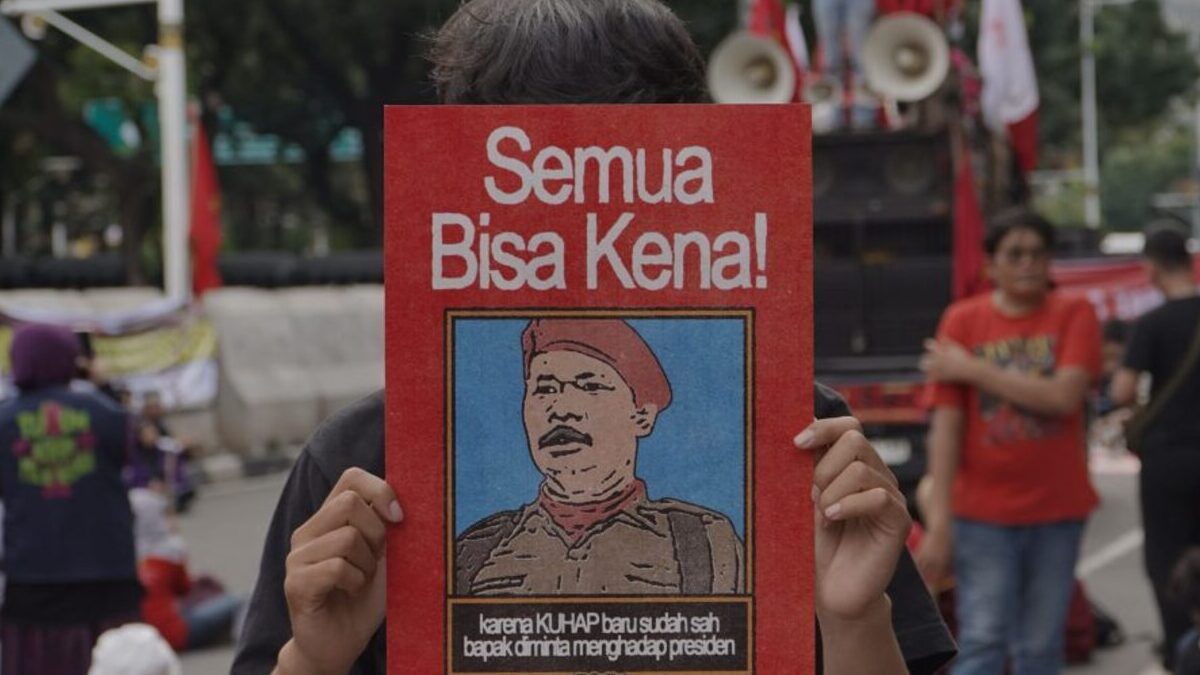
A viral Instagram reel released by the group portrayed the revised KUHAP as granting police “super power”, suggesting ordinary citizens could more easily be designated suspects. YLBHI’s media team said the reel was intended to make complex legal risks accessible to the public.
Protests intensified around Parliament as the bill neared passage. Demonstrators warned the revision would widen police authority without adequate checks.
KontraS representative Andri Yunus said the law should strengthen accountability but may instead enable abuse. Protesters issued five demands, including withdrawal of the bill, public release of the latest draft, and stronger judicial oversight.
Student groups such as BEM Universitas Padjadjaran backed the demands and pledged collective resistance.
What the revised KUHAP changes
The revised KUHAP contains 334 articles with major structural changes to criminal procedure. Among the most disputed elements is the expanded list of investigators, which critics say reinforces police dominance and undermines independent oversight.
Electronic reporting will be restricted to government-owned channels — a move civil-society groups fear could reduce transparency and accessibility.
The law expands pretrial review to all coercive measures, but exemptions for actions approved by judges and tight rules on who may file petitions have raised concerns about weakened accountability.
Another flashpoint is the ability to seize evidence without a court order in “urgent” situations, a term critics argue is vague and open to abuse.
Altered detention rules could allow suspects to be held beyond 24 hours, heightening concerns about prolonged detention when combined with limited pretrial rights.
While the draft boosts protections for victims and vulnerable groups, legal-aid organisations warn that weak enforcement could limit their real-world impact. The introduction of restorative justice and digital-justice systems has also raised questions over power imbalances, privacy, and risks of data misuse.
Political defence and sustained opposition
Chairman of Commission III Habiburokhman defended the legislative process, insisting that public input remained open until the final vote and citing invitations for organisations, including YLBHI, to join hearings.
YLBHI countered that the invitations were insufficient and said substantive objections raised during hearings were ignored.
Komnas HAM issued an assessment warning of constitutional concerns, particularly over expanded surveillance and risks of arbitrary detention. Legal experts echoed these alarms, pointing to ambiguous language and diminished judicial safeguards.