Josephine Teo says government does not intervene in editorial stance but expects responsible journalism
Josephine Teo said the government does not direct editorial positioning but expects media outlets to meet responsible journalism standards, responding to concerns over a Stomp article that drew public backlash.
- Josephine Teo said the government does not intervene in editorial decisions of media outlets.
- Media platforms, including Stomp, are expected to uphold responsible journalism standards under licensing rules.
- The comments followed parliamentary questions sparked by backlash over a Stomp article on a Toa Payoh hawker stall.
SINGAPORE: The government does not intervene in the editorial positioning of media outlets but expects them to uphold responsible journalism standards, Minister for Digital Development and Information Josephine Teo said on 12 January 2026.
Mrs Teo was responding to a parliamentary question from Pasir Ris–Changi GRC Member of Parliament Valerie Lee, who asked whether the government was concerned about the impact of SPH Media-run platform Stomp on public trust.
Ms Lee questioned the standards expected of state-supported platforms, noting that content published on Stomp often resembled tabloid-style coverage and could influence public perceptions of the media.
In a written parliamentary reply, Mrs Teo said the government does not direct or shape the editorial stance of individual newspapers or media outlets.
“Nevertheless, we expect all media outlets to uphold responsible journalism standards by ensuring their news reporting is accurate, fair and complies with the law,” she said.
Mrs Teo added that Stomp is individually licensed under the Online News Licensing Scheme, and is subject to specific content requirements.
She said licensees must comply with content standards designed to safeguard racial and religious harmony, public order, and good taste and decency.
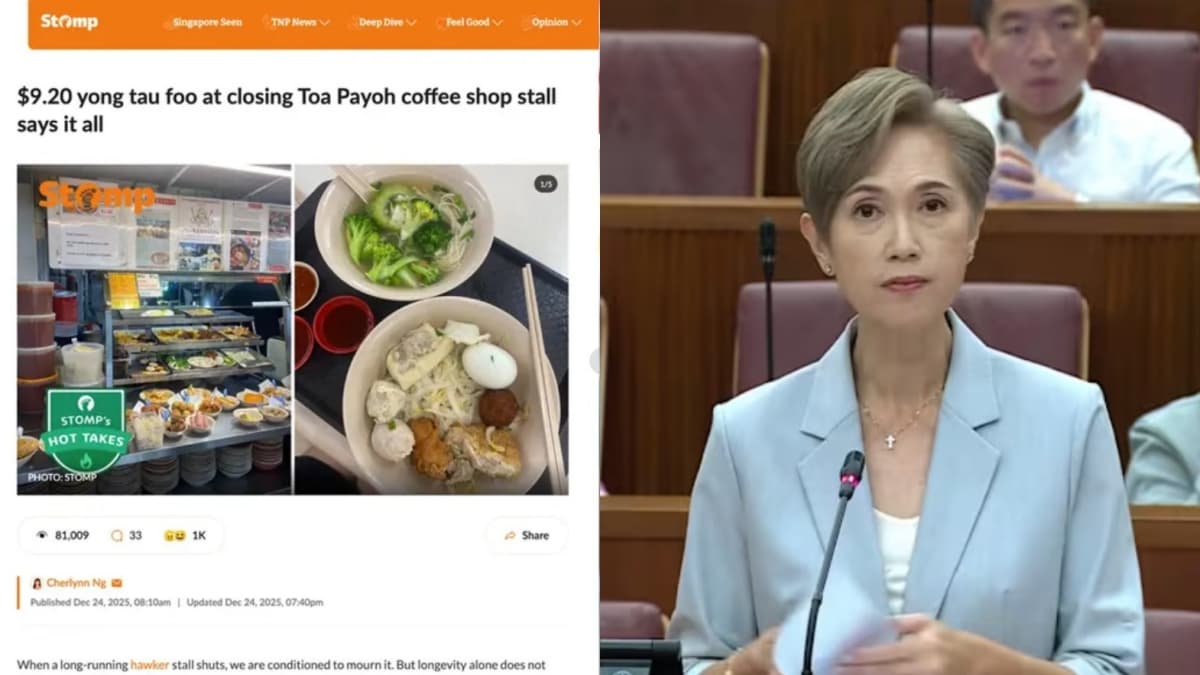
Stomp review of closing Toa Payoh hawker stall draws backlash from F&B community
Ms Lee’s question followed public backlash over a Stomp article published in December 2025 that reviewed food from a yong tau foo stall in Toa Payoh that is scheduled to close in January.
The article criticised the stall’s pricing, ingredients and portion sizes, and questioned the reasons given by the owners for shutting their business.
The stall, Hup Chong Yong Tau Foo, is a family-run operation with a history of about four decades in the neighbourhood.
The Stomp article was written by assistant editor Cherlynn Ng, who said she paid S$9.20 for a bowl of yong tau foo, which she described as excessive.
Ng wrote that she had “braced” herself for the price, but said her family and colleagues were “shocked” by the amount charged.
The article also challenged the stall’s explanation that nearby competition and work-from-home arrangements had affected business.
Ng suggested that the owners lacked “self-reflection” and implied that their pricing decisions may have contributed to the stall’s difficulties.
Following publication, the article drew widespread criticism online, with many commenters accusing it of lacking empathy and context.
Several days later, the stall’s owners responded in a Facebook post, saying they were “deeply hurt” by the article.
They said the piece misrepresented their pricing details and turned what was intended to be a quiet closure into a painful public experience.
Food and beverage operators and food critics also weighed in, highlighting broader economic pressures faced by hawkers.
According to comments shared publicly by industry figures including Lim Jialiang and KF Seetoh, rising costs for rent, labour and ingredients have made it increasingly difficult for hawkers to keep prices low.
They argued that hawkers cannot absorb such increases indefinitely while maintaining affordable food for customers.
Critics of the Stomp article said it focused narrowly on price and personal judgement, rather than situating the issue within wider structural challenges facing small food businesses.
Some commentators called for greater restraint and sensitivity in food journalism, particularly when covering family-run stalls nearing closure.
They said such reporting should aim to explore systemic pressures and sustainability issues, rather than framing difficulties as individual moral failings.
Stomp operates as a digital news platform and is one of several media brands under the SPH Media umbrella.
In February 2022, the government announced funding of up to S$900 million over five years for SPH Media Trust (SMT).
The support, capped at S$180 million annually, aimed to sustain quality journalism amid declining advertising revenues and audience migration to digital platforms.