About 15% of PSLE questions classified as ‘challenging’, says Janil Puthucheary
About 15 per cent of questions in each PSLE subject are classified as “challenging”, said Senior Minister of State for Education Dr Janil Puthucheary, adding that all questions remain within the school syllabus and do not require knowledge beyond it.
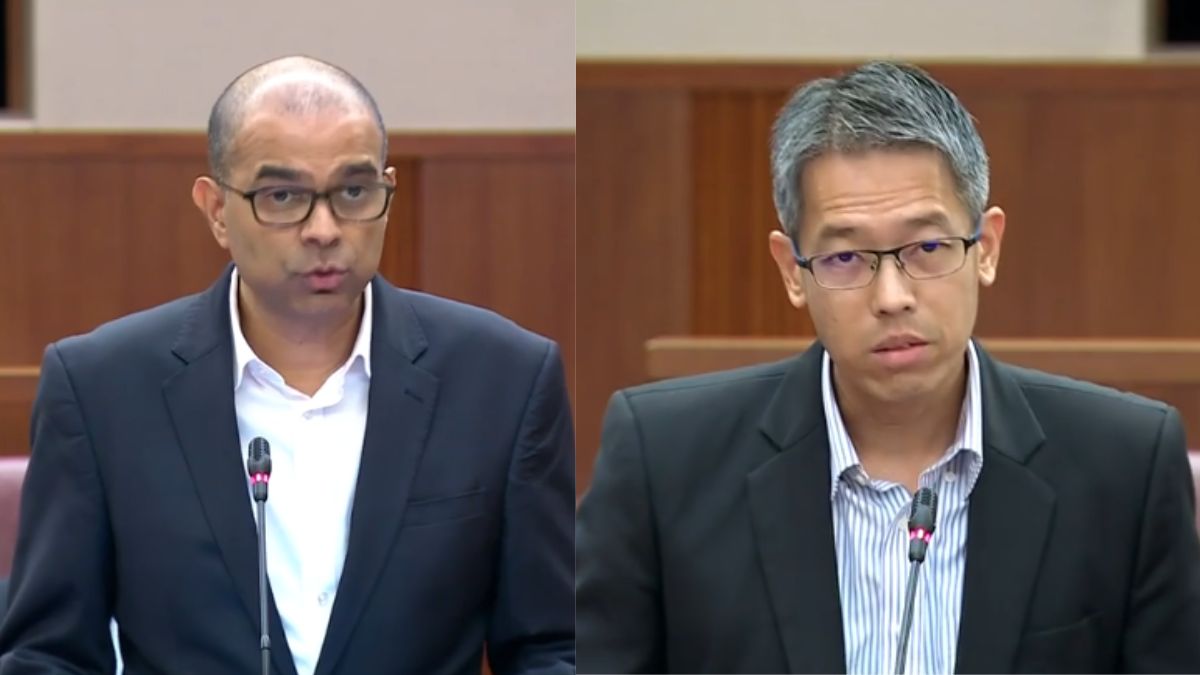
- About 15% of PSLE questions are classified as “challenging”, said Senior Minister of State for Education Dr Janil Puthucheary in response to WP MP Gerald Giam’s queries.
- All questions remain within the primary school syllabus and use age-appropriate language, with scaffolding to aid understanding.
- Higher-order questions are included to assess the full range of students’ academic abilities.
SINGAPORE: About 15 per cent of questions in each Primary School Leaving Examination (PSLE) subject are classified as “challenging”, said Senior Minister of State for Education Dr Janil Puthucheary in Parliament on Tuesday (4 Nov).
He explained that the PSLE is designed with questions of varying difficulty levels to allow students with different abilities to demonstrate their understanding.
The challenging questions, he said, require students to apply concepts learnt in novel or authentic contexts.
Dr Janil was responding to a parliamentary question from Workers’ Party Member of Parliament (MP) for Aljunied GRC, Gerald Giam, who had asked about the proportion of such questions in the 2025 PSLE papers for each of the four main subjects.
Giam also sought clarification on whether these questions required knowledge beyond the school syllabus, and what measures the Ministry of Education (MOE) had in place to ensure that students without access to private tuition would not be disadvantaged.
Questions Remain Within the Syllabus
Dr Janil emphasised that all PSLE questions, including the challenging ones, are based entirely on the primary school syllabus and do not require knowledge beyond it.
However, he noted that challenging questions require students to apply concepts in novel and authentic contexts.
“To ensure accessibility, all questions use age-appropriate language and contexts. In addition, challenging questions are often structured with scaffolding to help students attempt them progressively,” he said.
“These measures help to ensure that the PSLE remains accessible to all students, including those without private tuition.”
Giam Questions Teaching of Higher-Order Thinking Skills
In a follow-up question, Giam noted that answering such questions involves higher-order application of knowledge taught in school — including the ability to analyse, synthesise, evaluate and create solutions to complex problems.
“Are these higher-order application skills even taught in schools?” he asked. “Is there sufficient curriculum time to do that without overloading our teachers? Or are students expected to acquire them through private tuition?”
Giam also questioned the broader purpose of including such challenging questions in national exams if students are not taught in school how to answer them.
He cautioned that the inclusion of such questions could inadvertently become a “sorting mechanism” that benefits students from wealthier families who can afford tuition.
He pointed out that missing all the challenging questions in a PSLE paper could cap a student’s grade at AL3, potentially affecting their admission to competitive secondary schools.
Students Are Taught to Apply Concepts, Not Just Techniques
Dr Janil responded that higher-order questions are included to assess the full range of students’ academic abilities.
“There are students who can deal with these questions and need their cognitive and academic abilities assessed correctly. Without higher-order questions, these students would not be adequately assessed or served by the PSLE,” he said.
He added that students are not expected to rely on private tuition to learn how to tackle challenging questions. Instead, schools teach students how to apply their understanding to unfamiliar situations.
“This requires creativity, imagination, and problem-solving skills,” Dr Janil said.
“These skills are developed throughout the formal education system using concepts within the curriculum, and they are tested in combination with higher-order thinking in the PSLE framework.”
Giam then sought clarification on whether the ability to apply foundational concepts to challenging questions — what he referred to as “techniques” — was being taught in schools to all students.
Dr Janil replied, “He used the word ‘techniques’, implying that these are things one just follows from a checklist. These are skills, and a skill is not quite the same as a technique."
He added that the development of these skills is part of the formal curriculum and syllabus that all students go through.