
'Early CNY greetings?' Singapore food stall mocked for charging S$1 festive surcharge a month early
A S$1 “CNY surcharge” charged in early January by a curry chicken rice stall at Admiralty Place has amused and angered netizens, who questioned whether festive fees should apply more than a month before Chinese New Year.
- A curry chicken rice stall at Admiralty Place was criticised online for charging a S$1 “CNY surcharge” in early January, more than a month before Chinese New Year.
- Netizens questioned the legitimacy and transparency of the surcharge, with some calling it premature or misleading.
- Consumer guidelines from the Consumers Association of Singapore (CASE) stress the need for upfront disclosure of festive price increases.
SINGAPORE: A curry chicken rice stall at Admiralty Place has come under online scrutiny after a diner was charged a S$1 “Chinese New Year (CNY) surcharge” more than a month before the festival.
The issue surfaced after a screenshot of a receipt was shared on social media, prompting ridicule, debate, and broader discussion about festive price practices in Singapore’s food and beverage sector.
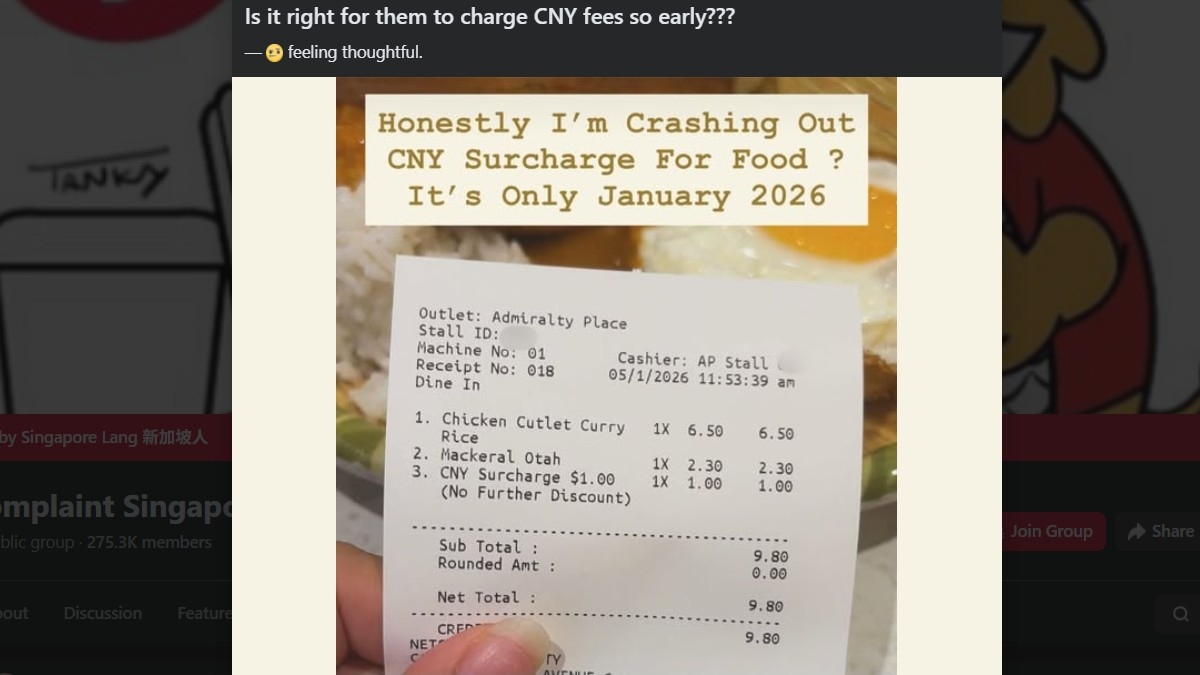
On 6 January, a netizen posted the receipt in the Singapore Facebook group Complaint Singapore.
The image showed a clearly itemised “CNY surcharge” added to the bill, despite Chinese New Year in 2026 falling on 17 February.
According to the receipt, the diner ordered a chicken cutlet curry rice priced at S$6.50 and a portion of mackerel otah costing S$2.30. A S$1 CNY surcharge brought the total bill to S$9.80.
In the caption accompanying the post, the netizen questioned whether it was appropriate to impose festive charges so early. “Honestly I’m crashing out. CNY surcharge for food? It’s only January 2026,” he wrote.
Netizens question fairness over early surcharge
The post quickly gained traction, drawing comments across Facebook and Reddit. Many users expressed disbelief at the timing of the surcharge rather than the amount itself.
Several commenters noted that CNY surcharges are typically applied during the festive period itself, often from Chinese New Year’s Eve to the second day of celebrations. Charging weeks in advance was seen as excessive by many.
Some users suggested that festive surcharges are more commonly associated with beauty services, such as hair salons or manicures, where higher labour costs during peak periods are often cited. They questioned whether the same logic should apply so early in food and beverage settings.
Argument over festive pricing norms and pricing transparency
Others said they would refuse to pay if confronted with a similar charge. One commenter wrote that they would cancel the order upon seeing such a surcharge, adding that they would scrutinise meal prices more closely in future.
Another user described the practice as “daylight robbery”, while others questioned whether the stall had clearly displayed a notice informing customers of the surcharge before ordering.
Transparency emerged as a recurring concern. Several commenters said that festive price increases are acceptable if clearly communicated, but objected when charges appear unexpectedly on receipts.
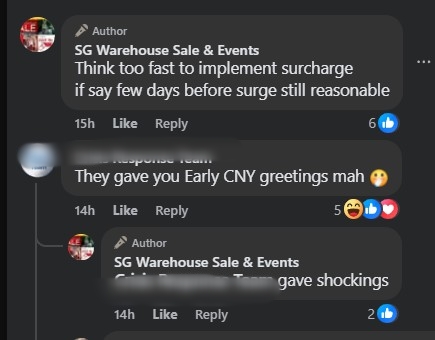
Some netizens responded with sarcasm, joking that the stall owner might be offering “early CNY greetings” through the surcharge.
Others took a more pragmatic stance, saying consumers could simply choose not to patronise stalls that impose early festive fees.

Comparisons were also drawn with common CNY practices elsewhere.
Some users shared that certain restaurants impose a 10 per cent increase or a flat surcharge of S$2 per dish during Chinese New Year’s Eve and the first two days of celebrations.
However, they argued that extending such charges to early January sets a troubling precedent. One commenter remarked that if businesses start charging so early, consumers’ only recourse is to stop buying from them.
Prior to CNY last year, consumer watchdog urges retailers to be upfront about CNY surcharges
The incident has also renewed attention on consumer guidelines issued by the Consumers Association of Singapore (CASE).
In January 2025, CASE urged sellers to be upfront about seasonal price increases during festive periods.
According to CASE, festive surcharges, often ranging from 10 to 30 per cent, are sometimes justified by higher labour costs, increased supply prices, and stronger demand.
However, the association stressed that transparency is critical.
CASE has previously received complaints from consumers about hidden or unexpected festive charges, particularly in services such as hairdressing, manicures, car washes, and vehicle grooming. In some cases, surcharges reached up to 30 per cent.
While festive surcharges are not illegal and are often considered industry norms, CASE has emphasised that consumers must be informed clearly and in advance. Failure to do so can erode trust and lead to disputes.
Consumers who feel they were charged unexpectedly can file complaints with CASE for assistance. CASE can be contacted via its hotline at 6277 5100 or through its official website.