Singapore couple alleges S$32 facial led to bill exceeding S$1,200 at beauty salon
A Singapore couple claimed a S$32 facial treatment escalated into a bill of more than S$1,200 after staff persuaded them to undergo multiple additional procedures. The salon denied misconduct, saying prices were transparent and consent was obtained.
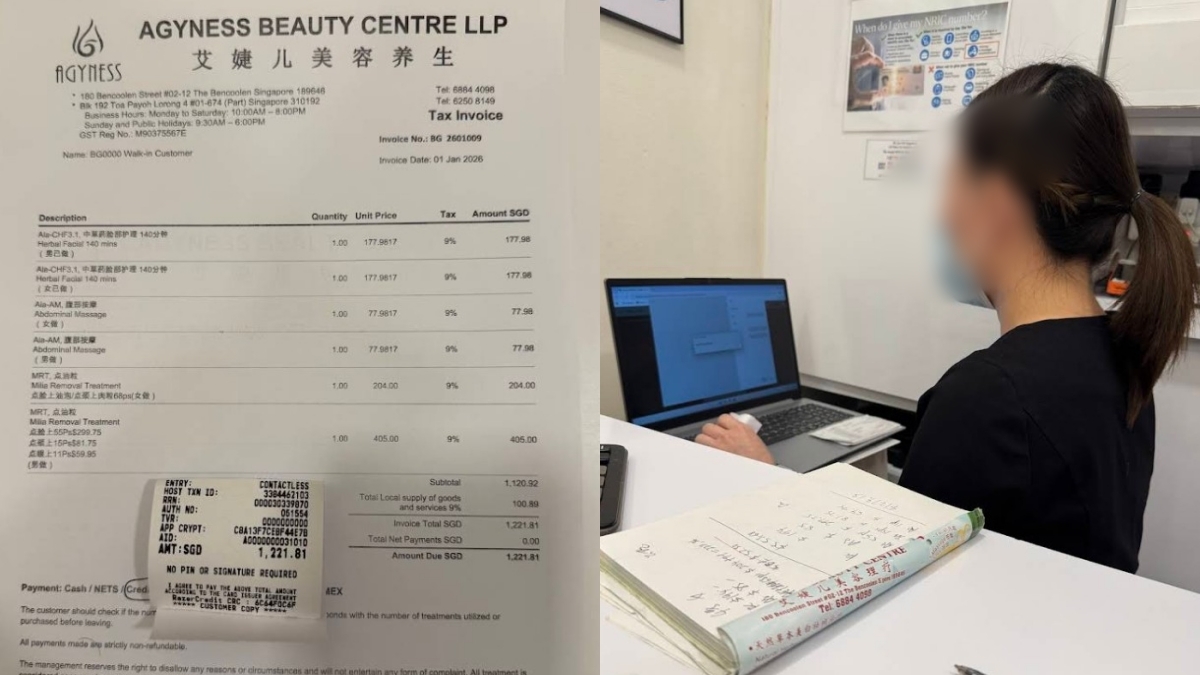
- A Singapore couple alleged a S$32 facial treatment escalated into a bill exceeding S$1,200 after multiple add-on procedures.
- The beauty salon denied wrongdoing, saying prices were displayed and consent was obtained before treatments proceeded.
- The case has renewed scrutiny of aggressive upselling practices in the beauty and hair industry, which remains a top source of consumer complaints.
A couple in Singapore have alleged that what began as a S$32 facial treatment at a city beauty salon escalated into charges exceeding S$1,200, following what they described as persistent persuasion to undergo additional procedures.
According to a report by Shin Min Daily News, the incident involved a 35-year-old woman, surnamed Pang, and her boyfriend, who visited Agyness Beauty Centre at The Bencoolen on 1 January 2026.
Pang said she had previously patronised the salon several months earlier for a S$5 mole removal and was not pressured into purchasing extra services during that visit, leaving her with a positive impression of the establishment.
During the January visit, Pang’s boyfriend opted for a S$32 facial treatment. Pang later agreed to undergo the same treatment after being persuaded by a staff member, according to Shin Min.
The couple were subsequently taken to separate rooms for their treatments.
Less than five minutes into her session, Pang said the beautician asked whether she wanted to upgrade to an S$88 package. She declined the offer, the report said.
Pain leads to costlier alternative
Pang later experienced pain when a device was used to treat pimples on her face. About 10 minutes later, a man who claimed to be the manager entered the room and commented that she appeared uncomfortable.
He suggested switching to a less painful alternative treatment, stating that it would cost S$194. He also told Pang that her boyfriend had agreed to the same option.
According to Pang, she eventually agreed to the switch as she was in significant pain at the time.
The beautician later asked whether Pang wanted to have her milia seeds removed, initially telling her that she had six and that the procedure cost S$3 per seed. Concerned about her skin condition, Pang agreed.
Partway through the session, the beautician said she had an upset stomach and was replaced by another staff member, Pang said.
The new staff member applied numbing cream and began counting the milia seeds. Pang said the count eventually reached 68.
“I didn’t want to continue anymore, but I felt I couldn’t refuse and just wanted the session to end,” Pang was quoted as saying by Shin Min.
The entire session lasted nearly three hours.
Shock at payment and police report lodged
Pang said she only realised the total cost exceeded S$1,200 when she went to make payment. Upset by the experience, she later lodged a police report.
She also shared her account in a Google review of the beauty centre, criticising what she described as aggressive upselling practices.
Based on the receipt she provided, 68 milia seeds were removed from Pang’s face and neck, while 81 were removed from her boyfriend’s face, neck and around his eyes.
Pang’s boyfriend said he had initially been told he had only 11 milia seeds.
Pang added that both of them were left with visible marks on their faces after the treatment and wore masks afterwards due to concerns over potential skin issues.
Salon denies wrongdoing, cites consent
Responding to the allegations, the salon’s manager, surnamed Zeng, told Shin Min that prices were clearly displayed and that consent had been obtained before all treatments were carried out.
She said the S$32 facial was a basic treatment, while the S$194 option was a herbal treatment recommended based on the customers’ skin conditions.
“If they disagreed, they could have refused payment and contacted the police on the spot,” Zeng said.
Pang also alleged that she had been persuaded to undergo a gastrointestinal massage after mentioning that her stomach felt slightly bloated. The massage reportedly cost about S$84 per person.
Zeng said the massage was recommended only after both Pang and her boyfriend mentioned gastrointestinal discomfort, adding that it could help improve digestion and skin condition.
She added that the price of milia seed removal depended on the size of the seeds and ranged from S$3 to more than S$20 per seed.
Zeng said Pang was charged S$3 per seed, while her boyfriend was charged S$5 per seed, and that customers could refuse the procedure at any stage, even after numbing cream had been applied.
Zeng further alleged that Pang had looked in the mirror and suggested removing all the milia seeds.
She added that the salon provided complimentary anti-inflammatory ointment after the procedure.
Other beauticians interviewed by Shin Min said milia seeds are typically removed as part of a treatment session rather than charged individually.
They added that only a small number are usually removed at a time due to pain and the lengthy healing process involved.
Longstanding concerns over aggressive upselling
The case has renewed attention on longstanding concerns over aggressive upselling in the beauty and hair industry.
In August 2025, the Hair and Cosmetology Association of Singapore (HACOS) called for stronger regulation after hair salons entered the Consumers Association of Singapore’s (CASE) top-10 list of most complained-about sectors for the first half of the year, with 167 complaints.
HACOS, which represents more than 300 members across the beauty, hair, makeup and nails industries, said increased oversight and minimum competency standards were necessary to raise professionalism and better protect consumers.
According to CASE figures released on 5 August 2025, complaints against hair salons ranked ninth among all industries between January and June, surpassing airlines.
High-pressure sales tactics, misleading or false claims among complaints against salons
CASE president Melvin Yong said complaints largely involved high-pressure sales tactics, misleading or false claims, hidden charges for add-on services and poor service.
Allegations of aggressive upselling and excessive charges have long plagued the industry.
In June 2025, the HairFun chain admitted to unfair trade practices after misleading elderly customers into purchasing expensive packages following free or low-cost haircuts.
In one case, an elderly man who went in for an S$8 haircut was charged nearly S$1,000 for a treatment package he had not consented to.