Singapore Nasi Lemak stall says S$1 ‘CNY surcharge’ on January receipt was charge for extra curry
A Nasi Lemak stall in Admiralty denied imposing a "CNY surcharge" in early January, saying a S$1 charge shown on a receipt was for extra curry and resulted from a cashier system error.
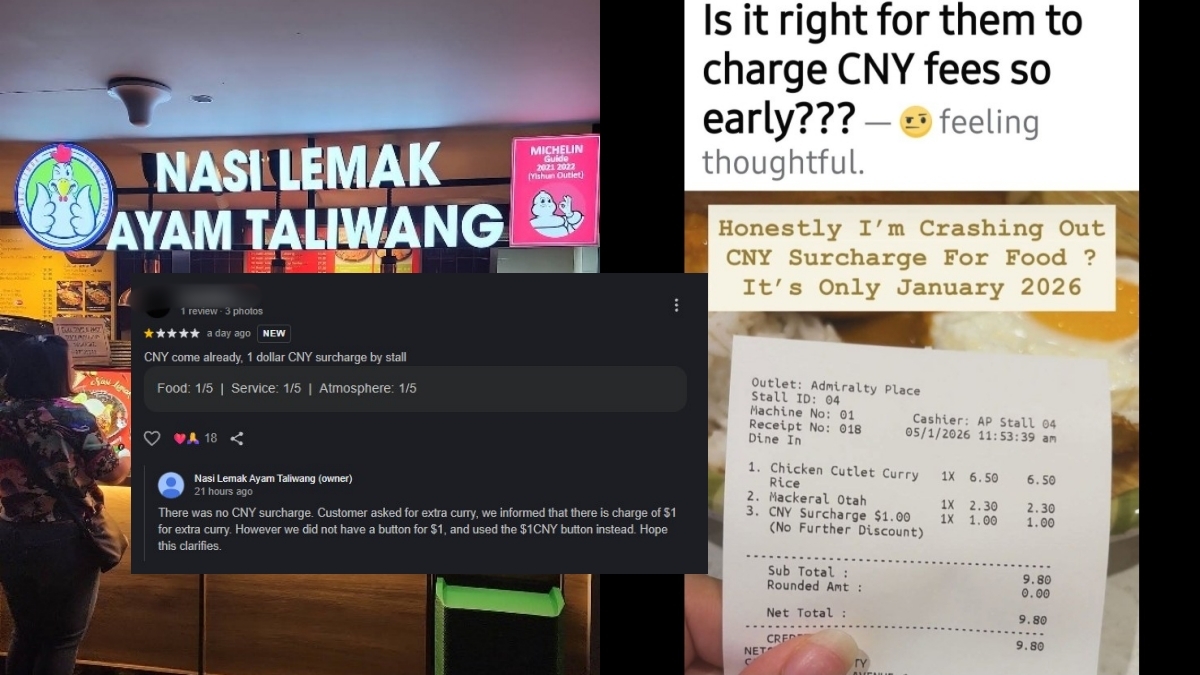
- A Nasi Lemak stall in Admiralty was accused of imposing a S$1 Chinese New Year surcharge in early January 2026.
- The stall and its operator said the charge was for extra curry and was wrongly labelled due to a cashier system limitation.
- Media reports said the issue was a misunderstanding and the system has since been corrected.
SINGAPORE: A Nasi Lemak stall at Admiralty has denied allegations that it imposed a "Chinese New Year (CNY) surcharge" month ahead the festive period, after a receipt showing a S$1 surcharge circulated widely online in early January 2026.
The controversy began on 6 January, when a netizen posted a photograph of a receipt in the Singapore Facebook group Complaint Singapore, questioning the legitimacy of the additional charge so far ahead of the festive period.
According to the receipt, the diner ordered a chicken cutlet curry rice priced at S$6.50 and a portion of mackerel otah costing S$2.30. A S$1 item labelled “CNY surcharge” was added, bringing the total bill to S$9.80.
Lunar New Year in 2026 falls on 17 February, prompting the poster to question whether festive pricing was being imposed prematurely.
In the caption, the netizen wrote that he was frustrated by what he perceived to be an unreasonable surcharge.
The post quickly drew attention, with commenters calling for a boycott of the stall and urging the contributor to reveal its name and location. Some netizens subsequently left negative reviews on the stall’s Google Maps listing.
The stall involved was later identified as Nasi Lemak Ayam Taliwang, located at the Kopitiam food court in Admiralty Place.
The food court houses nine stalls and is managed by FairPrice Group.
Stall owner explains there was no "CNY surcharge"
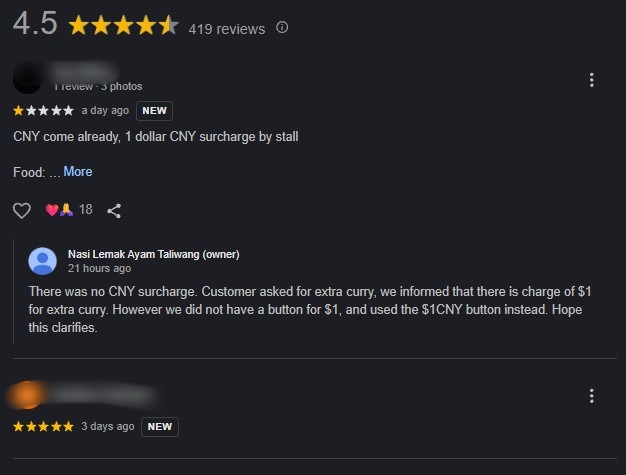
In response to the backlash, the stall addressed the allegation in a reply to a negative Google Maps review, stating that there was no “CNY surcharge” imposed on the customer.
The stall owner wrote that the S$1 charge was for extra curry requested by the customer.
The owner explained that staff had informed the customer of the additional cost at the point of order.
According to the explanation, the cashier system did not have a specific button for “extra curry”, and staff used an existing “CNY surcharge” button of the same value to record the charge.
The owner said this led to the misunderstanding and apologised for the confusion.
“There was no CNY surcharge. Customer asked for extra curry, we informed that there is charge of $1 for extra curry,” the response stated.
“However we did not have a button for $1, and used the $1 CNY button instead.”
Local Mandarin daily Lianhe Zaobao reported on 7 January that the stall responded formally to its inquiry, reiterating that the wording on the receipt was due to a technical issue with the cashier system.
A spokesperson for the Nasi Lemak chain said the matter had been resolved and stressed that the amount charged was correct, as it corresponded to the cost of the additional curry sauce requested by the customer.
The spokesperson added that the stall would continue to pay attention to price transparency and ensure that the cashier system accurately reflects all transaction items in future.
Staff had informed the customer of the extra cost, but did not clearly explain why the receipt reflected a “CNY surcharge”, resulting in confusion.
Zaobao also reported that the boss of Nasi Lemak Ayam Taliwang provided CCTV footage of the transaction, which the stall said showed that the charge arose from a misunderstanding rather than an intentional festive surcharge.
An employee interviewed by the newspaper said that the festive surcharge is only applied on the first and second days of the Lunar New Year, and not in the weeks leading up to the festival.
FairPrice Group, which manages the Kopitiam food court, also responded to Zaobao’s queries on 7 January. A spokesperson said the appearance of the “CNY surcharge” label on the receipt was caused by a technical error in the cashier system.
The spokesperson said the issue had been quickly rectified, and reiterated that the amount charged matched the cost of the add-on item. The group said it would work with stallholders to prevent similar issues from recurring.
Prior to CNY last year, consumer watchdog urges retailers to be upfront about CNY surcharges
The incident has also renewed attention on consumer guidelines issued by the Consumers Association of Singapore (CASE).
In January 2025, CASE urged sellers to be upfront about seasonal price increases during festive periods.
According to CASE, festive surcharges, often ranging from 10 to 30 per cent, are sometimes justified by higher labour costs, increased supply prices, and stronger demand.
However, the association stressed that transparency is critical.
CASE has previously received complaints from consumers about hidden or unexpected festive charges, particularly in services such as hairdressing, manicures, car washes, and vehicle grooming. In some cases, surcharges reached up to 30 per cent.
While festive surcharges are not illegal and are often considered industry norms, CASE has emphasised that consumers must be informed clearly and in advance. Failure to do so can erode trust and lead to disputes.
Consumers who feel they were charged unexpectedly can file complaints with CASE for assistance. CASE can be contacted via its hotline at 6277 5100 or through its official website.