Singapore counts 496 rough sleepers in 2025 single-night street count; MSF pledges S$450k homelessness fund
Singapore counted 496 rough sleepers in July 2025, down from 2022 levels. MSF said family conflicts, not housing supply alone, drive rough sleeping, and announced a new S$450,000 fund to support community-led solutions.
- MSF recorded 496 rough sleepers in its July 2025 single-night street count, a 6.4 per cent decrease from 2022.
- Nearly half of surveyed rough sleepers had a home to return to, with family or co-tenant conflicts cited as a key reason for sleeping rough.
- The ministry will launch a S$450,000 (US$349,896) Partnership to Tackle Homelessness fund from 1 April 2026.
Singapore recorded 496 rough sleepers in a nationwide single-night street count conducted on 18 July 2025, according to a report released by the Ministry of Social and Family Development (MSF) on 9 January 2026.
The figure represents a 6.4 per cent decrease from the 530 rough sleepers counted during the previous nationwide count in 2022, MSF said.
Rough sleepers are defined as individuals who sleep in public spaces, regardless of whether they have housing. This includes those without a home and those unable to return to their homes.
Homeless persons, by contrast, are those without access to adequate housing. Not all homeless persons sleep rough, as some stay in shelters or temporary accommodation while seeking longer-term housing.
Scope and methodology of the count
The July 2025 exercise was Singapore’s second nationwide “single-night street count”.
It was designed as a point-in-time count to provide a comprehensive snapshot of rough sleeping patterns while minimising duplicate counting.
Volunteers initially recorded 573 observations.
Of these, 77 were excluded after checks confirmed the individuals did not meet the criteria of a rough sleeper or were foreign nationals, the report stated.
More than 800 volunteers from public agencies, community organisations and the public took part in the exercise. All Urban Redevelopment Authority (URA) planning areas that were safe and accessible on foot at night were covered.
Areas excluded included offshore islands, cemeteries, military zones, water catchment areas, gated residential estates, and unsafe or poorly lit industrial zones.
Geographic distribution across planning areas
The count identified rough sleepers in 35 of Singapore’s 36 URA planning areas.
Tengah was the only area where none were recorded.
Bukit Merah and Jurong West recorded the highest numbers, with 39 rough sleepers each. Bedok followed closely with 38.
In 2022, Kallang had the highest count, with 50.
MSF noted that the number of planning areas with more than 20 rough sleepers declined marginally from nine in 2022 to eight in 2025. This reflected a “declining concentration” across planning areas.
The profile of rough sleepers remained broadly consistent.
About 85 per cent were male, and more than half were aged over 50.
Around 36 per cent were aged between 31 and 50, while 6 per cent were aged 30 and below.
Following the street count, MSF conducted a detailed survey between July and August 2025.
The survey involved 128 rough sleepers, representing 26 per cent of those counted on 18 July.
Expert advice for both the count and survey was provided by Dr Harry Tan from the Policy Lab at the Institute of Policy Studies, and Emeritus Professor Ho Kong Chong from the Yale-NUS Urban Studies Programme and the Department of Sociology and Anthropology at the National University of Singapore.
Duration and recurrence of rough sleeping
The survey found that 77 per cent of respondents had been sleeping rough for more than a year, while 70 per cent said it was not their first experience of rough sleeping.
“This suggests that some may be entrenched, possibly due to the complex and interconnected issues they face, and their reluctance to seek help despite the various support offered,” the report said.
Housing access and underlying causes
Despite prolonged periods of rough sleeping, 47 per cent of respondents indicated that they had a home to return to. These included public rental flats, purchased homes, or the homes of family members or friends.
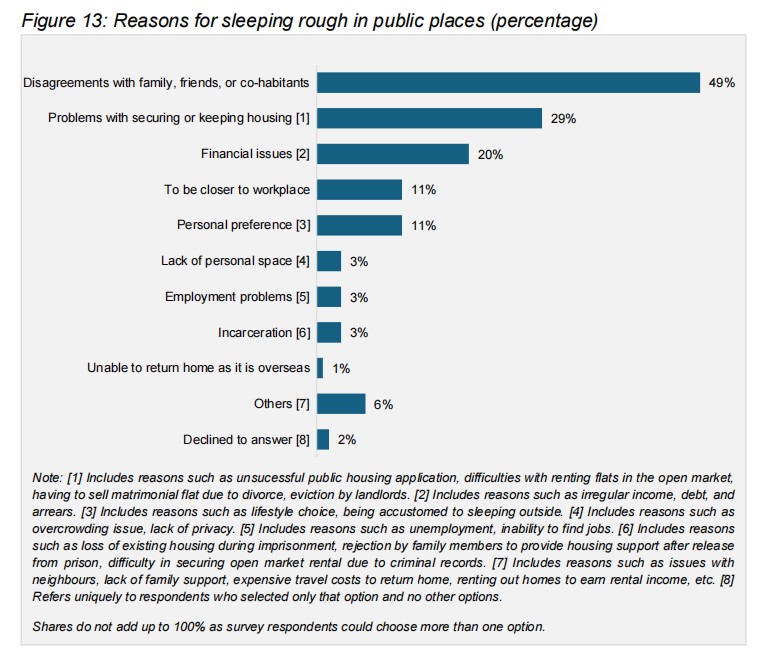
Almost half of respondents, or 49 per cent, cited disagreements with family members, friends or co-tenants as the main reason for sleeping rough. MSF said this highlighted that housing availability alone did not explain the issue.
Other contributing factors included difficulties securing or maintaining housing, cited by 29 per cent, and financial struggles, cited by 20 per cent.
Employment and income levels
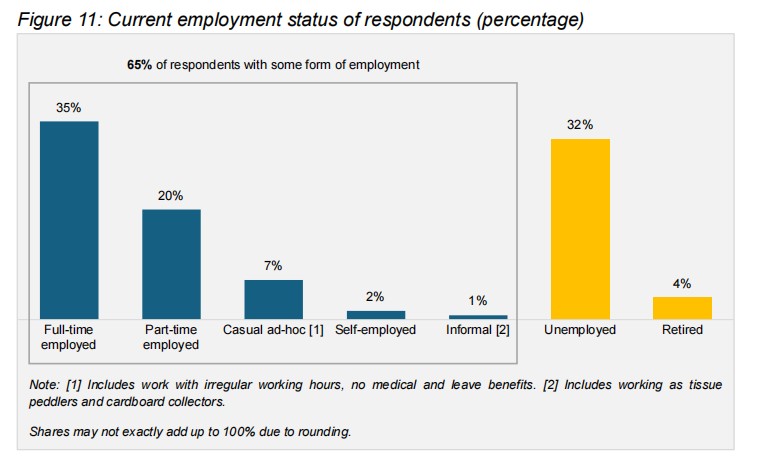
On employment, 65 per cent of respondents reported having some form of work.
About 35 per cent were in full-time employment, while 20 per cent worked part-time.
Among those employed, more than 70 per cent earned below S$2,000 (US$1,558) a month. A further 20 per cent earned between S$2,000 and S$3,999.
Of the 32 per cent who were unemployed, most said they were actively seeking work.
Health concerns among respondents
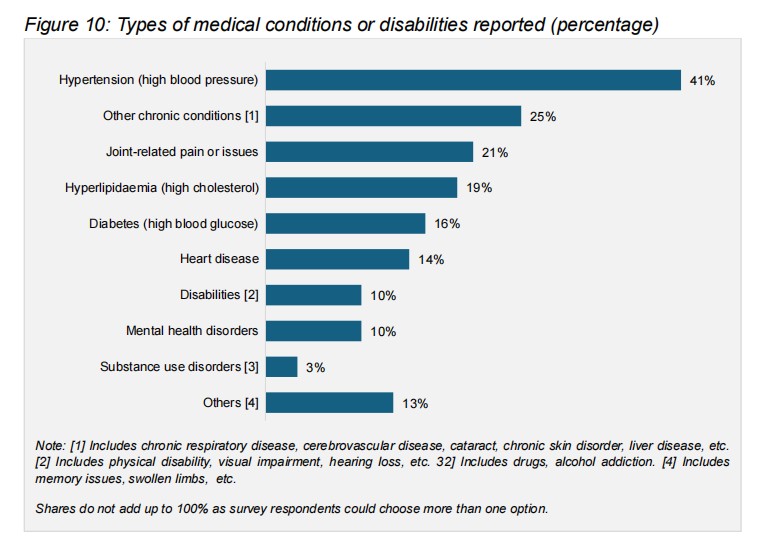
Health concerns were also prevalent. Nearly half of respondents reported having medical conditions or disabilities.
Hypertension, chronic illnesses and joint-related issues were among the most common conditions cited.
Speaking to the media at the Yio Chu Kang transitional shelter, Senior Parliamentary Secretary for Law, Social and Family Development Eric Chua said rough sleeping was often misunderstood.
He said it was a misconception that rough sleeping was a crime, and urged the public to show care and empathy rather than viewing rough sleepers as a problem.
New funding and shelter enhancements
To strengthen support, MSF announced it will launch a new S$450,000 Partnership to Tackle Homelessness (PATH) fund. Applications will open on 1 April 2026.
The fund will support community organisations in piloting solutions that address underlying causes of rough sleeping, including medical, psychological and social support.
MSF has also partnered transitional shelters at Yio Chu Kang and Jalan Kukoh to redesign units with more privacy and storage space, aiming to encourage greater uptake of shelter support.