
Singapore MRT reliability declined in 2025 compared with 2024 due to weaker performance on four lines
Singapore’s MRT network saw a decline in reliability in 2025 compared with the previous year, driven by weaker performance on four lines, even as overall reliability remained above national targets, according to the Land Transport Authority.
- Singapore’s MRT network was less reliable in 2025, with mean kilometres between failure falling from 2024 levels, though it remained above the national target.
- Four MRT lines recorded poorer performance, while the Circle Line showed significant improvement year on year.
- The Land Transport Authority expanded its rail reliability reporting and a taskforce has proposed reforms to address system gaps.
Singapore’s MRT network was less reliable in 2025 than in the previous year, due largely to poorer performance on four of its five established MRT lines, according to figures released by the Land Transport Authority (LTA).
Overall, trains across the MRT network travelled an average of 1.606 million train-km between delays in 2025, down from 1.982 million train-km in 2024, LTA said in its latest monthly rail reliability report released on 16 January.
Despite the decline, the network continued to exceed Singapore’s rail reliability target of one million train-km.
Overall MRT reliability slips but remains above national benchmark
This benchmark is measured using mean kilometres between failure (MKBF), the standard engineering indicator used to assess rail reliability.
MKBF measures the average distance travelled by trains before a delay lasting more than five minutes occurs. The metric does not reflect the severity or passenger impact of individual disruptions.
Of the five MRT lines assessed, only the Circle Line showed a marked improvement in 2025 compared with the previous year. The Thomson-East Coast Line was excluded from overall reliability calculations as it remains a new line.
LTA said its MKBF figures are calculated using a 12-month moving average, providing a rolling assessment of network performance rather than a snapshot of individual incidents.
Circle Line bucks trend as most lines weaken
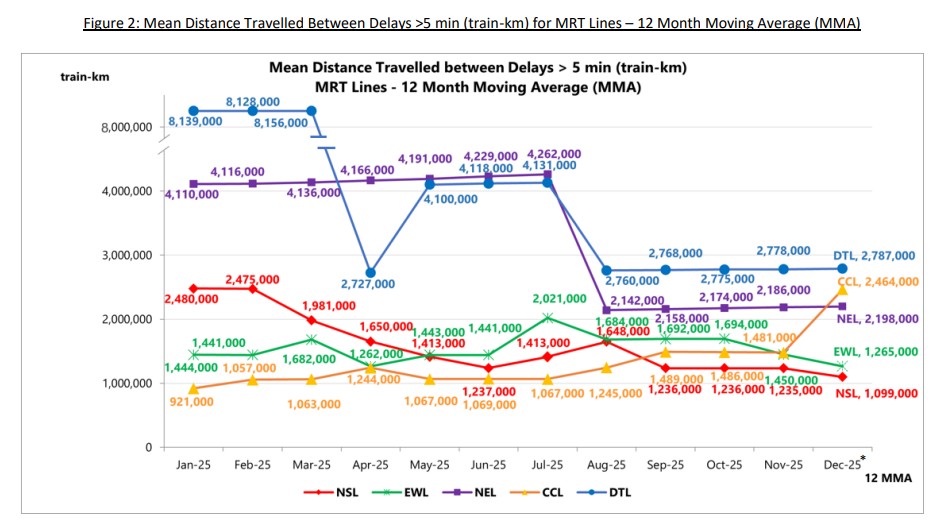
By line, the Downtown Line remained the most reliable in 2025, recording 2.787 million train-km between failures.
This was a significant decline from 8.131 million train-km in 2024, but still placed the line at the top of the rankings.
The Circle Line ranked second, with 2.464 million train-km in 2025, a substantial improvement from 919,000 train-km the year before. This allowed it to overtake the North East Line.
The North East Line averaged 2.198 million train-km in 2025, down from 4.101 million train-km in 2024. It was followed by the East-West Line, which recorded 1.265 million train-km, compared with 1.687 million train-km previously.
North-South Line records weakest performance
The weakest performer was the North-South Line, where MKBF fell from 2.485 million train-km in 2024 to 1.099 million train-km in 2025.
Across the MRT network, there were seven service disruptions lasting longer than 30 minutes in 2025, unchanged from the number recorded in 2024, according to LTA’s data.
In 2025, the East-West Line, Circle Line and Downtown Line each experienced two such major disruptions, while the North East Line had one. No major disruptions were reported on the North-South Line.
Punctuality improves slightly despite reliability decline
Beyond reliability, LTA also expanded its reporting to include punctuality and the proportion of trains running according to schedule, offering a broader view of network performance.
In 2025, 99.84 per cent of MRT train services completed scheduled trips within two minutes of their planned timings, up from 99.78 per cent in 2024.
The East-West Line was the only MRT line to show improvement in this measure, increasing by 0.4 per cent.
The North-South, North East, Circle and Downtown lines all saw slight declines of between 0.02 per cent and 0.13 per cent.
Overall train punctuality across the MRT network edged up to 99.38 per cent in 2025, from 99.35 per cent the year before.
The East-West, Circle and Downtown lines improved marginally, while the North-South and North East lines dipped slightly.
Thomson-East Coast Line excluded from network reliability results
The Thomson-East Coast Line, operated by SMRT, continues to be excluded from overall reliability results due to its lower mileage and operating frequency at this stage of development.
In 2025, trains on the Thomson-East Coast Line travelled 325,000 train-km, compared with 459,000 train-km in 2024. The line improved slightly in scheduled-trip completion to 99.62 per cent, while overall punctuality slipped by 0.1 per cent to 99.6 per cent.
Singapore’s Light Rail Transit network performed better in 2025, with trains travelling 429,000 car-km between failures, up from 382,000 car-km in 2024.
The Sengkang-Punggol LRT recorded 1.025 million car-km in 2025, nearly doubling its 549,000 car-km figure from the previous year. Bukit Panjang LRT posted 199,000 car-km, down from 232,000 car-km in 2024.
LTA reviewing Rail Reliability Taskforce's recommendation, to provide response by 1Q2026
LTA said in a press statement that it remains committed to working with rail operators to improve reliability across the rail network.
The authority also confirmed that the Ministry of Transport is reviewing recommendations from the Rail Reliability Taskforce and will provide a full response by the first quarter of 2026.
The taskforce, formed in September 2025 after at least 15 disruptions across MRT and LRT lines between July and September, submitted its recommendations on 30 December 2025 to Acting Transport Minister Jeffrey Siow.
Following technical audits and reviews of operations, maintenance and incident response, the taskforce identified gaps in backup systems, asset renewal, workforce capabilities and commuter management.
Its proposals include faster renewal of core systems, expanded use of data, automation and robotics, stronger engineering training and certification, and improved service recovery and passenger communication during disruptions.