Migration-background population in South Korea reaches record 5.2 percent in 2024
Migration-background individuals accounted for 5.2% of South Korea’s population in 2024, with more than half residing in the capital region, official data from the National Data Office show.
- People with a migration background reached 2.72 million in 2024, or 5.2% of South Korea's population.
- Over 56% live in the capital region (Gyeonggi, Seoul, Incheon), with Gyeonggi Province alone accounting for nearly one-third.
- Migration-background youth (under 25) now exceed 738,000, with the largest share having Vietnamese roots.
South Korea's population with a migration background surpassed 2.7 million in 2024, marking the first time it accounted for more than 5 percent of the national total, according to data released by the National Data Office on 8 December 2025.
As of 1 November 2024, the number of people with a migration background stood at 2,715,074, comprising 5.2 percent of the country's total population of approximately 51.8 million.
This marked a 0.3 percentage point increase from the previous year, continuing a trend of gradual demographic change driven by both foreign immigration and domestic integration of naturalised citizens and their children.
This was also the first time the National Data Office employed a registration-based census approach to quantify this demographic, drawing on 27 administrative databases from 13 government agencies to compile a detailed national snapshot.
Foreigners and naturalised citizens
Of the total migration-background population, foreign nationals made up 75.2 percent, or 2.04 million people, while 672,000 individuals (24.8 percent) were South Korean nationals with at least one parent who had migrated, had naturalised, or had other forms of recognised migrant heritage.
This included 380,928 second-generation immigrants, and 245,372 naturalised or acknowledged citizens, such as those granted citizenship through legal processes or as family members of naturalised parents.
Age and gender patterns
Demographically, the population skewed younger and slightly male. Men accounted for 52.5 percent of the migration-background population, with a sex ratio of 110.7 males per 100 females. The imbalance was most pronounced among foreign nationals, with a ratio of 132.6, compared to a ratio of 26.5 among naturalised South Korean women, suggesting gendered patterns in both migration and naturalisation.
By age, the working-age group (15 to 64) represented the vast majority at 81.9 percent, while those aged 14 or younger made up 12.7 percent, and those 65 or older accounted for 5.5 percent. The largest single age group was individuals in their 30s, who comprised 24.3 percent of the total, followed by those in their 20s at 21 percent.
People in their 20s represented the fastest-growing cohort, increasing by 8 percent year-on-year — more than 42,000 individuals — signalling continued inflows of young foreign workers and family reunification cases.
Rapid growth among youth
Children and adolescents aged 24 or younger with a migration background totalled 738,079 in 2024, a 7.9 percent increase from the previous year. This group now represents over a quarter (27.2 percent) of all people with migration backgrounds in the country.
Of these, 50.3 percent were foreigners, while 44.9 percent were second-generation immigrants — South Korean nationals born to at least one migrant parent. The remainder were naturalised minors or individuals in transitional status.
The most common parental nationality among this youth population was Vietnamese, accounting for 27.2 percent, followed by Chinese at 16.5 percent, and ethnic Koreans from China at 12 percent. Combined, these three groups made up more than half of the migration-background youth population.
Strong concentration in the capital region
Geographically, the migration-background population remained heavily concentrated in urbanised and industrialised regions, particularly the greater Seoul metropolitan area.
According to the National Data Office, 56.8 percent of all migration-background residents lived in Gyeonggi Province (32.7%), Seoul (17.5%), and Incheon (6.6%). These areas have historically attracted foreign workers, multicultural families, and foreign-born spouses due to their economic infrastructure and support services.
Beyond the capital, other notable shares were recorded in South Chungcheong (6.5%) and South Gyeongsang (6.2%).
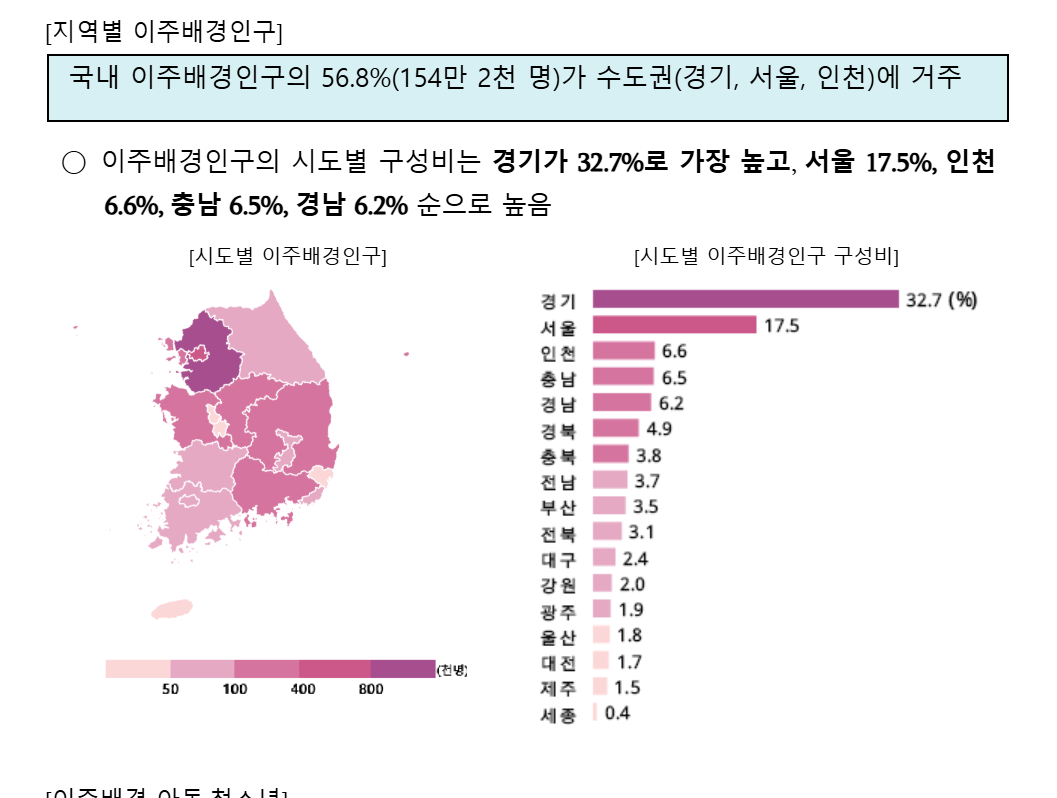
Distribution of South Korea’s migration-background population by region as of 2024, with the highest concentrations in Gyeonggi Province (32.7%), Seoul (17.5%), and Incheon (6.6%).
Municipal areas with highest ratios
The statistics also highlight cities and counties where migration-background residents make up a significant portion of the local population.
In Yeongam County (Jeonnam), they comprised 21.1 percent of the population — the highest rate in the country. Eumseong County (Chungbuk) followed at 19.9 percent, and Ansan City (Gyeonggi) at 16.1 percent.
Ansan City also had the highest number of migration-background residents in a single municipality, totalling 113,000 people, or 4.2 percent of the national total. It was followed by Hwaseong (85,000) and Siheung (81,000), both also in Gyeonggi Province.
Statistical approach and implications
The data were compiled using a registration-based census methodology that includes only individuals who had resided in Korea for three months or more as of the reference date, 1 November 2024.
The National Data Office noted that these figures are expected to play a critical role in evidence-based policymaking, particularly in education, labour integration, multicultural support programmes, and local government planning.