Thai authorities probe deadly crane collapse on China-backed rail line amid fresh safety concerns
A crane collapse at a China-backed high-speed rail construction site in Thailand has killed at least 32 people, raising fresh questions about site safety, particularly for the contractor Italian-Thai Development, which has faced prior incidents.
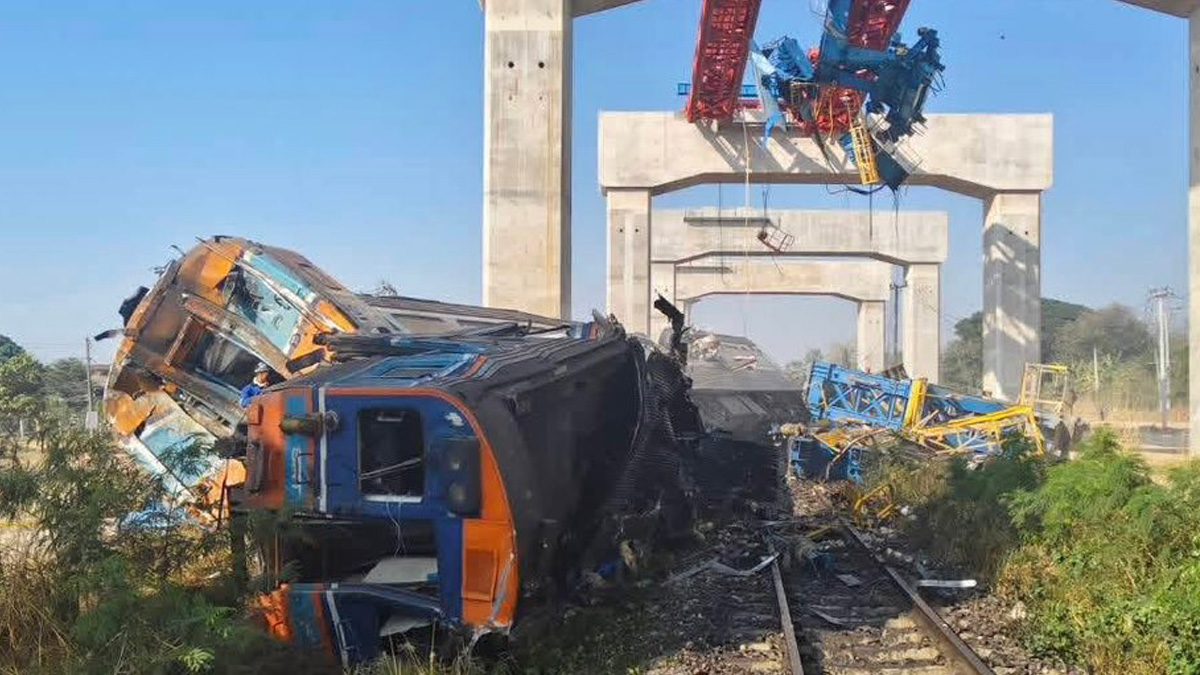
- A crane collapsed onto a passenger train in Thailand, killing at least 32 and injuring 64 others.
- The crane belonged to Italian-Thai Development, the contractor for a China-backed high-speed rail project.
- A separate crane accident occurred the next day on Rama II Road, killing two and injuring five.
At least 32 people were killed and 64 others injured after a crane collapsed onto a moving passenger train in Nakhon Ratchasima Province, Thailand, on 14 January, authorities confirmed.
The crane was part of construction operations for a China-backed high-speed rail project, a multi-billion-dollar initiative intended to link Bangkok with Kunming via Laos by 2028, under Beijing’s Belt and Road Initiative.
Footage verified from the scene showed smoke rising from the mangled remains of the train, with the crane’s twisted structure resting atop concrete pillars. Rescue workers laboured into the evening to recover bodies and search for the missing, using other cranes to shift the wreckage.
According to the Thai Ministry of Public Health, 32 fatalities were confirmed, with three people still unaccounted for. Among the 64 hospitalised, seven remain in serious condition.
Witness Mitr Intrpanya, 54, described the moment of impact: “I heard a loud noise, like something sliding down from above, followed by two explosions. When I went to see what had happened, I found the crane sitting on a passenger train with three carriages. The metal appeared to slice the middle carriage in half.”
The company contracted to build the section where the crane collapsed, Italian-Thai Development (ITD), is one of the largest construction firms in Thailand. The company has faced repeated scrutiny over its safety record following multiple fatal incidents at its sites in recent years.
In a statement issued after the collapse, ITD offered condolences to victims and pledged to “take responsibility for compensating the victims’ families and covering medical expenses for those injured.”
Theerachote Rujiviphat, an engineering consultant adviser with China Railway Design Corp, said the launching crane belonged to ITD and that the company was solely responsible for the collapse. He also referenced a similar prior accident under ITD’s responsibility.
Prime Minister Anutin Charnvirakul responded to the tragedy by calling for legislative reform to prevent repeated negligence. “These kinds of incidents happen very regularly,” he said. “It is time to change the law to blacklist construction companies that are repeatedly responsible for accidents.”
The collapse occurred during ongoing works to build a US$5 billion high-speed railway, one of the flagship Belt and Road projects in Southeast Asia. The rail link aims to reduce travel times and enhance economic connectivity between Thailand and China.
The latest incident has intensified concerns about construction safety standards in Thailand’s infrastructure projects. A day after the train accident, another crane-related tragedy occurred in Samut Sakhon province.
At approximately 9am on 15 January, parts of a construction crane collapsed onto vehicles on Rama II Road, a major highway connecting Bangkok to the southern provinces. According to Pol Lt Pirote Pinthip of the Muang Samut Sakhon police station, two people were killed and five were injured.
FM91 Trafficpro reported that the crane was part of an expressway bridge construction. The crane fragments struck two vehicles, causing immediate fatalities and serious injuries. Authorities temporarily closed both inbound and outbound lanes, leading to significant traffic congestion.