Shallow earthquake jolts Yogyakarta region, no damage reported
A shallow earthquake struck northeast of Bantul Regency in Yogyakarta on Tuesday afternoon, rattling buildings across the region but causing no reported damage or injuries, according to Indonesia’s meteorology agency.

- A shallow magnitude-4.4–4.5 earthquake struck northeast of Bantul Regency on 27 January 2026.
- Strong tremors were felt across Yogyakarta and surrounding districts, but no damage or casualties were reported.
- BMKG linked the quake to activity along the Opak Fault and confirmed there was no tsunami risk.
A shallow earthquake struck the northeast of Bantul Regency in Indonesia’s Special Region of Yogyakarta on Tuesday afternoon, 27 January 2026, sending strong tremors across the provincial capital and neighbouring districts but causing no reported damage or casualties.
Indonesia’s Meteorology, Climatology and Geophysics Agency (BMKG) recorded the earthquake at 1:15 pm local time (Western Indonesian Time, WIB), with a magnitude of 4.4–4.5. The epicentre was located on land at coordinates 7.87 degrees south latitude and 110.49 degrees east longitude, approximately 16 kilometres east of Bantul Regency, at a depth of about 11 kilometres.
Because of its shallow depth, the tremor was clearly felt across a wide area, including Yogyakarta City, Sleman, Gunung Kidul, and Kulon Progo. Residents reported brief moments of panic as buildings shook and household items rattled.
“The shaking was sudden and quite strong,” said Farida, a resident of Ngemplak in Sleman. “The house was shaking and objects were rattling. I immediately ran outside because I was afraid.” Neighbours in her area also rushed into the street to check on one another’s safety.
Linked to Opak Fault activity
BMKG said the afternoon earthquake was a shallow tectonic event triggered by activity along the Opak Fault, a known geological structure that runs through parts of Yogyakarta and has been associated with damaging earthquakes in the past.
Based on the Modified Mercalli Intensity (MMI) scale, the quake reached intensity III in Bantul, Yogyakarta City, Sleman, Gunung Kidul, Kulon Progo, and Klaten—levels at which vibrations are felt indoors and likened to the passage of a heavily loaded truck. Weaker shaking at intensity II was felt as far away as Wonogiri, Purworejo, Surakarta (Solo), Pacitan, Magelang, and parts of East Java.
BMKG confirmed that the earthquake carried no potential to trigger a tsunami.
A day of multiple tremors
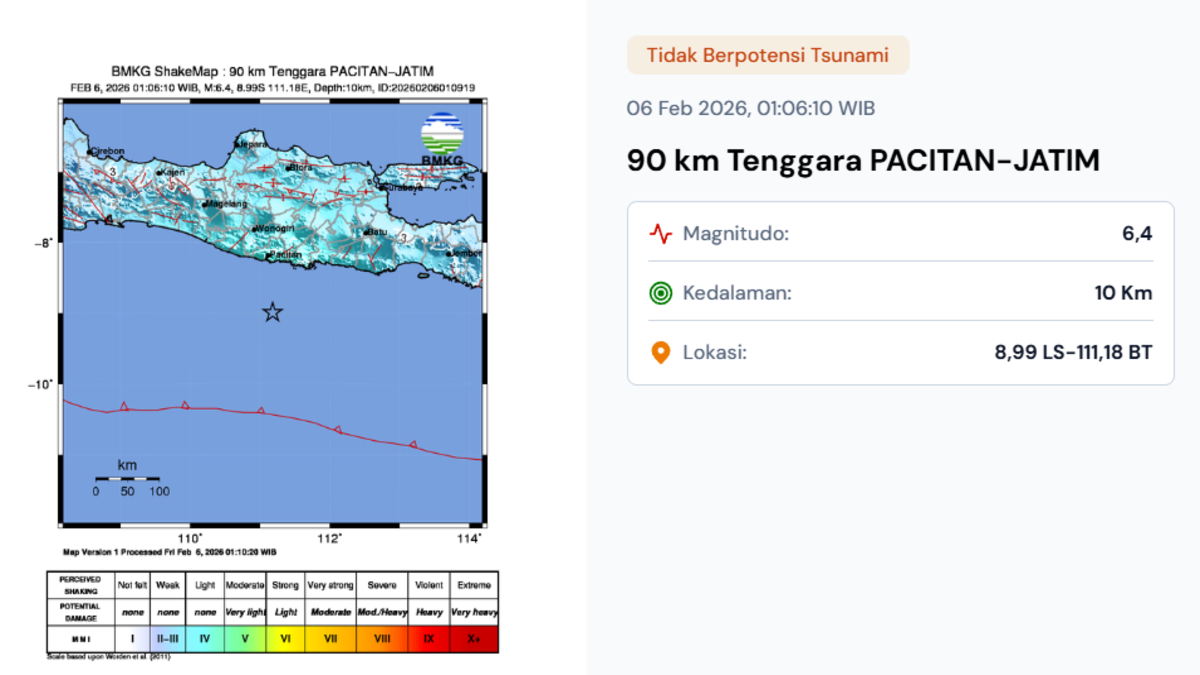
The afternoon jolt was the second earthquake felt in the Yogyakarta region on the same day. Earlier, at around 8:20 am WIB, a stronger magnitude-5.5 earthquake struck off the coast near Pacitan in East Java. That morning quake was felt across a broad swathe of Java and Bali, including Yogyakarta, Semarang, Malang, Denpasar, and Mataram, though at generally low intensities.
Following the 1:15 pm quake, BMKG recorded 14 aftershocks by 1:45 pm, the strongest measuring magnitude 2.0. None were reported to have caused damage.
Authorities urge calm
As of Tuesday afternoon, local authorities had received no reports of collapsed buildings, injuries, or fatalities. BMKG urged residents to remain calm, stay alert for possible aftershocks, and avoid spreading unverified information.
“The information we release prioritises speed,” the agency said, noting that early data are preliminary and may be updated as more complete analysis becomes available.
Yogyakarta lies in one of Indonesia’s most seismically active regions, where the Indo-Australian tectonic plate subducts beneath the Eurasian plate. While Tuesday’s earthquakes were relatively moderate, officials reiterated the importance of preparedness and reliance on official channels for accurate updates.