SM Lee warns US strike on Venezuela breaches UN Charter, signals risks of rising unilateralism
Senior Minister Lee Hsien Loong said the US military intervention in Venezuela contravenes international law and the UN Charter, warning that unilateral actions undermine the global system and pose serious risks for small states.
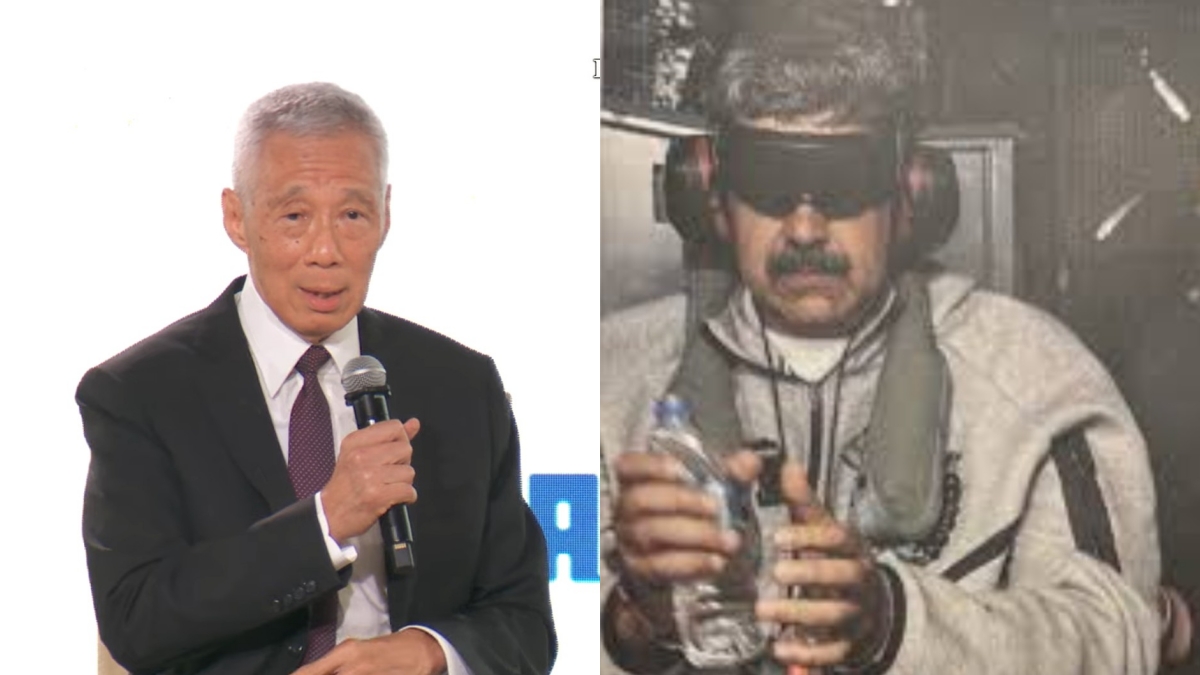
- Senior Minister Lee Hsien Loong said the US military intervention in Venezuela contravenes international law and the UN Charter.
- Singapore warned that unilateral military action undermines the international system, especially for small states.
- Lee highlighted wider global shifts, including US unilateralism, US–China tensions, and growing uncertainty in trade and security.
Singapore is gravely concerned by the United States’ military intervention in Venezuela, as it contravenes international law and the United Nations Charter, Senior Minister Lee Hsien Loong said on 9 January 2025.
Speaking at an academic dialogue, Lee said that while Venezuela presents complex political and humanitarian challenges, these do not justify unilateral military intervention by one country without proper international authorisation.
He was addressing the issue at the ISEAS – Yusof Ishak Institute’s Regional Outlook Forum, held at the Sands Expo & Convention Centre.
Domestic instability does not justify intervention
Professor Chan Heng Chee, chairperson of the ISEAS-Yusof Ishak Institute’s board of trustees, asked Lee how Singapore views the situation in Venezuela and how recent events reflect changes in the global order, particularly in the region.
The forum was attended by about 650 participants, including academics, policymakers, foreign officials, lawmakers, and other invited guests.
Lee said Venezuela’s internal situation, including questions over the legitimacy of its government and spillover effects such as drug trafficking and refugee flows, could not excuse external military action.
“It is causing difficulties to its neighbours because of drugs, because of refugees. It is destabilising the neighbourhood, and causing some difficulty to the United States,” he said.
However, he stressed that these challenges do not legitimise intervention “unilaterally, and without any proper authorisation”.
US operation and immediate outcomes
The comments followed a US operation on 3 January, during which American forces captured Venezuelan President Nicolas Maduro and his wife, Cilia Flores.
Maduro later pleaded not guilty at a federal court in Manhattan to charges including narco-terrorism, cocaine importation conspiracy, and possession of machine guns and destructive devices.
Lee acknowledged that, in the immediate term, the US action might appear successful from a military standpoint.
“The immediate consequences – maybe it works, it is a spectacular military success,” he said.
Long-term risks for small states
However, Lee warned that the longer-term consequences for the international system were far more troubling, especially for small states.
“From the point of view of a small country, if that is the way the world works, we have a problem,” he said.
Singapore’s Ministry of Foreign Affairs had earlier issued a statement on 4 January reaffirming the country’s commitment to international law and the principles of the UN Charter.
According to the ministry, these principles safeguard the independence, sovereignty, and territorial integrity of all states, particularly smaller ones.
The ministry added that Singapore has consistently opposed actions contrary to international law by any party, including foreign military intervention in any country.
Lee said Singapore’s stance on such matters has been clear and consistent, regardless of which countries are involved.
Past precedents: Ukraine and Grenada
He cited Singapore’s positions on Russia’s invasion of Ukraine in 2022 and the US invasion of Grenada in 1983 as examples.
In March 2022, Singapore co-sponsored and voted in favour of UN General Assembly Resolution ES-11/1, which condemned Russia’s aggression against Ukraine and called for the withdrawal of Russian forces.
Singapore also voted in support of a UN General Assembly resolution denouncing the US invasion of Grenada, which had been ordered by then-President Ronald Reagan.
Lee said these positions reflected Singapore’s long-standing commitment to a rules-based international order.
Rising unilateralism and global consequences
During the dialogue, Lee highlighted major strategic changes over the past year.
One significant shift, he said, was the US being more willing to act unilaterally when it perceived its national interests to be at stake.
He cited US actions in the Middle East, Nigeria, and Venezuela, as well as strikes on Iran’s nuclear facilities in June 2025.
In the short term, some of these actions produced “spectacular and even positive results”, he said.
He pointed to a ceasefire in Gaza, while noting that it remained imperfect.
However, Lee stressed that such actions carried longer-term risks for a global system built on international law and peaceful coexistence.
Europe rethinks defence responsibility
On European security, Lee said countries in the region were reassessing how much responsibility they could take for their own defence.
This included questions over defence spending and the difficulty of forming a coherent European security policy less dependent on the US.
He described this as a fundamental change to the global order.
Ukraine, meanwhile, would have to reconsider realistic pathways forward as it confronts Russia amid a changed US posture.
Asia-Pacific recalibrates amid US–China rivalry
Asia-Pacific countries, Lee said, are also rethinking their strategic positions.
While the US remains a key security and economic partner, China continues to grow in economic importance across the region.
Much will depend on how China chooses to engage its neighbours and the wider world, Lee said.
He noted that China has made positive statements on multilateralism, trade, and a rules-based system, and expressed hope these would translate into concrete policies.
Lee said the world is entering a different phase, with economic and security consequences likely to unfold in 2026 and beyond.
Structural tensions between Washington and Beijing
Turning to US–China relations, Lee said neither side appeared eager to incur massive economic costs in the near term.
However, he described the rivalry as fundamentally rooted in opposing strategic objectives.
The US, as the status quo power, wants to keep China at a distance, while China views its right to develop as a red line.
Tensions and risks of miscalculation remain, Lee said, citing incidents such as the Chinese high-altitude balloon that entered North American airspace in 2023.
Taiwan Strait and trade outlook
On Taiwan, Lee reiterated Singapore’s support for the one-China policy and opposition to Taiwan independence and unilateral changes to the status quo.
He acknowledged, however, that the status quo is dynamic and has become more tense in recent years.
Lee said it was important to preserve peace in the Taiwan Strait and expressed cautious hope that major powers would act to prevent escalation.
On trade, Lee said the impact of US President Donald Trump’s tariffs had been “slightly less bad” than initially feared.
Nevertheless, he warned that retaliation and supply chain adjustments would likely lead to slower growth, reduced stability, and weaker global economic integration.