Thailand rejects US view of border clash, urges full probe into landmines and Cambodian rocket attacks
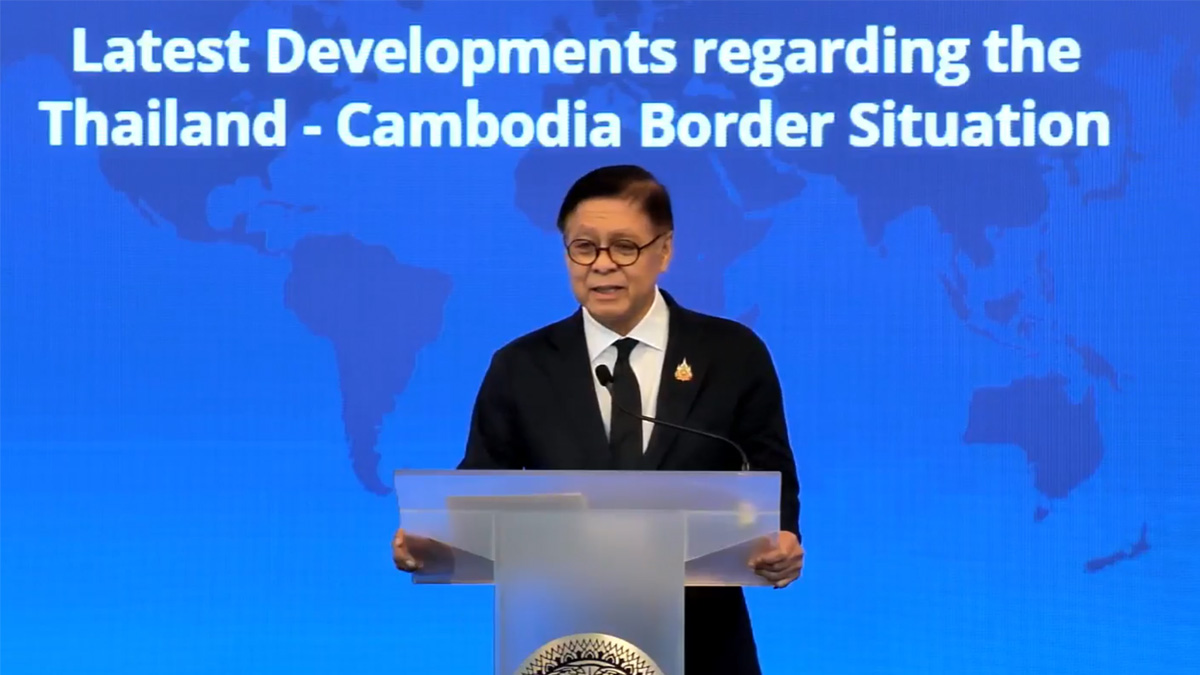
Thailand's Foreign Minister Sihasak Phuangketkeow has expressed disappointment over US President Donald Trump's remarks on the border conflict with Cambodia, stating Thai soldiers were maimed by deliberately placed landmines and calling for any satellite probe to include Cambodia’s rocket attacks.
- Thailand’s Foreign Minister says Cambodia deliberately used landmines and launched rockets at civilians.
- US President Trump's comments on the border situation have caused disappointment in Thailand.
- Thailand supports satellite investigations but insists probes include Cambodian rocket fire and landmines.
Thailand has strongly criticised remarks made by United States President Donald Trump regarding the ongoing Thai-Cambodian border tensions, describing them as inaccurate and hurtful.
Speaking on 13 December, 2025, Foreign Minister Sihasak Phuangketkeow said that contrary to the President’s social media statement, Thai soldiers were not injured by accident but by landmines deliberately laid by Cambodian forces.
The remarks follow a widely publicised telephone conversation between Thai Prime Minister Anutin Charnvirakul and President Trump on 12 December.
At a media briefing, Sihasak emphasised that Thailand had already provided a full account of events that night, and expressed gratitude for President Trump’s concern. However, he stressed that peace could not be achieved unilaterally.
“Thailand also wants peace, but peace cannot come from one side alone,” said the Foreign Minister.
Sihasak underscored that on the same day as the landmine incident, Cambodia fired BM-21 rockets into a civilian area in Sisaket province. He called this a “deliberate action”, rejecting any notion of accidental escalation.
President Trump’s portrayal of Thailand’s actions as “harsh retaliation” was rejected. Sihasak stated: “Thailand’s response has not been excessive.”
He also voiced disappointment over the tone of President Trump’s message, noting that it had deeply affected Thai sentiment.
“Thailand and the US have stood side by side through many security challenges,” said Sihasak. “We are disappointed.”
The Foreign Minister welcomed Cambodian Prime Minister Hun Manet’s proposal for satellite-based verification of events, but insisted any investigation must also address the use of landmines and cross-border rocket fire.
Referring to a previous proposal made at the Ottawa Convention, Sihasak reiterated Thailand’s support for an independent fact-finding mechanism.
Sihasak also raised concerns about broader threats along the Thai-Cambodian border, pointing to organised criminal groups and human trafficking networks.
“These involve serious harm, including human trafficking and victims across the region and beyond,” he said. “This is something the entire international community must recognise in the broader fight against online crime.”
He announced that on 17 December, Thailand would host a ministerial-level meeting to enhance international cooperation on combating online scams and transnational cybercrime.
While he thanked President Trump for affirming that bilateral trade discussions should continue separately from the border issue, he voiced frustration with Cambodia’s refusal to open the border crossing at Poipet.
Sihasak said more than 6,000 Thai nationals were currently stranded at the checkpoint due to security fears.
He noted that Thailand had already allowed Cambodian nationals to return, and described Cambodia’s decision to block the border as a violation of humanitarian principles.
Hun Sen, President of the Cambodian Senate and former Prime Minister, reportedly ordered the suspension of all cross-border travel, despite earlier commitments to open the border from 13:00 to 16:00 hrs on 13 December.
“This clearly amounts to a violation of human rights and humanitarian principles,” Sihasak said.
When asked whether President Trump’s remarks were constructive, Sihasak replied they did not reflect reality, adding that ASEAN observers had already confirmed the use of newly laid landmines.
“The comment describing it as an ‘accident’ has undoubtedly affected the feelings of the Thai people and of Thailand as a whole,” he stated.
Sihasak also addressed President Trump’s call for a ceasefire, questioning its practicality in light of Cambodian military activity.
“Talk of a ceasefire is meaningless if the Cambodian side has not stopped firing,” he said. “This is the same pattern as before — saying one thing, doing another.”
He described the conflict as not only a military confrontation but also a diplomatic challenge on the international stage.
Responding to speculation about the phone conversation between Prime Minister Anutin and President Trump, Sihasak clarified that while a ceasefire was discussed, no agreement had been reached.
He emphasised that any lasting ceasefire would require coordination at the military level and multiple preparatory steps.
“A ceasefire declared when no one is ready is not a sustainable ceasefire,” Sihasak concluded.