Four Indonesians seek refuge in Phnom Penh after escaping Cambodia scam syndicates
Four men from Bengkulu City have sought protection at the Indonesian Embassy in Phnom Penh after escaping alleged forced labour in Cambodia’s online scam industry, reviving concerns over transnational human trafficking networks.
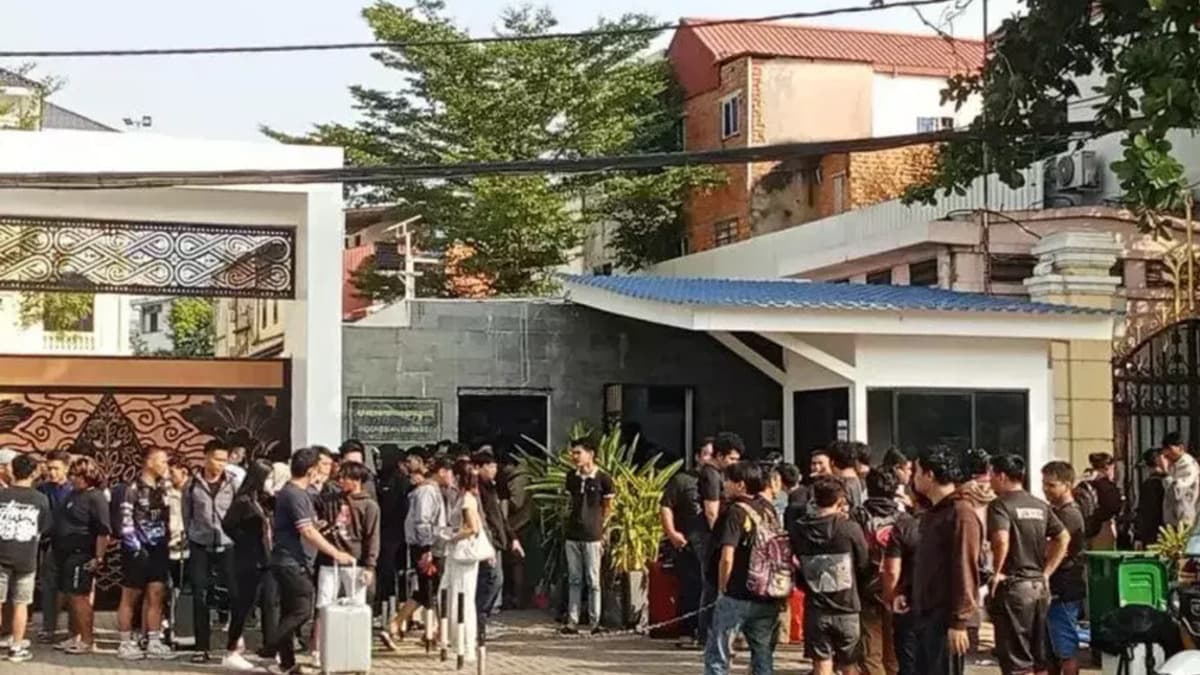
- Four residents of Bengkulu City have sought refuge at the Indonesian Embassy in Phnom Penh after escaping alleged forced labour in Cambodia’s online scam industry.
- Families and officials say the men were deceived by overseas job offers and subjected to violence, coercion, and extreme working hours.
- The case highlights a wider trafficking network that Indonesian police say trapped at least 699 citizens in Cambodia-based scam operations in 2025.
Four residents of Bengkulu City are seeking protection at the Indonesian Embassy in Phnom Penh after escaping what their families describe as violent forced labour inside Cambodia’s online scam industry.
The case has drawn renewed attention to a transnational human trafficking network that Indonesian authorities say has trapped hundreds of citizens in cyber-enabled fraud operations across Southeast Asia.
The men — Ardi, Deni Febriansyah, Imron, and Engga — left Indonesia believing they had secured legitimate overseas employment. Recruiters promised jobs as electronic marketing staff in Vietnam, with monthly salaries that far exceeded what they could earn at home. Instead, they were taken to Cambodia, where they were allegedly coerced into working for online gambling and scamming operations.
Violence, Coercion, and 24-Hour Shifts
According to testimonies from their wives, all four men were subjected to violence and intimidation.
They were reportedly forced to work for up to 24 hours at a stretch, with punishments imposed if they failed to meet daily targets.
Sustri, Imron’s wife, said her husband had been promised a marketing position in Vietnam but was instead transported to Cambodia.
“They worked for 24 hours. If they became sleepy, they were given electric shocks. If they failed to meet targets, they were fined,” she said when met at her home in Bengkulu City on Sunday, 25 January 2026, as quoted by Indonesian media.
Before escaping, Imron managed to make a video call showing the conditions inside the workplace: a large room filled with rows of computers. Sustri said many of the workers — including several supervisors — were Indonesian, while a Chinese national appeared to be overseeing the operation.
Escape to the Embassy
With financial help transferred by their wives in Indonesia, the four men rented a car and travelled for approximately six hours to Phnom Penh, where they sought refuge at the Indonesian Embassy on Saturday, 24 January.
“They had no money at all,” Sustri said. “They contacted their wives so we could send money for the car rental.”
The families are now urging the Indonesian government to ensure the men’s swift and safe return home.
Iman SP Noya, Chairperson of the Indonesian Volunteer Guard (GARIS) in Bengkulu Province, who is accompanying the families, said his organisation is coordinating with ministries and the Bengkulu governor to accelerate the repatriation process. He added that the men had been recruited as prospective Indonesian migrant workers, issued passports in Bekasi, and routed through several countries — including Malaysia, Singapore, and Taiwan — before being taken to Cambodia.
“They were forced into online scam work,” he said. “Because most of them did not understand computers, they were tortured, electrocuted, and sometimes given only one meal a day.”
A Widespread and Decentralised Crime
The Bengkulu case mirrors a much broader pattern. Indonesia’s Criminal Investigation Agency under the Indonesian National Police has recorded at least 699 Indonesians as victims of human trafficking linked to online scam operations in Cambodia during 2025 alone.
Nurul Azizah, Director of Women, Children, and Human Trafficking (PPA–PPO) at Bareskrim, said the figure illustrates the “significant scale” of the crime. Victims are commonly lured with promises of salaries ranging from IDR15 million to IDR20 million (around US$890–1,180) per month, along with free accommodation, and are told they will work in customer service, telemarketing, or crypto-related roles.
Investigators say dismantling the syndicates has proved difficult because the networks are highly decentralised, spread across multiple countries and layers of intermediaries. Another challenge is the legal grey area faced by victims who are coerced into participating in online fraud. Nurul stressed that Indonesian authorities would avoid criminalising individuals who acted under duress.
Embassy Under Strain
The influx of escapees has placed heavy pressure on Indonesia’s diplomatic mission in Phnom Penh. Indonesia’s Ambassador to Cambodia, Santo Darmosumarto, said more than 1,440 Indonesians had reported directly to the embassy as of 20 January 2026.
Many arrived without passports after their documents were confiscated by scam syndicates, or were living in Cambodia without valid visas. Embassy officials are now issuing Temporary Travel Documents (SPLP) on a large scale and coordinating with Cambodian authorities to ease overstay penalties and accelerate exit permits.
In January alone, the embassy handled more than 1,047 cases involving Indonesians in distress, a sharp rise compared with previous years. In 2025, it dealt with 5,088 cases, about 82 per cent of which were linked to online scam activities.
Crackdowns and Continuing Risks
The surge in Indonesians seeking help follows a renewed crackdown by Cambodian authorities on scam compounds linked to international criminal syndicates. High-profile arrests and deportations have prompted many foreign workers to flee, seeking refuge at diplomatic missions.
Indonesian officials warn that prevention must now go hand in hand with enforcement. Public awareness of fraudulent overseas job offers, they say, is crucial to stopping the flow of victims.
“The priority,” Nurul said, “is ensuring that victims can return home safely, with dignity, and without fear of criminalisation.”