Cambodian lobbying campaign targets Thai legitimacy, says defence ministry
Thailand's Ministry of Defence has accused Cambodia of waging an information warfare campaign with the help of Western lobbyists, aiming to sway international opinion by portraying itself as a victim in the ongoing border conflict.
- Thai authorities claim Cambodia hired a US lobbying firm to sway global opinion amid border conflict.
- Leaked FARA documents reveal Cambodia's lobbying efforts include claims of Thai aggression and treaty violations.
- Thailand relies on diplomatic channels to counter what it terms a misinformation campaign.
Thailand’s Ministry of Defence has reiterated claims that Cambodia is actively engaging in information warfare, using foreign lobbyists to influence international opinion in its favour during the ongoing Thai-Cambodian border conflict.
Rear Admiral Surasant Kongsiri, defence spokesperson, stated that Cambodia had enlisted the help of Western lobbyists to portray itself as a victim of Thai aggression. These lobbyists have been seen disseminating English-language content online, which allegedly misrepresents the conflict.
“There has been video footage of foreigners in Cambodia calling for an end to attacks on Cambodians’ houses,” said Rear Adm Surasant on 16 December 2025. “All the lobbyists are Westerners. They are hired to create images that attract sympathy for Cambodia.”
He noted that Thai military operations have only targeted military infrastructure, not civilians, and called on the public to be aware of what he described as fabricated narratives.
The Ministry of Foreign Affairs has confirmed that it is addressing these lobbying campaigns through diplomatic channels. Deputy Director-General of the Department of Information, Maratee Andamo, said the ministry is supplying facts, evidence, and official explanations to counter Cambodia’s efforts.
“Information operations have short-lived effect and cannot compare with facts with sustainable effect from us,” she said.
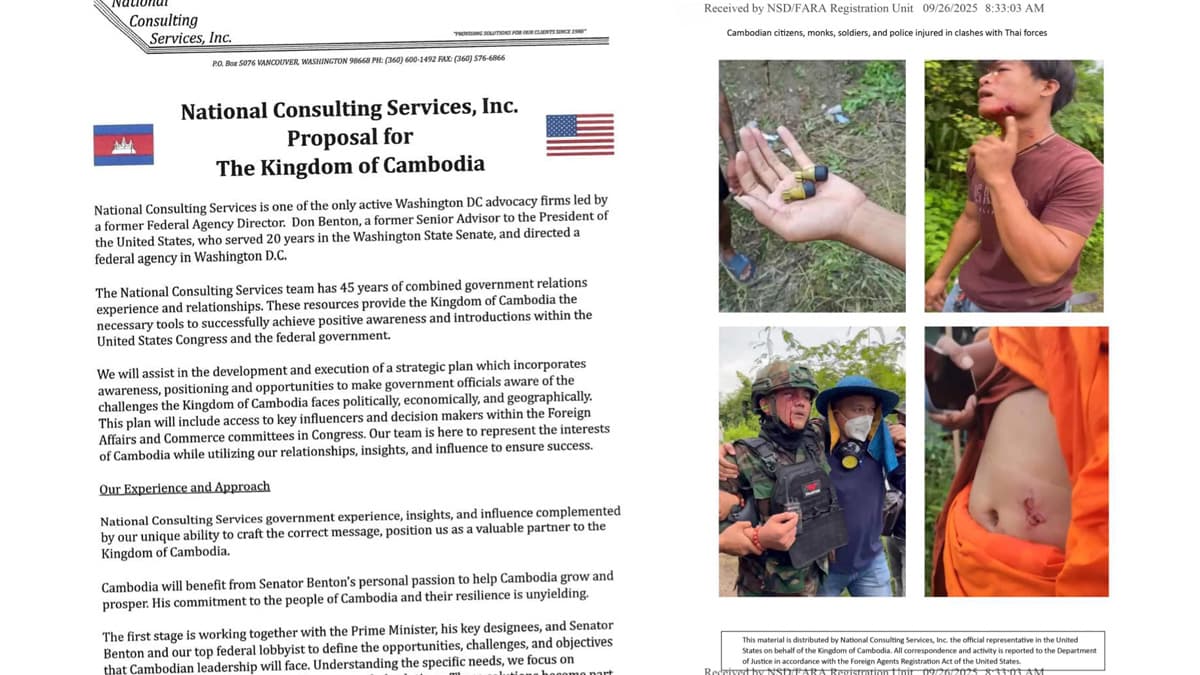
Documents obtained and released by the STRONG Anti-Corruption Thailand Club on 14 December 2025 have reinforced the Thai government’s claims. The club revealed that Cambodia hired National Consulting Services, Inc., a lobbying firm based in Washington, D.C., in February 2025 to represent its interests in the United States.
The contract was signed by Don Benton, a former US federal agency director and adviser to the president, and Koy Kuong, Cambodia’s ambassador to the United States. The agreement is publicly listed under the US Foreign Agents Registration Act (FARA) and includes public-relations materials such as press releases and policy statements.
According to the STRONG Club, the documents have three main goals:
-
Seek international support – including letters from Cambodia’s prime minister to leaders in the US, China, Europe, and the United Nations.
-
Accuse Thailand of misconduct – citing unilateral military action, human rights violations, and breaches of the 2000 memorandum of understanding.
-
Invoke legal arguments – referencing historical treaties and court rulings to paint Cambodia as the aggrieved party.
The club stressed that the content, while legally registered under FARA, represents Cambodia’s narrative, not verified conclusions by the US government. “These are unilateral claims by the Cambodian government packaged as an official document,” the club stated.
One of the most contentious documents includes photos of villagers allegedly struck by rubber bullets during June clashes in Ban Nong Chan, a contested area in Sa Kaeo province. These images were reportedly circulated by National Consulting Services to US authorities with a note stating that the firm is acting as Cambodia’s official representative.
The club described these efforts as “full-scale information warfare”, conducted not through weapons but by manipulating narratives using language, images, and official channels.
“This is not merely communication, but fighting without bullets,” the group said. “The danger is not because the document is fake, but because it is presented in the name of a state and disseminated through the legal system of a major power”.
Thailand has not responded in kind by hiring lobbyists. Instead, it continues to rely on its Ministry of Foreign Affairs and diplomatic corps to assert its position and counter what it regards as misinformation.
During an earlier round of conflict, Thai authorities unmasked a US PR consultant posing as a White House correspondent who was spreading pro-Cambodian narratives on social media. Thai officials have since grown increasingly concerned about what they describe as organised foreign disinformation efforts.