Indonesia megathrust quake injures residents in Java, damages homes, but no tsunami threat
A magnitude 6.2 earthquake struck offshore near Pacitan Regency early on 6 February 2026. BMKG confirmed it was a shallow megathrust event linked to the southern Java subduction zone and did not generate a tsunami.
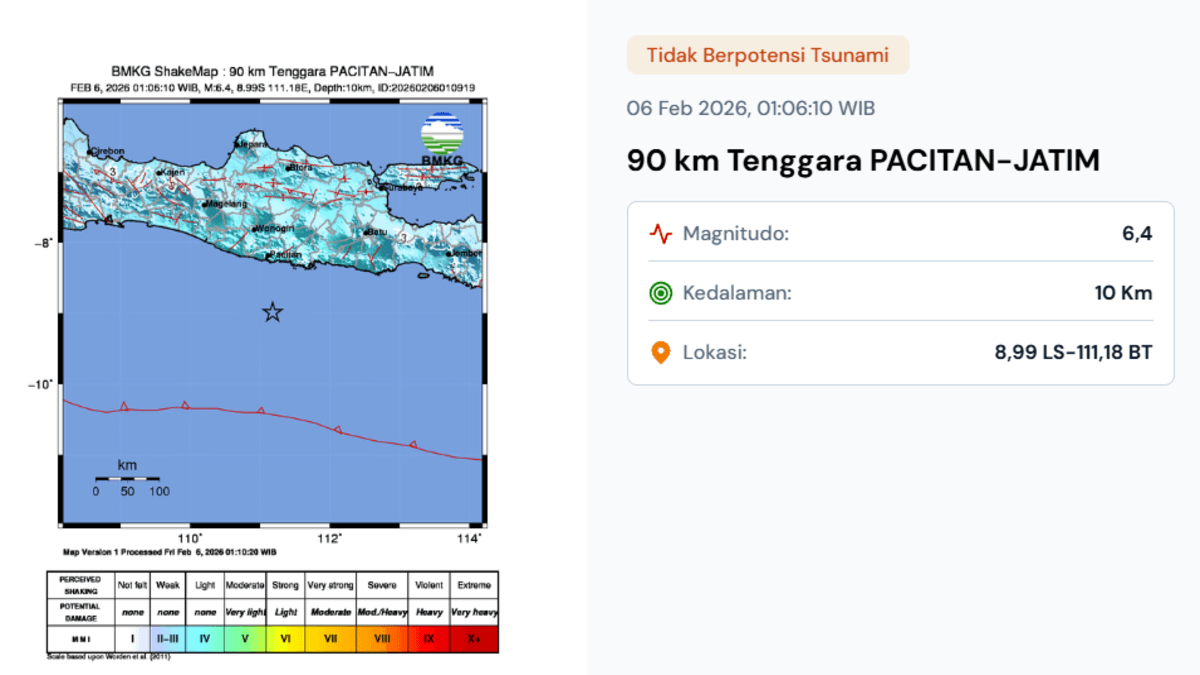
- A magnitude 6.2 shallow megathrust earthquake struck offshore near Pacitan Regency early on 6 February 2026.
- Indonesia’s BMKG confirmed the quake was linked to the active southern Java subduction zone and did not trigger a tsunami.
- Shaking was felt widely across Central and East Java, with limited structural damage and no reported casualties.
A shallow megathrust earthquake struck offshore near Pacitan Regency in East Java in the early hours of Friday, 6 February 2026, injuring residents and damaging homes and public facilities across parts of Java, while narrowly avoiding the conditions that could have triggered a tsunami.
Indonesia’s Meteorology, Climatology and Geophysics Agency (BMKG) reported the quake occurred at approximately 01:06 Western Indonesia Time (WIB), with its epicentre located around 89 kilometres southeast of Pacitan city at a depth of 58 kilometres beneath the seabed.
Shallow Megathrust Mechanism
BMKG Director of Earthquakes and Tsunami, Daryono, explained that the earthquake resulted from thrust or upward movement along the southern Java megathrust, where the Indo-Australian tectonic plate subducts beneath the Eurasian plate.
“The earthquake mechanism involved upward or thrust movement, characteristic of events occurring along the southern Java megathrust subduction zone,” Daryono said in a statement on Friday.
Pacitan Regency lies directly opposite this active fault system, making the area particularly vulnerable to offshore seismic activity.
No Tsunami Triggered
Despite its strength, BMKG modelling showed the quake posed no tsunami threat, and no abnormal sea-level activity was recorded along Java’s southern coast.
Daryono said residents could be thankful the event did not exceed magnitude 7.0, as larger earthquakes in the region could potentially generate destructive tsunami waves.
Historical records show tsunamis have struck Pacitan in the past, including events on 4 January 1840 and 20 October 1859 following major subduction-zone earthquakes.
Experts warn Pacitan’s coastline — marked by bays and narrow beaches — could amplify tsunami waves if a significantly larger offshore earthquake occurs.
Shaking Felt Across Central and East Java
The earthquake was widely felt across Java, waking many residents shortly after midnight.
BMKG reported shaking intensity of IV on the Modified Mercalli Intensity (MMI) scale in Pacitan, Bantul, and Sleman, where many people indoors felt strong shaking and light objects moved.
Intensity III shaking was reported across a broad area including Kulon Progo, Trenggalek, Wonogiri, Malang, Blitar, Surakarta, Karanganyar, Magelang, Jombang, Tulungagung, Ponorogo, Magetan, Nganjuk, Wonosobo, and Banjarnegara, with vibrations comparable to heavy vehicles passing nearby.
Weaker tremors at intensity II MMI were felt in Tuban and Jepara.
As of 01:35 WIB, BMKG reported no aftershocks had yet been detected, though monitoring continued.
Injuries Reported in Bantul
The strongest reported impacts outside East Java occurred in Bantul Regency in the Special Region of Yogyakarta, where local authorities confirmed injuries requiring hospital treatment.
The Bantul Regional Disaster Management Agency (BPBD) recorded that 15 residents were injured following the earthquake and were referred to hospitals for treatment.
“A total of 15 people have been referred to hospitals,” said Aka Luk Luk Firmansyah, coordinator of the Operations Control Centre (Pusdalops) of BPBD Bantul, on Friday.
According to Firmansyah, six victims were sent to Panembahan Senopati Regional Hospital, three to PKU Muhammadiyah Bantul General Hospital, and two to Saras Adyatma Regional Hospital. Other patients were treated at Permata Husada General Hospital, St Elisabeth General Hospital, and Prambanan General Hospital.
Authorities did not immediately detail the nature of the injuries, but officials said the victims required medical treatment following the strong shaking.
Damage to Homes and Public Facilities
Damage reports continue to emerge as local authorities conduct assessments.
Initial data from East Java’s BPBD showed one house in Pacitan suffered heavy damage, while light damage occurred to one house in Wonogiri Regency in Central Java, four houses in Bantul, and one house in Sleman.
Local volunteers also reported a collapsed house in Ploso Village in Pacitan District and a collapsed roof in Jatisrono District in Wonogiri.
In Bantul Regency alone, authorities recorded damage at 13 separate locations affecting both residential properties and public infrastructure.
Firmansyah said seven houses, two places of worship, one government facility, two educational facilities, and one health facility were damaged. Three government-owned facilities were also affected.
The impacted sites are spread across several subdistricts, including Imogiri, Jetis, Pundong, Kasihan, Srandakan, Banguntapan, Pleret, Bantul town, and Pajangan.
Officials emphasised that damage and casualty figures remain provisional as field surveys continue.
Reminder of Java’s Seismic Risk
Indonesia sits on the Pacific “Ring of Fire”, making earthquakes and volcanic activity common across the archipelago. Java’s southern coast remains particularly exposed due to the megathrust fault running parallel to the island.
Seismologists have repeatedly warned that the region is capable of producing much larger earthquakes, which could pose serious tsunami risks to densely populated coastal communities.